
Summary
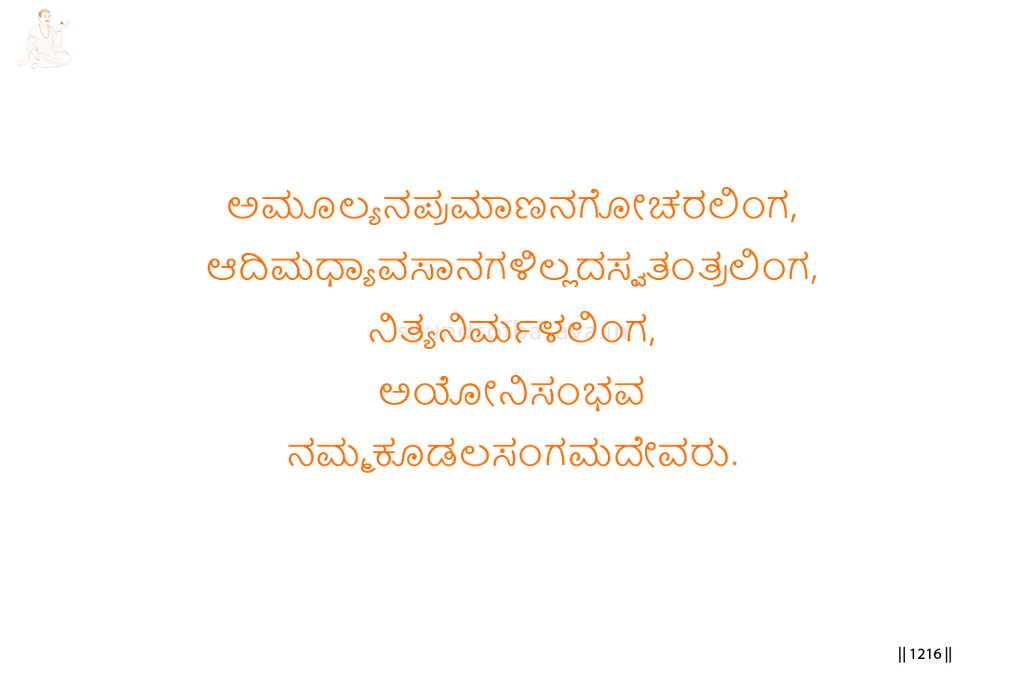
Basavanna names Kudalasangama Deva as the Linga beyond valuation and beyond the reach of measure.
This Linga has no beginning, middle, or end. It is independent, eternally stainless, and not born from a womb.
Each expression removes a distinct limitation: valuation, measurement, temporal sequence, dependence, acquired purity, and generated birth. The entire sequence culminates in the direct identification of this Linga as our Kudalasangama Deva.
Imagery & Symbolic Relevance
The vachana contains no natural or household comparison. Its imagery is created through five fields by which ordinary things are understood: value, measure, temporal sequence, dependence, purity, and birth.
The opening word is Amulya.
Ordinary objects may be valued, priced, exchanged, or compared according to their worth. Even what is called precious remains within a scale through which greater and lesser value may be assigned.
The Linga is Amulya: no value can be fixed for it. The word does not merely mean that Linga is extremely valuable. It removes the very scale upon which such valuation could be made.
The next expression places Linga beyond the reach of pramana, measure or determining standard.
Measurement requires a known unit. Length is measured against length, weight against weight, and one quality against another established standard. Basavanna declares that no such standard contains the Linga.
The movement from value to measure is precise. Something may escape monetary valuation yet remain intellectually classified or proportionally measured. Kudalasangama Deva exceeds both valuation and determination.
The sequence beginning, middle, and end introduces the complete course by which anything produced is ordinarily known.
A beginning marks its arising.
A middle marks its continuance.
An end marks its completion or cessation.
Basavanna says that none of these three applies to the Linga. Kudalasangama Deva cannot be located at one point within a sequence of arising, duration, and ending.
The three terms must remain together. The vachana does not merely say that the beginning is unknown. It removes the whole temporal structure by which a produced thing is traced from origin to conclusion.
The expression Svatantra-Linga gives the next image.
Svatantra means independent, self-standing, or dependent upon no other controlling source. Ordinary things arise through conditions, remain through supports, and change when those supports change.
The Linga is not one dependent member within such a chain. Its being is not established by another object, person, place, ritual, or prior cause.
This independence also clarifies the earlier statement. Because Linga is not produced through dependence upon another source, beginning, middle, and end cannot become its governing measure.
The phrase Nitya-Nirmala-Linga introduces the image of stainlessness.
Nirmala means pure, clear, or without stain. Nitya makes this condition continuous and unceasing.
The Linga is not first stained and later purified. Its stainlessness is not the result of a cleansing event. Purity belongs continuously to the way Kudalasangama Deva is named here.
The final and most concrete image is Ayonisambhava.
Yoni is the womb or generative source through which embodied birth occurs. To be womb-born is to enter a lineage of generation: one form arises from another and becomes part of a succession.
Kudalasangama Deva is not born through such a womb. He has no generated origin within the field of embodied production.
This final expression gathers the earlier declarations together. What is not womb-born cannot be traced through ordinary birth, lineage, or biological beginning. It does not depend upon a parent-source, enter a temporal sequence, or receive its nature from a prior produced condition.
The closing words, “our Kudalasangama Deva,” transform the sequence from an abstract description into direct Divine identification.
Basavanna is not presenting five detached philosophical qualities. The invaluable, immeasurable, beginningless, independent, eternally stainless, and womb-originless Linga is Kudalasangama Deva Himself.
Lingayoga
In Lingayoga, Ishtalinga is received into immediate worship, but its nearness does not reduce it to an object whose reality is created by the practitioner.
The hand may bear Linga, the eye may behold it, and worship may be performed through embodied discipline. Yet the Linga remains independent and beyond the personal measures through which the practitioner evaluates experience.
The expression Nitya-Nirmala also places purification correctly. Worship does not make Linga pure. Through worship, the practitioner’s attention, conduct, and relation are brought into alignment with the eternally stainless Linga.
The absence of beginning, middle, and end prevents the seeker from treating Linga-awareness as merely one temporary state among other experiences. Experiences may arise, remain, and pass; Kudalasangama Deva is not confined within that pattern.
Ayonisambhava gives the final orientation. Linga is not one generated form within embodied life. Embodied practice takes refuge in the One who does not arise through embodied generation.
Editorial Commentary
Amulya means invaluable, beyond price, or beyond the possibility of fixed valuation.
The opening cluster joins this absence of valuation with the Linga’s being beyond pramana—measure, standard, or determining means. The force is that Linga cannot be adequately priced, compared, quantified, or contained by an ordinary standard of determination.
Adi, madhya, and avasana mean beginning, middle, and end. Together they represent the complete sequence of arising, continuance, and conclusion.
Svatantra-Linga means the independent or self-standing Linga. Svatantra here concerns freedom from dependence upon another source.
Nitya-Nirmala-Linga means the eternally or continuously stainless Linga.
Ayonisambhava means not born from a womb or not arising through womb-generation.
All these expressions directly qualify our Kudalasangama Deva.
Related Vachana
Supporting Vachana
Sharana Sthala Vachana 27 — The Impossibility of Self-Perfection
Sharana Vachana 27 asks whether the seeker can arrange his virtues and faults and thereby stand equal to Kudalasangama Deva, whose glory is incomparable. It ends by asking what the seeker can accomplish apart from Him.
This prepares Vachana 982 by exposing the limit of personal valuation and self-measurement. Virtue, fault, effort, and self-assessment cannot become a scale by which the Lord is reached or equalled.
Vachana 982 carries that recognition into a direct description of Linga: Kudalasangama Deva is not merely greater than the seeker’s measure; He is beyond valuation and measure altogether, independent and without generated origin.
Advancing Vachana
Aikya Sthala Vachana 1398 — Beyond All Lineage and Comparison
Vachana 982 declares Kudalasangama Deva to be without beginning, middle, or end and not born from a womb.
Vachana 1398 advances the same movement through the expressions Ajata-caritra and Apratima-mahima: no history of birth or arising can be assigned to Him, and no comparable greatness can be placed beside Him.
What Vachana 982 establishes through independence, eternal stainlessness, and womb-originlessness is thus carried further into the removal of lineage and comparison. Kudalasangama Deva cannot be traced through an origin or measured through an equal.
