

Summary
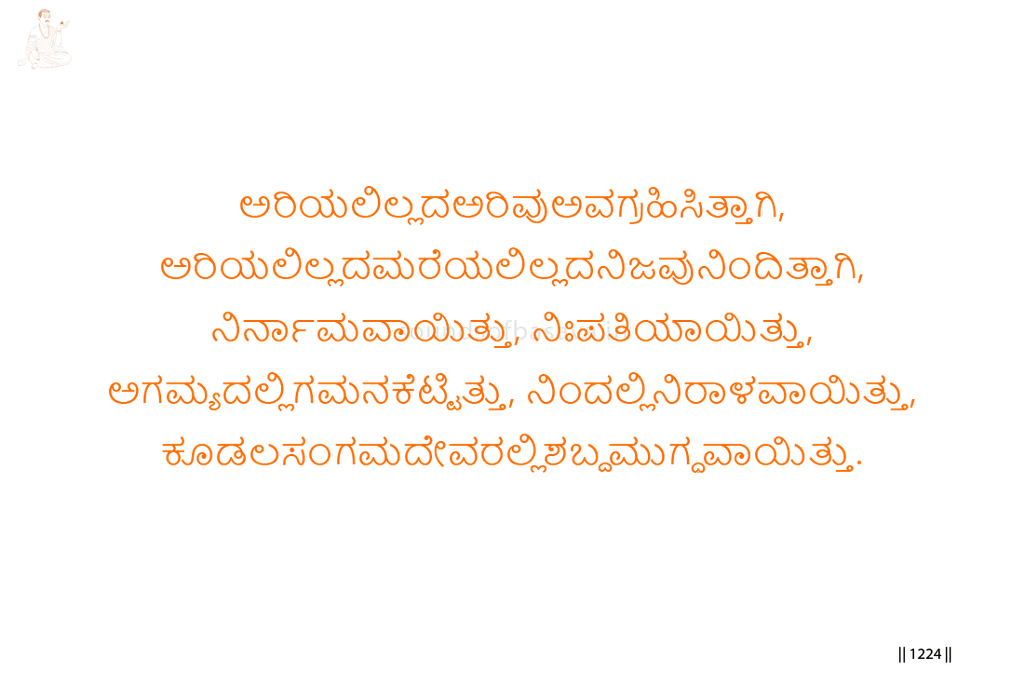
An awareness that cannot be contained by ordinary knowing takes hold. A truth that cannot be fully known and cannot be forgotten stands established.
Name disappears, and fixed measure falls away. Attention loses its course in the inaccessible. In that standing, the condition becomes free and unconfined.
Within Kudalasangama Deva, speech becomes mugdha—stilled in speechless wonder.
Imagery & Symbolic Relevance
The vachana contains no natural or household comparison. Its imagery is formed through knowing, forgetting, naming, measuring, movement, standing, and speech.
The opening expression is “an awareness that cannot be known.”
Ordinary knowing places something before a knower and says, “I have understood it.” The awareness named here cannot be brought under that structure.
The verb indicates that this unknowable awareness takes hold. Basavanna does not say that he captures or possesses it. The movement is reversed: awareness acts upon him.
The next expression concerns truth beyond knowing and forgetting.
Something ordinarily known may later be forgotten. Knowledge and forgetfulness therefore belong to one changing mental field.
The truth described here cannot be fully contained through knowing, yet it also cannot be lost through forgetting. It stands independently of both mental possession and mental lapse.
The phrase “became nameless” removes the next boundary.
A name distinguishes one thing from another and makes it available for reference. When the condition becomes nameless, language can no longer establish it as one definable object among others.
The following expression removes fixed determination or measure.
After name has fallen away, no standard remains by which the condition may be limited, classified, or brought to a final conclusion. The movement is therefore from the failure of naming to the failure of measuring.
The central verbal image joins agamya and gamana.
Agamya is that which cannot be reached or approached.
Gamana is movement, attention, direction, or the act of proceeding toward something.
Basavanna says that within the inaccessible, movement loses its course. Attention cannot map a path through what offers no reachable object or destination.
This is not distraction. The movement ceases because the field before it cannot be traversed through ordinary direction.
The next line speaks of standing and becoming nirāḷa.
After movement has lost its course, the condition stands without pressure or confinement. Nirāḷa conveys freedom, openness, ease, and an unconfined state.
The final movement concerns speech.
Speech has accompanied knowing through name, definition, and measure. When these no longer function, speech reaches its own limit.
In Kudalasangama Deva, speech becomes mugdha. The word conveys being stilled, rendered speechless, or overcome in wonder.
The silence is therefore not imposed from outside. Speech becomes silent because it cannot contain what awareness has encountered.
The complete sequence is exact:
unknowable awareness takes hold;
truth stands beyond knowing and forgetting;
name falls away;
fixed measure falls away;
movement loses its course in the inaccessible;
standing becomes free and unconfined;
and speech becomes mugdha in Kudalasangama Deva.
Lingayoga
In Lingayoga, knowing, remembrance, contemplation, and sacred language guide the practitioner, but none should become a claim that Linga has been fully possessed.
When direct awareness takes hold, the practitioner does not continue multiplying names and conclusions. Attention remains without attempting to force the inaccessible into a familiar mental form.
The silence of this vachana is not cultivated muteness. It is the natural stilling of speech when name and measure can no longer contain the relation with Kudalasangama Deva.
Practice therefore matures into unconfined abidance: awareness stands, unnecessary movement ceases, and speech serves the experience by becoming quiet before it.
Editorial Commentary
Ariyalillada arivu means awareness or knowing that cannot itself be brought under ordinary knowing.
Avagrahisitu indicates taking hold, seizing, or apprehending. The unknowable awareness is the active force.
The phrase concerning knowing and forgetting describes a truth that is neither possessed by cognition nor lost through forgetfulness.
Nirnāma means nameless or without an identifying name.
The following expression indicates the disappearance of fixed determination, limit, or measure. It should not be expanded into a separate doctrinal category.
Agamya means inaccessible or beyond approach.
Gamana kettitu means that movement or attention lost its course. It does not prescribe a particular technical method of meditation.
Nirāḷa means free, open, unconfined, or at ease.
Śabda-mugdha means that word or speech became stilled, speechless, or overcome in wonder. The final silence occurs specifically in Kudalasangama Deva.
Related Vachana
Supporting Vachana
Sharana Sthala Vachana 1231 — The Sword of Silence and the Discipline of Jangama
In Sharana Vachana 1231, Basavanna confesses that he failed to wield the weapon of silence and instead grasped the sword of ego. Seeing that ego could overturn even the Jangama-Linga vow, he asks the Jangama to strike, cut, and protect him.
It prepares Vachana 1012 by showing the correction required before silence becomes natural. In Sharana Sthala, ego still attempts to possess and wield silence. In Aikya Vachana 1012, that false wielder no longer appears: name, measure, and directed movement have ceased, and speech itself becomes mugdha in Kudalasangama Deva.
Advancing Vachana
Aikya Sthala Vachana 1092 — Consumed in the Name Beyond Name
Vachana 1012 reveals the disappearance of name and the stilling of speech before the inaccessible condition of Kudalasangama Deva.
Vachana 1092 advances this silence through a concrete image. The Divine Name becomes the Nameless, and the devotee becomes like camphor consumed in flame.
What remains unspoken in Vachana 1012 is thus shown through complete offering in Vachana 1092: name passes into Namelessness, and the separate claimant is consumed in Kudalasangama Deva.
