

Summary
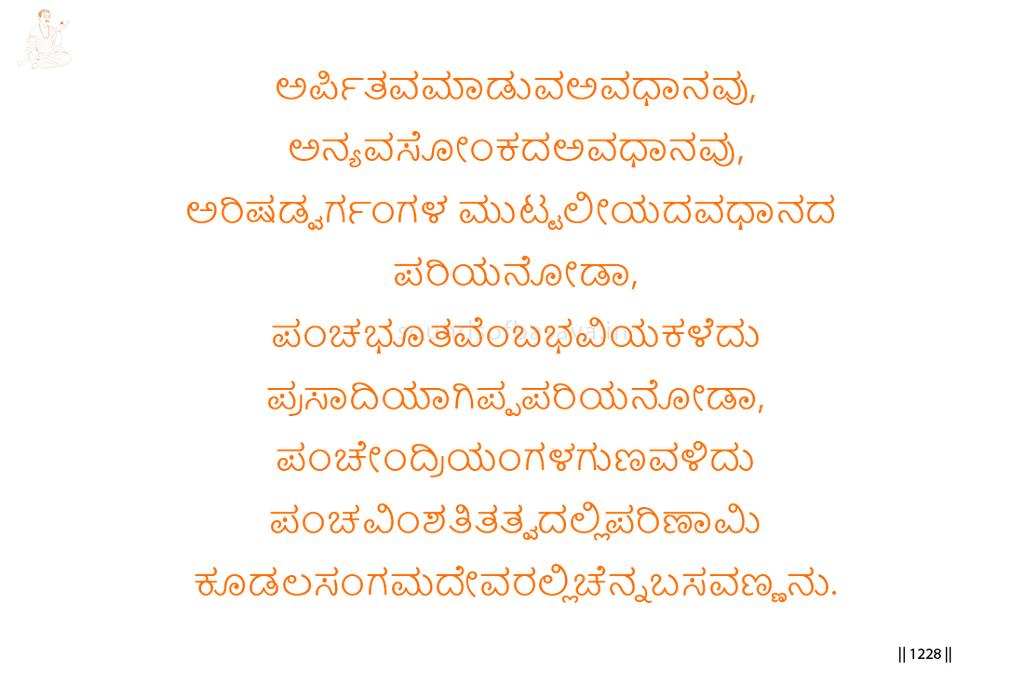
The vachana describes Chenna Basavanna’s complete inward vigilance.
His attention has itself become an offering to Kudalasangama Deva. Because it is fully centred in the Divine, it is not drawn toward anything else. Desire, anger, greed, attachment, pride, and jealousy cannot disturb it.
The five elements still form the body, but they no longer bind him to the ordinary bhavi condition. The body and life are received as Prasada. In the same way, the five senses no longer pull the mind outward through sound, touch, sight, taste, and smell.
Thus body, senses, and awareness are brought into harmony. Chenna Basavanna stands transformed within Kudalasangama Deva.
Imagery & Symbolic Relevance
The vachana begins with avadhāna—alert and steady attention.
This is not ordinary concentration used for completing a task. Chenna Basavanna’s whole attention has been offered to Kudalasangama Deva. Nothing in him remains reserved for a separate purpose.
The next phrase says that this attention is untouched by anya, or what is other. This means that no competing attraction, attachment, or second centre can enter and divide his awareness.
The six inner enemies are then named through the expression ariṣaḍvarga: desire, anger, greed, delusion or possessive attachment, pride, and jealousy. In ordinary life these forces enter the mind and direct its actions. Here, they cannot even touch Chenna Basavanna’s vigilance.
The vachana repeatedly asks the reader to “see the manner” of this state. It is therefore pointing to Chenna Basavanna as a living example, not merely defining an ideal.
The five elements—earth, water, fire, air, and space—represent the constitution of the body. The vachana says that the bhavi condition connected with them has been removed.
This does not mean that the physical body has disappeared. It means that Chenna Basavanna no longer identifies himself merely as an ordinary embodied individual. The elements remain, but their power to create separate identity has ended.
He therefore becomes Prasadi. His body and life are no longer treated as personal possessions. They are received as the Prasada of Kudalasangama Deva.
The five senses form the next part of the teaching. Their natural tendency is to run outward toward objects: the ear toward sound, the skin toward touch, the eye toward form, the tongue toward taste, and the nose toward smell.
The vachana says that the qualities of the senses have fallen away. This does not mean that Chenna Basavanna has become unable to see, hear, touch, taste, or smell. It means that the senses no longer control his awareness or scatter it among objects.
The reference to the twenty-five tattvas places this transformation within the complete structure of embodied existence. Body, senses, mind, and the other principles are no longer functioning as separate and competing powers.
The word parināmi indicates a real transformation. The senses are not forcibly suppressed; they have become part of an integrated state centred in Kudalasangama Deva.
The final line names Chenna Basavanna. This is important because the vachana presents the entire condition through him: fully offered attention, freedom from the six inner enemies, transformed embodiment, and senses that no longer create distraction.
The complete movement is therefore clear: attention becomes offering; other attractions lose their hold; the six enemies cannot enter; the elemental body becomes Prasadi; the senses cease to scatter awareness; and Chenna Basavanna abides in Kudalasangama Deva.
Lingayoga
In Lingayoga, offering is not limited to presenting flowers, food, or other objects before the Linga. The seeker must also offer attention itself.
When attention is divided, outward worship may continue while the mind remains elsewhere. This vachana teaches that true offering requires alertness without a second inward allegiance.
The six inner enemies should not be allowed to direct thought and action. The senses also need not be destroyed or rejected. They must cease to rule the mind.
The body is similarly not to be hated. When it is freed from possessive identity and received as Prasada, embodied life itself becomes part of worship.
Chenna Basavanna therefore gives a practical measure of mature Lingayoga: the mind is steady, the senses are disciplined, the body is received as grace, and the whole person remains centred in Kudalasangama Deva.
Editorial Commentary
Avadhāna means alert, steady, and undistracted attention. It should not be reduced to intellectual concentration.
Arpita avadhāna means that attention itself has been offered or consecrated.
Anya-sonku literally carries the sense of contact with what is other. It therefore describes vigilance that is not touched by another attraction or competing centre.
The falling away of the five elements does not mean destruction of the body. What is removed is the bhavi identity created through attachment to the elemental body.
Likewise, the falling away of the senses’ qualities does not mean physical loss of sensory ability. It means the end of their uncontrolled outward pull.
The twenty-five tattvas are mentioned collectively. The explanation should not introduce a detailed list that the vachana itself does not provide.
The final reference to Chenna Basavanna must be retained. The vachana presents this transformed state as visible in him.
Related Vachana
Supporting Vachana
Sharana Sthala Vachana 47 — The Cry of Helplessness
Sharana Vachana 47 describes the earlier condition of the seeker. Desire, anger, greed, delusion, pride, and jealousy obstruct Shiva-bhakti. Hunger, thirst, the senses, and the bodily elements add further disturbance. Basavanna therefore cries before Kudalasangama Deva, asking how true Bhakti and Shivachara can become possible.
This directly prepares Vachana 1022.
In Vachana 47, the six enemies, senses, and bodily conditions still bind the seeker. In Vachana 1022, they have lost their controlling power. The six enemies cannot touch Chenna Basavanna’s vigilance, the elemental body has become Prasadi, and the senses have been brought into harmony.
The helplessness expressed in Sharana Sthala therefore matures into the settled vigilance of Aikya Sthala.
Advancing Vachana
Aikya Sthala Vachana 1344 — When Linga Is Anga and Anga Is Linga
Vachana 1022 shows body, senses, and awareness becoming fully integrated in Kudalasangama Deva.
Vachana 1344 carries this further by declaring that Linga is Anga and Anga is Linga; Linga is Prāṇa and Prāṇa is Linga. Nothing remains separately present to be displayed, and nothing remains absent to be sought.
The progression is exact. In Vachana 1022, otherness can no longer touch awareness, and the powers of body and senses have been transformed. In Vachana 1344, even the distinction between the transformed individual and Linga disappears.
The complete offering of Vachana 1022 therefore advances into uninterrupted Linga-presence in Vachana 1344.
