
Summary
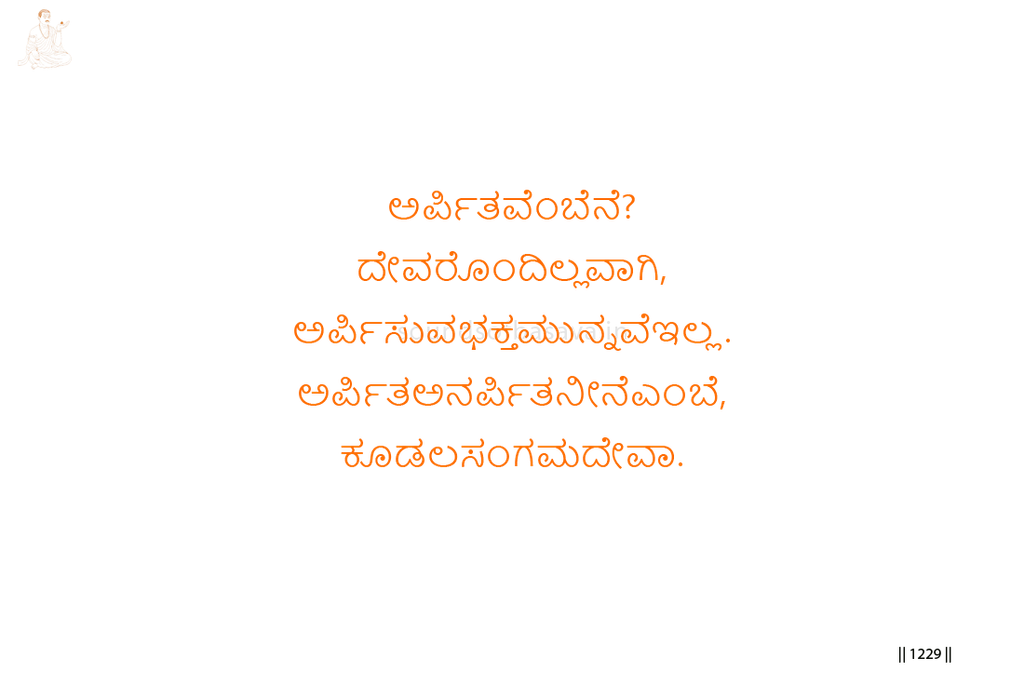
Basavanna asks what can truly be called an offering.
Offering ordinarily assumes three separate realities: a devotee who gives, something that is given, and God who receives it. Basavanna removes this separation by declaring that nothing exists apart from Kudalasangama Deva.
There is no independently existing devotee who first owns something and then offers it. What is called offered and what is called unoffered are both Kudalasangama Deva. Offering is complete when the distinction between “Yours” and “mine” disappears.
Imagery & Symbolic Relevance
The opening question—“What shall I call offered?”—examines the basis of offering itself.
A person normally offers something by saying, “This was mine; I now give it to God.” Such an act still contains a giver, an owned object, and a receiver.
Basavanna next states that nothing exists apart from God. Therefore, neither the devotee nor the object offered possesses an existence independent of Kudalasangama Deva.
The line concerning the devotee removes the separate giver. Before the act of offering arises, there is no independently existing devotee standing outside the Divine.
The contrast between “offered” and “unoffered” exposes the remaining division. The mind calls one part of life surrendered and retains another part as personal possession.
Basavanna declares that both are Kudalasangama Deva. Nothing becomes Divine only after it is offered, and nothing remains outside the Divine because it has not yet been consciously surrendered.
The final “You” gathers the giver, the gift, and the distinction between offered and unoffered into Kudalasangama Deva.
The movement is concise: offering is questioned, separate ownership is removed, the independent giver disappears, and all is recognized as belonging to the Divine.
Lingayoga
In Lingayoga, body, mind, wealth, action, and the fruits of work are offered before the Linga.
This vachana asks the seeker to surrender the claim of ownership within that act. The body, the object offered, and the capacity to offer did not arise independently of Kudalasangama Deva.
The practical discipline is to offer without pride in being the giver. Mature offering is not “I gave what was mine,” but the recognition that nothing was ever separate or privately owned.
Editorial Commentary
The opening question does not reject offering. It removes the assumption of an independent owner behind the offering.
The statement that there was no devotee beforehand denies the devotee’s separate existence, not the visible devotee or the practice of devotion.
“Offered” and “unoffered” represent the division between what is acknowledged as belonging to God and what is still retained as “mine.” The final declaration removes that division.
Related Vachana
Supporting Vachana
Sharana Sthala Vachana 681 — The Unfinished Offering
Sharana Vachana 681 distinguishes between giving something and giving oneself. Dasayya gives his garment, Siriyala his son, and Ballala his bride, yet the giver still remains behind each gift. Sindhumarala is presented as the one who gives himself in Kudalasangama Deva.
This directly prepares Vachana 1023.
Vachana 681 brings offering to the surrender of the giver himself. It asks whether the offering has reached the one who claims ownership or has remained limited to external possessions.
Vachana 1023 carries the teaching further. Even the devotee who says, “I have given myself,” cannot remain as a separate giver. Offered, unoffered, and the one who offers are all Kudalasangama Deva.
The Sharana first gives himself without remainder. In Aikya, it is recognized that the self who appeared to give was never independent of the Divine.
Advancing Vachana
Aikya Sthala Vachana 1024 — Where Offering Becomes Delight
Vachana 1023 removes the separate giver and declares that offered and unoffered are both Kudalasangama Deva.
Vachana 1024 shows the lived result of this recognition. The joy of offering does not diminish; everything becomes offered within that joy. The doubt associated with separate Anga disappears, and bodily pleasure is transformed into Linga-delight. Kudalasangama Deva alone stands foremost.
The progression is immediate and precise. Vachana 1023 establishes that nothing exists outside the Divine to be separately offered. Vachana 1024 shows how life is experienced after that distinction has disappeared.
Offering is no longer a deliberate transaction. It becomes a natural delight in which bodily experience, the sense of Anga, and the act of surrender are gathered into Linga.
