

Summary
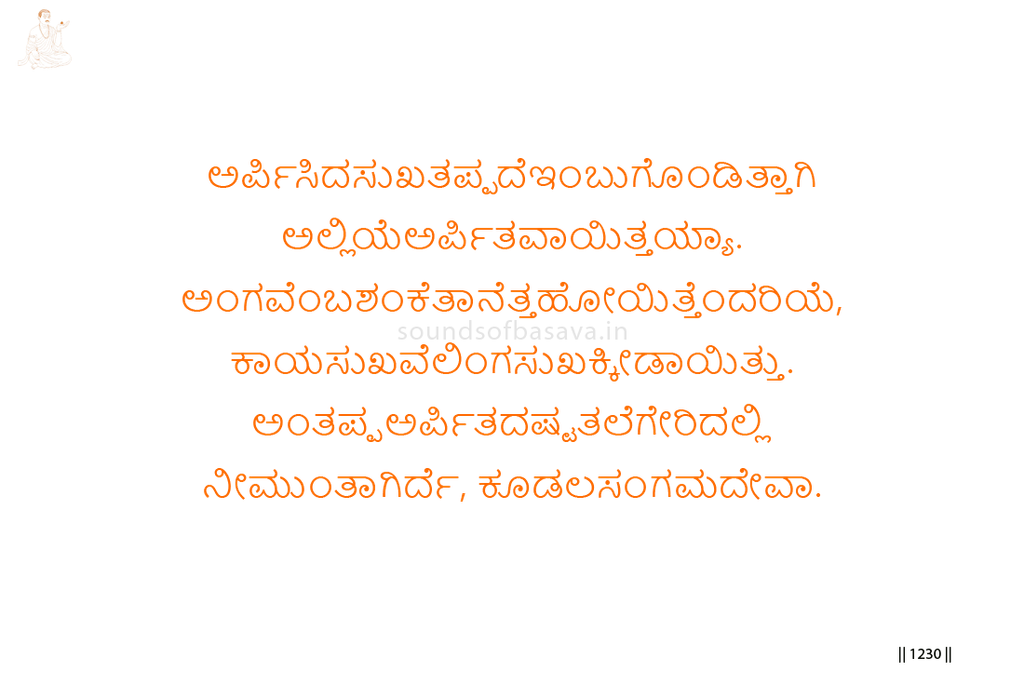
Offering does not leave Basavanna with a feeling of loss. Its joy remains full, and within that joy everything becomes offered.
Once the offering is complete, the doubt that the Anga—the embodied self—is separate disappears. Bodily happiness no longer stands apart from the Linga; it becomes Linga-delight.
When offering reaches this fullness, Kudalasangama Deva alone stands foremost.
Imagery & Symbolic Relevance
The vachana begins with the happiness of offering. Basavanna does not experience surrender as deprivation. Nothing valuable seems to have been taken away.
Because the joy remains undiminished, the offering becomes complete “there itself.” It is no longer a series of separate acts in which one possession is given while another is retained.
The doubt called Anga is the uncertainty that the body and the individual self still belong separately to oneself. When everything becomes offered, this doubt has no place to remain.
The next line brings the teaching directly into bodily life. Kāya-sukha, the happiness experienced through the body, becomes Linga-sukha, the happiness of the Linga.
This does not mean that physical pleasure is automatically sacred. It means that the body is no longer experienced as an independent field belonging to a separate self. Its life and happiness are received within the relation to Linga.
The phrase describing the offering as rising to the head indicates culmination. Offering has reached its fullness and become the governing condition of life. It should not be expanded into an unsupported account of bodily centres.
The final statement, “You stood foremost,” completes the vachana. Kudalasangama Deva is no longer one interest among several. When separate ownership and the doubt of Anga disappear, no competing centre remains.
The movement is therefore from joyful offering, to total offering, to the disappearance of separate bodily identity, and finally to the recognition of Kudalasangama Deva as foremost.
Lingayoga
In Lingayoga, the seeker offers more than possessions. The sense that the body, experience, and happiness belong privately to the individual must also be surrendered.
The practical test is whether a separate claimant remains after the offering. When the thought “this is my body and my happiness” falls away, embodied life can be received in relation to Linga.
The body is neither rejected nor treated as an independent source of enjoyment. Its life becomes part of the undivided belonging to Kudalasangama Deva.
Editorial Commentary
The “doubt called Anga” refers to the lingering sense that the embodied self stands separately from Linga. Its disappearance does not mean destruction of the body.
Kāya-sukha becoming Linga-sukha should not be read as permission for indulgence or as denial of bodily experience. The line describes bodily life no longer being claimed apart from Linga.
Related Vachana
Supporting Vachana
Sharana Sthala Vachana 1176 — Through the Threefold Offering I Was Purified
Sharana Vachana 1176 places the three principal fields of life in sacred relation: the body is offered to Guru, the mind to Linga, and wealth to Jangama. Through this precise threefold offering, Basavanna says that he becomes purified.
This prepares Vachana 1024 clearly.
In the Sharana vachana, action, thought, and possession are no longer kept under private control. Each is placed where it properly belongs.
Vachana 1024 reveals the fruit of that offering. Surrender no longer feels like loss; it becomes delight. The doubt of separate Anga disappears, and bodily happiness itself is received as Linga-sukha.
What begins in Sharana as disciplined offering matures in Aikya as joyful, undivided belonging.
Advancing Vachana
Aikya Sthala Vachana 1025 — Beyond Yes and No
Vachana 1024 removes the distinction between bodily happiness and Linga-delight. Kudalasangama Deva stands foremost when the doubt of separate Anga disappears.
Vachana 1025 carries this freedom into thought itself. Basavanna says that one should not declare either “It is not” or “It is.” The fellowship of Kudalasangama’s Sharanas is too vast to be confined by either affirmation or denial.
The continuation is immediate. In Vachana 1024, the division between the embodied self and Linga loses its hold. In Vachana 1025, the mind’s opposing conclusions also lose their authority.
The delight of complete offering therefore opens into a realization wider than “yes” and “no,” lived within the immeasurable fellowship of Kudalasangama Deva’s Sharanas.
