

Summary
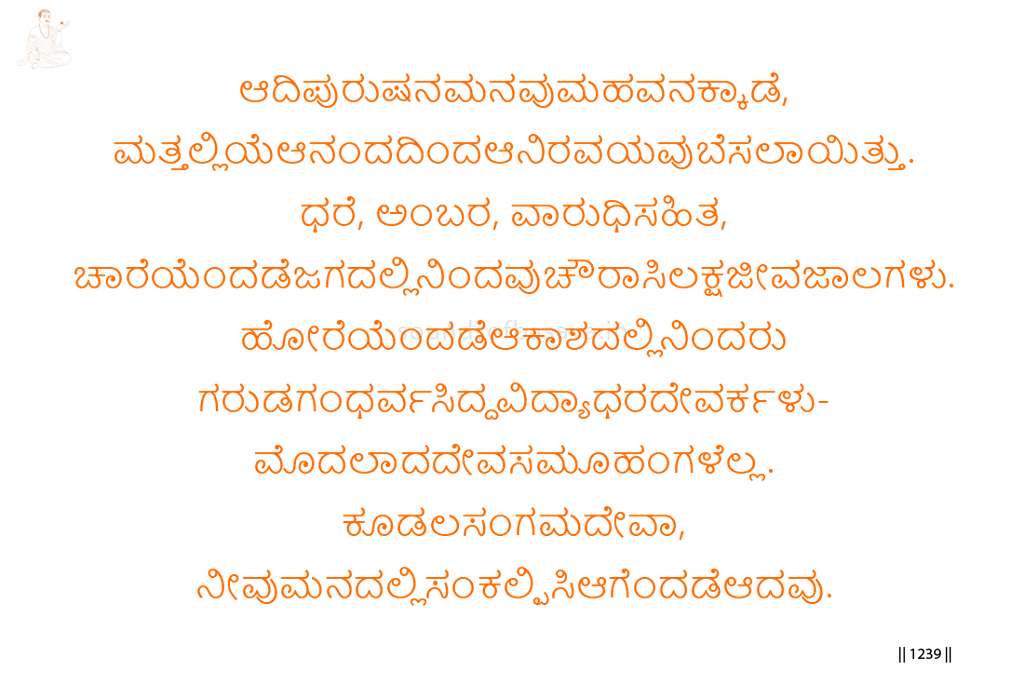
A great intention arises in the mind of the Primordial Person. In that very movement of delight, the formless expands into manifestation.
Earth, sky, waters, the many forms of earthly life, and the celestial beings all come into existence. None arises independently or through its own power.
Basavanna gathers the entire vision into one declaration: whatever came into being did so because Kudalasangama Deva intended it within His mind.
Imagery & Symbolic Relevance
The vachana begins with the Ādi Purusha, the Primordial Person. This does not describe an ordinary person living at the beginning of time. It points to the conscious source before manifested creation.
The “great intention” is the first movement. It is not an uncertain human thought or a plan formed after deliberation. It is the Divine sankalpa through which what was unmanifest begins to appear.
The vachana next says that the formless expanded in delight.
The formless does not disappear when forms arise. Nor does it change into something completely separate from itself. It becomes expressed through the many forms of creation.
The word “delight” is important. Creation is not presented as arising from weakness, compulsion, or dissatisfaction. The movement begins in fullness and joy.
Earth gives the ground on which embodied life stands. Sky gives the open expanse above and around it. The waters surround, nourish, and sustain the living world.
These are followed by the eighty-four lakh forms of life. The expression represents the immense variety of living beings moving throughout the world. Basavanna includes the complete earthly field, not human life alone.
The movement then rises to the celestial realm. Garudas, Gandharvas, Siddhas, Vidyadharas, gods, and the other heavenly assemblies are also included.
By naming both earthly creatures and celestial hosts, the vachana leaves no level of existence outside the Divine intention.
The final statement gives the governing meaning of the whole sequence. Earth, sky, waters, creatures, and celestial beings do not first exist by themselves and later become connected with Kudalasangama Deva. Their very coming into existence rests within His intention.
The movement is therefore from the Primordial Person, to Divine intention, to the joyful expansion of the formless, to earthly and celestial manifestation, and finally to the recognition that all becoming depends upon Kudalasangama Deva.
Lingayoga
In Lingayoga, the world should not be treated either as independent of Linga or as something that must simply be rejected.
The body, the natural elements, other living beings, and the wider field of life all arise within the Divine order. The seeker must therefore meet creation with responsibility rather than possessiveness.
Human action still matters, but it is not self-created power. The body, ability, opportunity, and world in which action occurs are already given within Kudalasangama Deva’s sustaining presence.
The practical teaching is to act with gratitude and humility, recognizing that life is received rather than independently produced.
Editorial Commentary
The “mind” of the Primordial Person should not be understood as an ordinary thinking mind. It indicates the conscious field of Divine intention.
The expansion of the formless does not mean that the formless becomes limited or ceases to be formless. The vachana describes manifestation without presenting creation as separate from its source.
The eighty-four lakh living forms are a traditional expression for the vast range of life. The interpretation need not turn this into a modern biological calculation.
The named celestial beings should remain part of the vachana’s complete movement. Their purpose is to show that earthly and heavenly existence arise within the same Divine intention.
Related Vachana
Supporting Vachana
Sharana Sthala Vachana 399 — Formless Meets Form
Sharana Vachana 399 asks whether a painting can appear without a surface or a seed grow without earth. It then asks whether Linga-worship can take place without Jangama and whether Rudreshwara can be known without the embodied field.
The teaching is that what is hidden or subtle requires a field through which it becomes visible and knowable. The formless Kudalasangama Deva is encountered through the living face of Jangama.
This prepares Vachana 1040 clearly.
Vachana 399 shows the principle through simple images: the painting appears upon a surface, and the life hidden in the seed appears through earth.
Vachana 1040 expands the same principle cosmically. The formless becomes manifest as earth, sky, waters, living beings, and celestial hosts through Divine intention.
The Sharana vachana teaches how the invisible becomes accessible through form. The Aikya vachana reveals the entire universe as manifestation arising from the formless source.
Advancing Vachana
Aikya Sthala Vachana 1157 — Not Even a Blade of Grass Moves Without You
Vachana 1040 declares that all creation arises through Kudalasangama Deva’s intention.
Vachana 1157 carries this from origin into continuing existence. Kudalasangama Deva is Lord of all fourteen worlds, and even their guardians remain His devotees. Human actions have consequences, yet apart from the Lord’s sustaining presence, not even a single blade of grass can move.
The continuation is precise. Vachana 1040 explains how the vast creation comes into being. Vachana 1157 shows that creation does not become independent after arising.
The Divine intention that brings forth worlds and living beings remains the ground of their smallest movement. The vision therefore moves from cosmic origin to the ordinary blade of grass, without placing either outside Kudalasangama Deva.
