

Summary
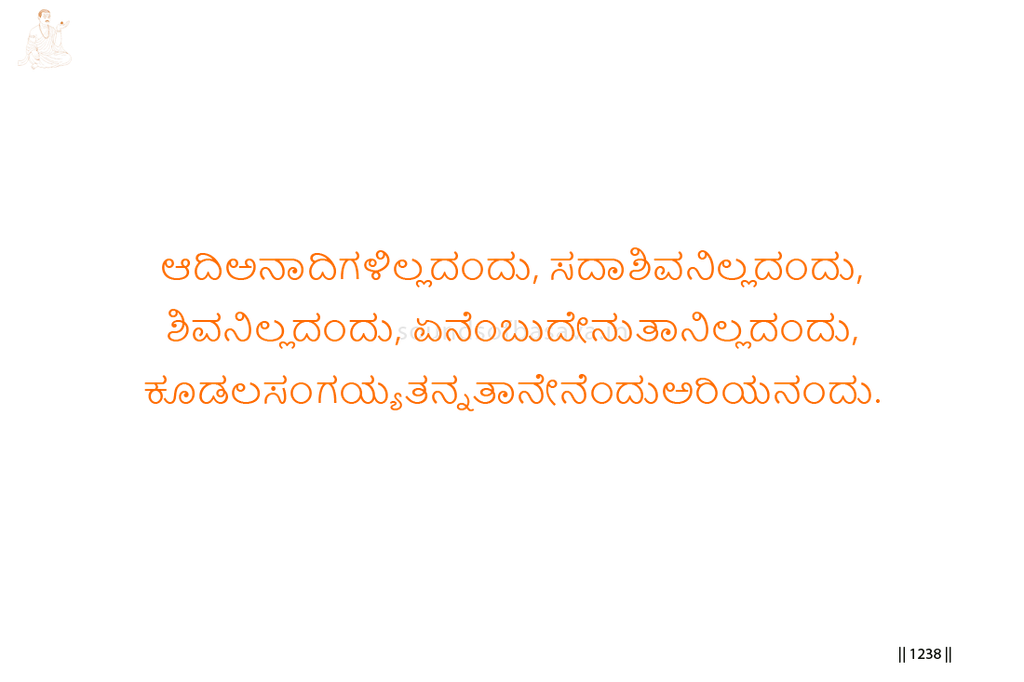
Basavanna moves beyond every idea used to explain origin.
He speaks of a reality before Adi, before Anadi, before Sadashiva, before Shiva, and before anything could be identified by saying, “It is this.”
At that point there was no second reality through which Kudalasangama Deva could be observed, named, or known as an object. The final line does not describe ignorance. It describes complete non-division: Kudalasangama Deva alone was, without the separation of knower and known.
Imagery & Symbolic Relevance
The vachana begins with Adi, the beginning.
Ordinary thought searches for a first event from which everything arose. Basavanna moves prior to that beginning.
He then says, “before Anadi”—before beginninglessness. This is more radical. Even the idea that Reality has no beginning is still a statement formed by the mind. Basavanna points to what cannot be confined by either “beginning” or “beginningless.”
Sadashiva and Shiva are named next. These are sacred names through which the Divine is understood. Basavanna is not rejecting them. He is showing that the reality of Kudalasangama Deva is prior to every name and divine category.
The phrase “before anything called ‘what’ existed” removes the possibility of identifying an object. There was not yet something about which one could ask, “What is this?”
The final statement gives the heart of the vachana: Kudalasangama Deva did not know Himself as another.
Ordinary knowledge contains a knower and something known. Here, no second thing had arisen. Therefore, the Divine was not standing apart and looking at Himself as an object.
This should not be understood as lack of awareness. It means that awareness had not divided into observer and observed.
The movement is therefore from beginning, to beginninglessness, to divine names, to all identifiable existence, and finally beyond the separation required for ordinary knowing.
Lingayoga
In Lingayoga, the seeker first approaches Linga as the sacred presence before him. This relation is necessary for worship and discipline.
As awareness matures, however, Linga cannot remain merely an object observed by a separate worshipper. The distinction between the one who knows and the Linga being known must become quiet.
The vachana does not ask the seeker to imagine a distant time before creation. It asks him to see how names, categories, and the sense of a separate knower arise within awareness.
The practical movement is to remain before Linga without trying to contain Kudalasangama Deva within a definition.
Editorial Commentary
“Before” should not be treated only as chronological time. Basavanna uses it to remove every conceptual ground on which the mind tries to stand.
The references to Sadashiva and Shiva do not establish a hierarchy of competing deities. They show that even the highest sacred names arise after the reality they seek to name.
“Kudalasangama Deva did not know Himself as another” must not be interpreted as Divine ignorance. It means that no division existed between knower and known.
Related Vachana
Supporting Vachana
Sharana Sthala Vachana 1042 — The One Who Revealed the Beginningless
In Sharana Vachana 1042, Basavanna says that Prabhudeva revealed Adi and Anadi, loosened the hold of the worldly, established the Beyond, and showed the Vast Reality. He straightened the mind, revealed the subtle path, weakened bodily identification, and removed doubt.
This prepares Vachana 1039 closely.
The Sharana vachana shows the seeker being led beyond ordinary identity and being taught to understand both beginning and beginninglessness.
Vachana 1039 carries that revelation further. It does not stop by choosing Anadi over Adi. It points to Kudalasangama Deva before the distinction between the two arose.
What Prabhudeva first reveals as the Beginning and the Beginningless matures in Aikya into recognition of the reality that cannot be confined by either.
Advancing Vachana
Aikya Sthala Vachana 1040 — Creation Arises from the Divine Intention
Vachana 1039 reveals Kudalasangama Deva before beginning, beginninglessness, divine names, and the division between knower and known.
Vachana 1040 immediately turns from this undivided ground toward manifestation. A great intention arises in the Primordial Person; the Formless expands in delight; and earth, sky, waters, living beings, and celestial hosts appear through Divine intention.
The continuation is exact. Vachana 1039 shows the reality before anything can be called “this.” Vachana 1040 shows how the many forms called “this” arise from that same undivided source.
The first vachana reveals Kudalasangama Deva before manifestation. The next reveals manifestation as arising within His own intention, not as a second reality independent of Him.
