

Summary
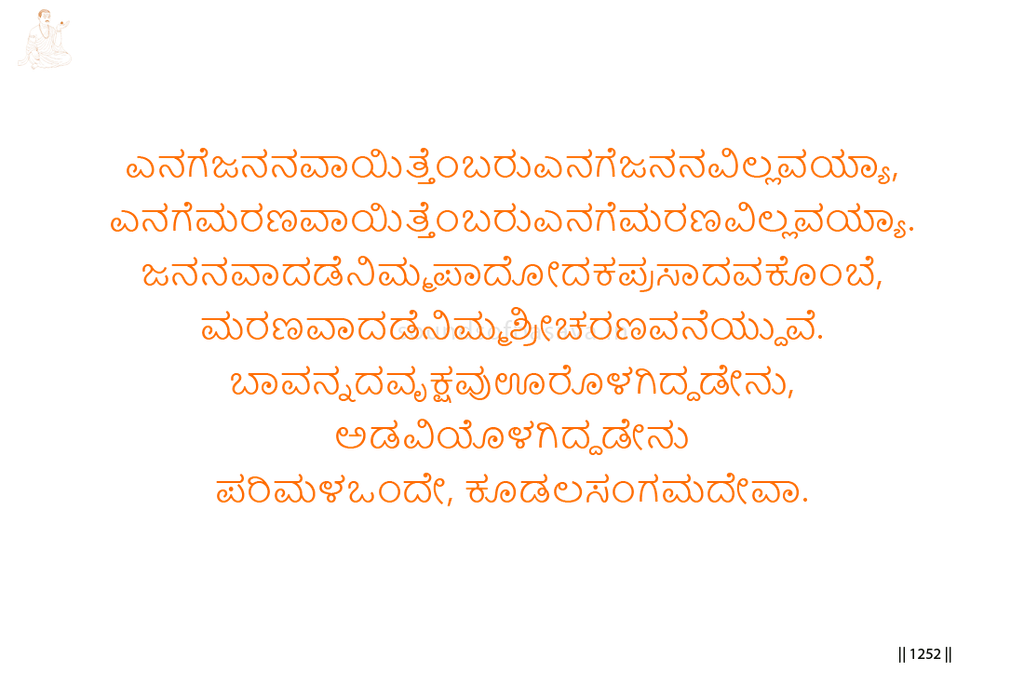
Others say that Basavanna was born and will die. He replies that birth and death do not define his true relation with Kudalasangama Deva.
If birth is spoken of, it is an opportunity to receive the sacred water of the Lord’s feet as Prasada. If death is spoken of, it is a resting at those same feet.
A fragrant tree does not lose its scent because it grows in a village or in a forest. In the same way, the Sharana’s Divine belonging remains unchanged through different places, circumstances, birth, and death.
Imagery & Symbolic Relevance
The vachana begins with the words of others: “They say that I was born.”
From the world’s point of view, a person begins with bodily birth. Basavanna does not deny that the body appears and lives. He refuses to let that event become the deepest truth about him.
The same structure is repeated with death: “They say that I died, but I know no death.”
The visible body may come and go, but Basavanna’s belonging at Kudalasangama Deva’s feet is not created by birth and cannot be ended by death.
He then gives a sacred meaning to both conditions.
If there is birth, it is for receiving Padodaka Prasada—the sacred water associated with the Lord’s feet. Birth is therefore not presented as the beginning of an independent life. It becomes an entrance into grace.
If there is death, Basavanna says that he will rest at the Lord’s blessed feet. Death is not described as falling into an unknown place. The feet that give grace during life become the place of rest at death.
The same refuge holds both movements. Birth receives from the feet; death rests at the feet.
The final image is a fragrant tree.
The tree may grow inside a village, where people see and know it, or deep in a forest, where few may notice it. Its location changes, but its fragrance remains the same.
This image describes the Sharana. Public or hidden, near or far, living or called dead, the essential fragrance of Divine belonging does not change.
The comparison is simple and exact: place does not create the tree’s fragrance, and changing circumstance does not create or destroy the Sharana’s relation with Kudalasangama Deva.
The movement is therefore from the world’s language of birth and death, to their transformation into receiving and resting at the Lord’s feet, and finally to the unchanging fragrance of the Sharana.
Lingayoga
In Lingayoga, the seeker should not build identity only upon the body’s beginning, condition, location, or end.
The body is received as the field in which the grace of Linga is known. Life is lived through Prasada, and death is met without loss of refuge.
The practical measure is continuity: does remembrance of Kudalasangama Deva remain steady when place, health, age, recognition, and circumstance change?
Editorial Commentary
“I know no birth” and “I know no death” do not deny bodily events. They deny that those events define the Sharana’s essential identity.
The references to Padodaka and the sacred feet should remain concrete. Birth is linked with receiving grace, and death with resting in the same refuge.
The fragrant tree represents an unchanged spiritual quality despite change of location.
Related Vachana
Supporting Vachana
Sharana Sthala Vachana 57 — The Illusion of Ownership
Sharana Vachana 57 says that Basavanna is born where Kudalasangama Deva causes him to be born, dies where the Lord causes him to die, and remains where the Lord places him.
He repeatedly asks what is truly within his control and finally wonders what he can call his own.
This prepares Vachana 1075 directly.
In Sharana Vachana 57, birth, death, and placement are surrendered to Kudalasangama Deva. Personal control and ownership are questioned.
Vachana 1075 carries the teaching further. Birth and death are no longer merely conditions governed by the Lord; they lose their power to define the Sharana. Birth becomes the receiving of grace, death becomes rest at the Lord’s feet, and the fragrance of belonging remains unchanged.
Advancing Vachana
Aikya Sthala Vachana 1103 — Where There Is No Death
Vachana 1075 says that birth and death cannot alter the Sharana’s fragrance or remove him from Kudalasangama Deva’s feet.
Vachana 1103 makes this realization explicit. Basavanna declares that for those established in true union within Linga, there is no death and no second destination apart from that Linga.
Soddala Bacharasa is not described as one who has departed. He has entered and merged within the Nija-Linga, and Basavanna sees no one who can truthfully say that he is gone.
The continuation is precise. Vachana 1075 uses the fragrant tree to show that Divine identity remains unchanged through birth, place, and death. Vachana 1103 shows the fulfilled condition in which even the statement “he has died” no longer applies to the Sharana established in Linga.
