

Summary
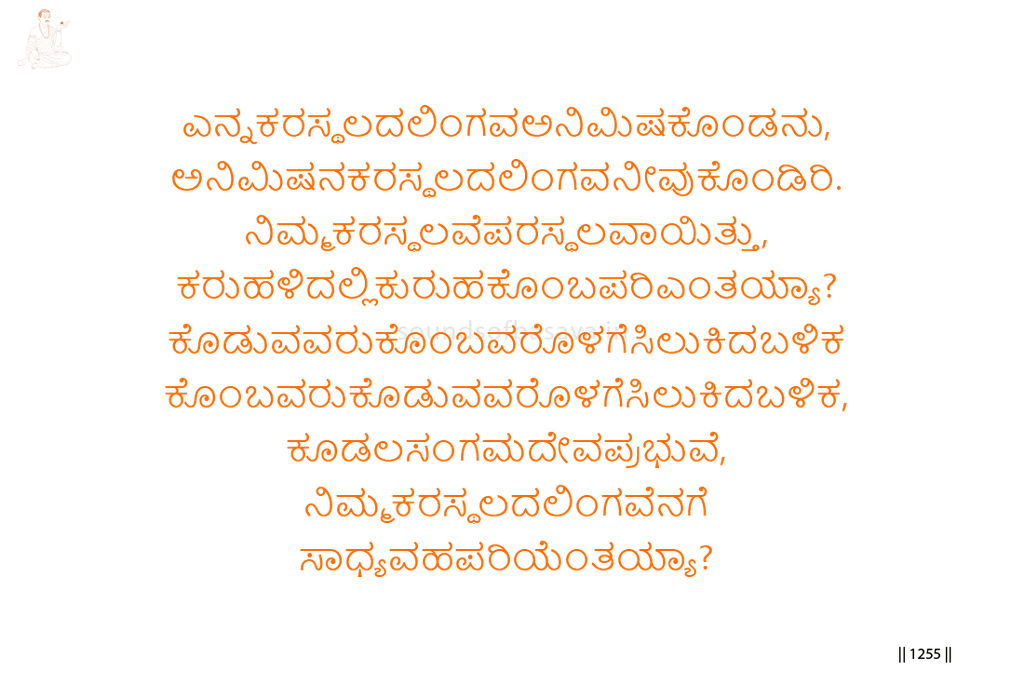
Basavanna describes a sacred exchange involving Animisha, the Linga held in the palm, the devotee, and Kudalasangama Deva.
The Linga is received from Animisha, yet the movement is reversed when the Lord receives the Linga from the devotee’s palm. Giving and receiving no longer move in only one direction.
The Karasthala—the palm in which Linga is held—becomes Parasthala, the Supreme Abode. The sign and what it signifies, the giver and the receiver, enter one another so completely that their boundary cannot be shown.
Basavanna therefore ends in wonder. The relation can no longer be described as one person holding and offering a separate Linga; the entire exchange has become one in Kudalasangama Deva.
Imagery & Symbolic Relevance
The vachana begins with the Linga in Basavanna’s Karasthala.
Karasthala is the palm in which the Ishtalinga is received, held, and worshipped. The palm is therefore the immediate meeting place between Anga and Linga.
Animisha, the Unblinking One, receives or gives the Linga within this sacred exchange. The name suggests unwavering awareness, but the emphasis of the vachana is upon the relationship created through receiving.
The movement is then reversed. Kudalasangama Deva receives the Linga from the devotee’s palm.
Normally, the Lord is regarded as the giver and the devotee as the receiver. Here, the devotee also gives and the Lord receives. The relation is no longer one-sided.
Basavanna then declares that the Lord’s Karasthala has become Parasthala.
Parasthala is the Supreme Abode. It is not another distant place reached by leaving the palm-held Linga behind. The very field in which Linga is held and worshipped reveals the Supreme presence.
The palm is therefore no longer seen merely as a small physical location containing a sacred object. Karasthala becomes the place where the highest reality is directly present.
The next image concerns the kuruhu—the sign or mark—and that which is known through the sign.
The Linga is the visible sign through which Kudalasangama Deva is approached. Ordinarily, the sign and the reality indicated by it may appear separate.
Basavanna asks how that separation can be maintained when the sign and the signified have entered one another. Linga no longer points toward a Lord imagined elsewhere; Kudalasangama Deva is present in the Linga itself.
The giver and receiver provide the final image.
At first, Animisha gives and Basavanna receives. Then Basavanna gives and the Lord receives. Finally, the giver is absorbed in the receiver and the receiver in the giver.
The action continues, but its separate ownership disappears. No one can say, “I alone gave,” or “I alone received.”
The final question acknowledges the limit of speech. When Karasthala has become Parasthala and the participants in the exchange cannot be separated, Basavanna cannot stand outside the experience and describe it as an observer.
The movement is therefore from receiving the Linga, to returning it in offering, to Karasthala becoming Parasthala, and finally to the disappearance of the boundary between sign and reality, giver and receiver.
Lingayoga
In Lingayoga, the Ishtalinga is first held and worshipped in the palm. The seeker may initially experience himself as the worshipper and Linga as the sacred presence before him.
This vachana shows the fulfilment of that relation. The palm-held Linga is no longer treated as an object owned by the devotee, and the Lord is no longer imagined as distant from the act of worship.
Offering becomes complete when the seeker neither claims the gift nor remains proud of giving. Receiving and offering become one continuous movement of grace.
Editorial Commentary
Karasthala means the palm as the place where Linga is held. Parasthala means the Supreme Abode. The statement does not destroy the physical meaning of the palm; it reveals the Divine fullness present there.
The sign and the signified should remain connected to Linga and Kudalasangama Deva. The line does not reject the visible Linga; it removes the idea that the reality indicated by Linga exists elsewhere.
The mutual absorption of giver and receiver does not end offering. It ends personal ownership of the offering.
Related Vachana
Supporting Vachana
Sharana Sthala Vachana 508 — Doer and Receiver Are You
Sharana Vachana 508 rejects the desire to claim greatness, spiritual fruit, or personal merit after serving Kudalasangama Deva’s Bhaktas.
Basavanna says that whatever has been done has occurred through the grace of Sri Guru-Linga. The one who acts and the one who receives the action are both Kudalasangama Deva. The deed remains, but the claim “I did it” disappears.
This prepares Vachana 1080 directly.
In Sharana Vachana 508, the distinction between doer and receiver is corrected through humility. Basavanna refuses to claim the act or its fruit.
In Vachana 1080, this relation reaches a deeper Aikya expression. The giver enters the receiver, the receiver enters the giver, and even the Linga passing between them cannot be separately owned.
What begins in Sharana as freedom from personal doership matures in Aikya as mutual absorption within Kudalasangama Deva.
Advancing Vachana
Aikya Sthala Vachana 1190 — The Prasada of Jangama and the Prasada of Linga Are One
Vachana 1080 shows the sign and the signified, giver and receiver, entering one another until their boundary disappears.
Vachana 1190 carries this realization into the relationship between Linga and Jangama. The true devotee knows Jangama as Pranalinga. Therefore, Jangama-Prasada cannot be separated from Linga-Prasada; both stand joined within living awareness.
The continuation is precise. In Vachana 1080, the Linga held in Karasthala is no longer separate from the Supreme presence, and giving cannot be divided from receiving.
In Vachana 1190, that unity becomes lived sacred relationship. The grace received through Linga and the grace received through Jangama are recognized as one current of Kudalasangama Deva.
Karasthala becoming Parasthala thus advances into a condition where worship, living presence, offering, and Prasada cannot be divided.
