

Summary
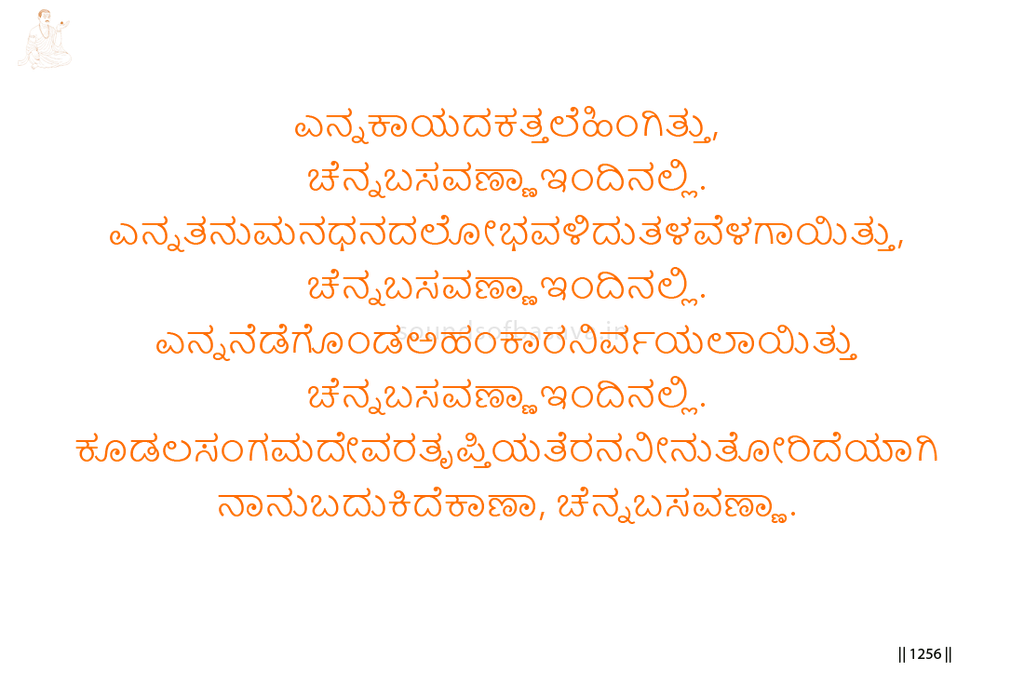
Basavanna describes a decisive change that takes place through Chennabasavanna.
The darkness connected with bodily identity is broken. Greed for body, mind, and wealth falls away, and the ego that had taken possession of him dissolves.
Chennabasavanna then reveals the contentment of Kudalasangama Deva. Because this Divine fullness has been shown to him, Basavanna declares, “Now I truly live.”
Imagery & Symbolic Relevance
The repeated phrase “on this day” gives the vachana its urgency. Basavanna points to a decisive turning that has become real in his present life.
The first change is the breaking of the body’s darkness.
This does not mean that the physical body disappears or becomes worthless. The darkness is the mistaken belief that bodily existence is the whole self and that life must be governed by its demands.
The next line names greed connected with body, mind, and wealth.
Greed for the body appears as excessive concern for comfort, pleasure, protection, and personal identity. Greed of the mind appears as attachment to one’s own thoughts, intentions, judgments, and achievements. Greed for wealth appears as possessiveness, security-seeking, and the desire to control through possessions.
Basavanna says that this threefold greed falls away. Body, mind, and wealth remain, but the possessive claim over them loses its strength.
The ego is the power that says, “This body is mine, this thought is mine, this wealth is mine, and this achievement is mine.” It had taken hold of Basavanna and governed his experience.
Through Chennabasavanna, that ego is dissolved completely. Basavanna does not say that he weakened it through his own discipline. The repeated address to Chennabasavanna identifies the source through which the transformation occurred.
The vachana then moves from what was removed to what was revealed.
Chennabasavanna shows Basavanna the trupti of Kudalasangama Deva. This is not ordinary satisfaction gained by fulfilling a desire. It is Divine contentment—the fullness in which the restless feeling of lack has ended.
The final declaration, “I have lived,” gives the meaning of the whole transformation. Basavanna had existed before, but life ruled by bodily darkness, possessiveness, and ego was not true life.
True life begins when the ego’s ownership ends and Kudalasangama Deva’s fullness becomes known.
The movement is therefore clear: bodily darkness breaks, possessiveness over body, mind, and wealth falls, ego dissolves, Divine contentment is revealed, and Basavanna begins to live truly through Chennabasavanna’s grace.
Lingayoga
In Lingayoga, transformation must reach the seeker’s relation to body, mind, and possessions.
These need not be destroyed. The possessive thought that treats them as the property and achievement of a separate self must fall away.
The practical sign is a movement from restless ownership toward contentment, gratitude, and receptivity to the grace revealed through Guru and Sharana.
Editorial Commentary
The “darkness of the body” refers to body-centred ignorance, not rejection of embodied life.
The greed named in the vachana covers body, mind, and wealth together. Its removal means freedom from possessive control, not neglect of practical responsibilities.
The repeated “on this day” marks a decisive transformation. Kudalasangama Deva’s trupti is Divine fullness, and “I truly live” indicates awakened life rather than literal recovery from death.
Related Vachana
Supporting Vachana
Sharana Sthala Vachana 1082 — Beyond My Power
In Sharana Vachana 1082, Basavanna admits that he cannot remove the darkness of the body, establish the true condition of life, or cleanse the impurity of bhava by his own strength.
This confession is not despair. It removes the false claim that the seeker can complete his purification independently and prepares him to receive transforming grace.
Vachana 1083 gives the direct answer. What Basavanna could not accomplish by himself takes place through Chennabasavanna: bodily darkness breaks, greed falls away, ego dissolves, and Divine contentment is revealed.
The Sharana-stage confession of personal inability thus matures in Aikya into transformation received through the living Sharana.
Advancing Vachana
Aikya Sthala Vachana 1226 — The Final Offering into Purity
Vachana 1083 shows Chennabasavanna breaking bodily darkness, removing attachment to body, mind, and possessions, and dissolving the ego that claims them as “mine.”
Vachana 1226 advances this into complete surrender. Wealth, body, mind, Bhava, and even Nirbhava are progressively offered; through Chennabasavanna’s help, Basavanna offers himself wholly in Kudalasangama Deva and becomes pure.
Thus freedom from darkness and possessiveness matures into total self-offering without remainder.
