

Summary
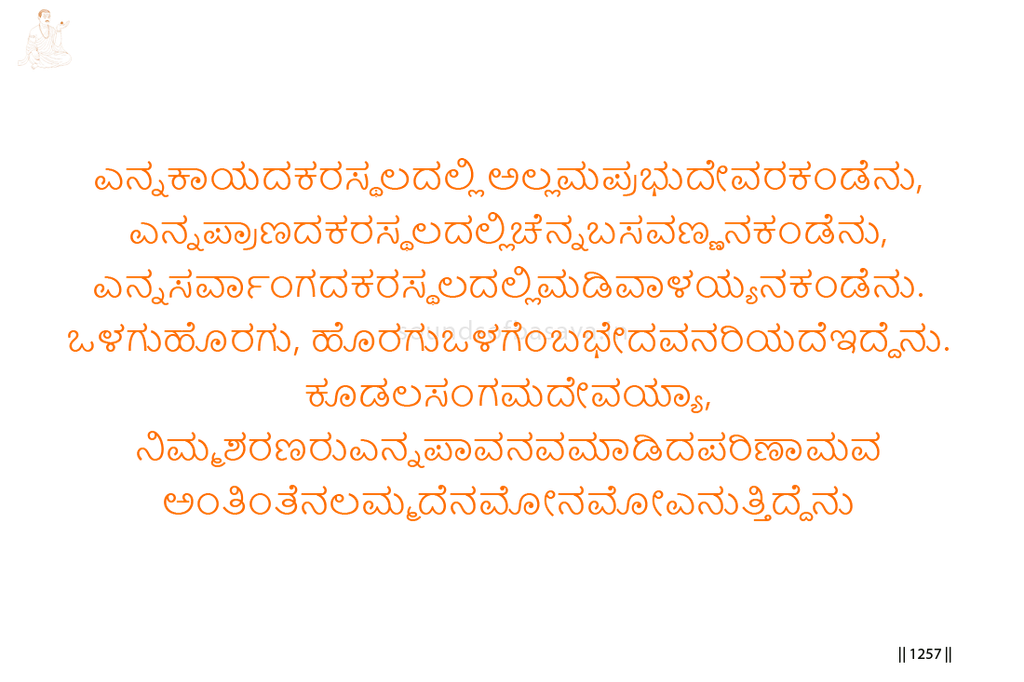
Within the Karasthala-Linga, Basavanna beholds Allama Prabhudeva, Chennabasavanna, and Madivala Machideva.
The Linga held in the palm is no longer experienced as an isolated object of worship. It becomes the field in which the living presence of Kudalasangama Deva’s realized Sharanas is revealed.
With this vision, the difference between inner and outer disappears. Basavanna recognizes his purification as the work of the Sharanas and responds with repeated gratitude: “Namo, Namo.”
Imagery & Symbolic Relevance
The vachana is arranged through three related fields: the body, the mind, and awareness.
In the Karasthala of the body, Basavanna beholds Allama Prabhudeva.
The body is normally understood as the outward field of action and perception. Yet the vision of Prabhudeva within the body’s Karasthala shows that realized presence is not distant from embodied life.
In the Karasthala of the mind, Basavanna beholds Chennabasavanna.
The mind is usually filled with thought, memory, doubt, and intention. Here it becomes a sacred field in which Chennabasavanna is directly known. The mind no longer stands apart as a private and self-governed region.
In the Karasthala of awareness, Basavanna beholds Madivala Machideva.
Awareness is the inward light through which body and mind are known. The presence of Machideva there shows that the purification received through the Sharanas has entered the very faculty of knowing.
The repeated Karasthala image is therefore broader than the physical palm alone. It begins with the Ishtalinga held in the palm and extends into body, mind, and awareness.
Basavanna does not say that he merely remembers the three Sharanas. He says that he sees them. The vachana describes direct recognition within Linga-yoga rather than recollection of respected persons.
Allama Prabhudeva, Chennabasavanna, and Madivala Machideva remain distinct named Sharanas. They should not be reduced to interchangeable symbols. Yet their presence is revealed within the same Linga-field.
The vision therefore does not divide the Sharanas from Linga. The Karasthala-Linga becomes the meeting place where Linga, realized Sharana-presence, and Basavanna’s own awareness are experienced together.
The next statement removes the difference between inner and outer.
Normally, the Linga in the palm is considered outside, while thought and awareness are considered inside. Basavanna says that this distinction can no longer be maintained.
The outer Linga has entered inward awareness, while the Sharanas known outwardly are beheld within the Karasthala. Inner and outer no longer form two opposing regions.
This does not mean that practical bodily distinctions disappear. It means that Divine and Sharana-presence can no longer be confined to either an external object or an internal thought.
Basavanna then attributes his purification to Kudalasangama Deva’s Sharanas.
He does not claim that disciplined contemplation alone produced the vision. The Sharanas have worked upon his body, mind, and awareness until the division between inner and outer has fallen away.
The word parinama, or result, shows that this vision is the fruit of their transforming grace. Their influence has produced a real change in how Basavanna sees.
The repeated “Namo, Namo” is therefore not a formal conclusion. It is the only fitting response after recognizing the extent of the purification received.
The complete movement is from the threefold vision within Karasthala, to the disappearance of inner–outer division, to the recognition of purification through the Sharanas, and finally to repeated reverence.
Lingayoga
In Lingayoga, contemplation of the Ishtalinga should not remain an external act performed only with the hand and eye.
The Linga held in the palm must enter the mind and awareness until body, thought, and inward seeing remain within one sacred relation.
The vachana also shows that the realized Sharanas are not separate from this practice. Their guidance and grace help transform the seeker’s way of seeing.
The practical measure is whether Karasthala worship reduces division or leaves the seeker thinking of Linga, Sharana, and personal life as unrelated fields.
Editorial Commentary
Karasthala first means the palm in which the Ishtalinga is held. In this vachana, the expression is extended through body, mind, and awareness.
The three Sharanas should be retained by name and in the order given. The vachana does not present them as three separate objects competing for Basavanna’s vision.
The disappearance of inner and outer concerns spiritual separation. It should not be interpreted as loss of practical awareness of the body or the world.
The closing “Namo, Namo” expresses gratitude for purification already received through Kudalasangama Deva’s Sharanas.
Related Vachana
Supporting Vachana
Sharana Sthala Vachana 892 — Where the Mind and Body Find Their True Abode
In Sharana Vachana 892, Basavanna says that his body is drawn toward Allama and his mind toward Chennabasavanna. With body and mind taken into these realized presences, he asks where a separate “I” can remain before Kudalasangama Deva.
This prepares Vachana 1084 closely.
In Vachana 892, the former arrangement of body and mind is unsettled by Allama and Chennabasavanna. The seeker can no longer find a secure place for independent identity.
In Vachana 1084, that uncertainty is resolved through the Karasthala-Linga. Allama is beheld in the bodily field, Chennabasavanna in the mental field, and Madivala Machideva in awareness.
What begins in Sharana Sthala as body and mind being drawn away from separate selfhood matures in Aikya into a complete vision in which the Sharanas are present within Linga and the difference between inner and outer disappears.
Advancing Vachana
Aikya Sthala Vachana 1119 — The Stainless Vision Beyond the Mind
Vachana 1084 shows the Sharanas revealed within the Karasthala and the division between inner and outer coming to an end.
Vachana 1119 carries this vision further. The gaze turns inward through Karasthala, bodily limitation is left behind, and awareness rises beyond the farthest reach of the mind. Thought and perception lose their hold, and the play of becoming and non-becoming ends.
Basavanna then declares that through Prabhudeva he lives in Kudalasangama Deva and calls Chennabasavanna to witness the realization.
The continuation is precise. Vachana 1084 reveals the realized Sharanas within the Linga-field. Vachana 1119 shows the inward vision opened through that field becoming free from bodily and mental limitation.
The purification that ends inner–outer division thus advances into stainless awareness beyond the mind, lived through Prabhudeva in Kudalasangama Deva.
