

Summary
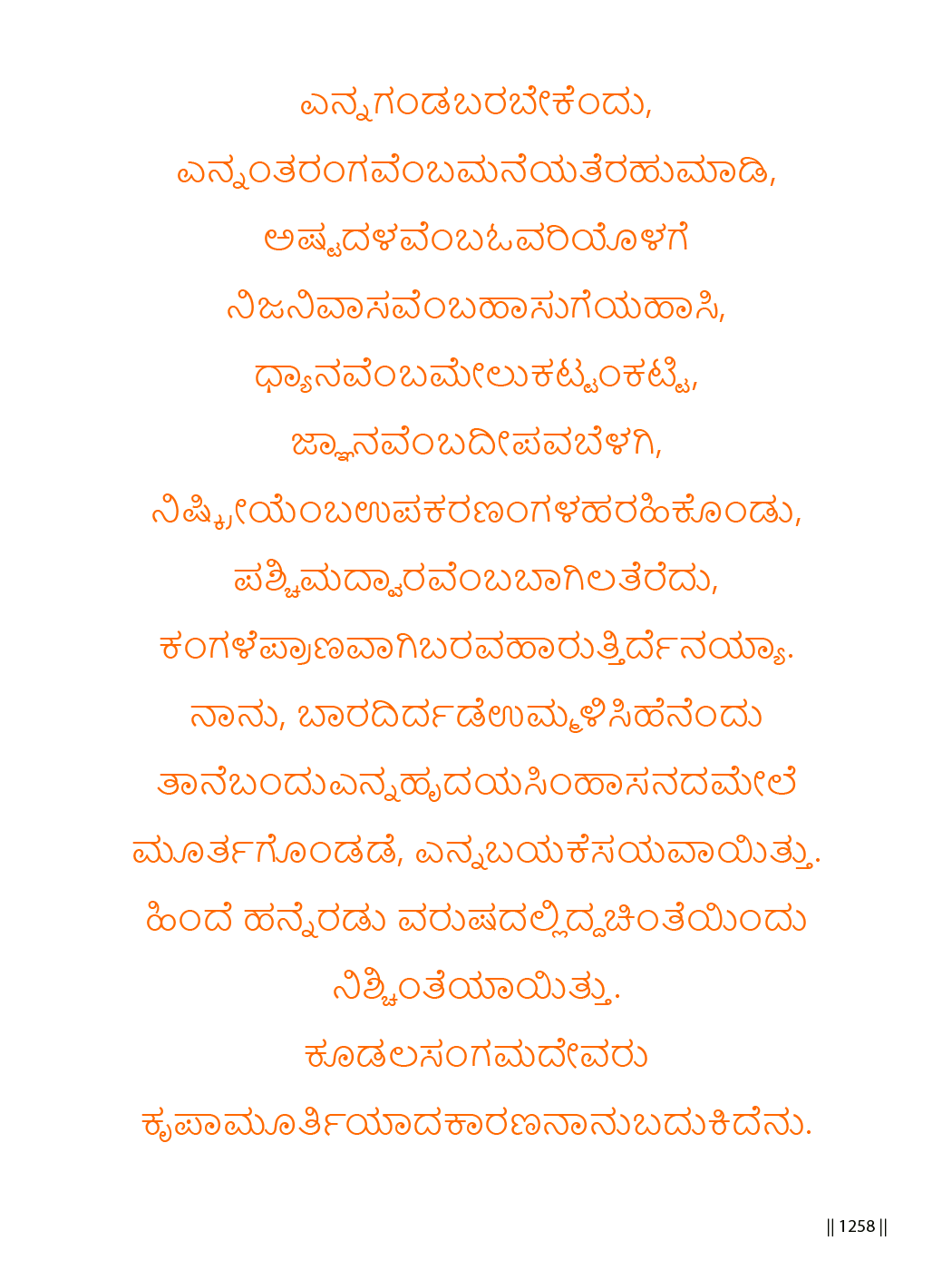
Basavanna speaks in the voice of one preparing an inner home for the arrival of the Beloved Lord.
He opens the house of the inner being, prepares the chamber of the eight-petalled lotus, spreads the couch of true abiding, raises the canopy of meditation, lights the lamp of knowledge, arranges the furnishings of stillness, and opens the western gate. Having completed these preparations, he waits with his whole life gathered in his eyes.
The Lord finally comes by His own compassion and takes His seat upon the throne of Basavanna’s heart. Longing is fulfilled, the anxiety carried for twelve years becomes peace, and Basavanna declares that he has truly begun to live.
Imagery & Symbolic Relevance
The vachana begins with the expectation of the husband’s arrival. Basavanna adopts the bridal voice and receives Kudalasangama Deva as the Beloved who is to enter the home.
The house is the antaranga, the inner being. Preparing this house means making the inward field ready for the Lord rather than waiting for an outward appearance alone.
The chamber of the eight-petalled lotus is the prepared centre within this inner house. The vachana does not describe the lotus separately from the act of preparation; it becomes the room in which the Lord is to be received.
Within that chamber, Basavanna spreads the couch of nija-nivāsa, true abiding. A couch provides a place of rest. Here it represents an inward condition made steady enough for Divine presence to remain.
Above it he raises the canopy of meditation. Meditation is not the final arrival, but it keeps the inner chamber gathered and protected from distraction.
The lamp of knowledge gives light to the house. Without this lamp, longing could remain confused or blind. Knowledge makes the inward preparation clear and enables the seeker to recognize the One who comes.
Basavanna next arranges the furnishings of niṣkriya, stillness beyond restless activity. The image is domestic and practical: the chamber is not considered ready until unnecessary movement has settled.
He then opens the western gate. In the source movement, this indicates an inward opening away from outward distraction. The gate is not opened toward another worldly object; it gives entry into the prepared interior.
After preparing everything, Basavanna waits. His eyes themselves become his life. This shows intense expectation: attention is fully directed toward the arrival of Kudalasangama Deva.
The waiting is not passive. Opening, spreading, raising, lighting, arranging, and watching have all been completed. Yet none of these actions can compel the Lord to appear.
Even when the arrival seems delayed, Basavanna continues to wait. Longing remains, but it does not abandon the prepared house.
The decisive movement comes when the Lord Himself arrives. Divine presence is not produced by the arrangements. The preparation belongs to Basavanna; the arrival belongs to Kudalasangama Deva’s compassion.
The Lord takes His seat upon the throne of the heart. The heart is no longer merely a place from which Basavanna longs. It becomes the seat from which Kudalasangama Deva governs his life.
At that moment, longing ends because the One who was awaited is present. The concern carried for twelve years becomes freedom from concern.
The closing declaration—“I have lived”—shows that mere bodily existence was not complete life for Basavanna. True life begins when Kudalasangama Deva becomes firmly established upon the throne of the heart.
Lingayoga
In Lingayoga, inward preparation requires meditation, knowledge, stillness, and sustained attention. These practices make the seeker receptive, but they do not turn Divine presence into a personal achievement.
The seeker must prepare without demanding that the Lord appear according to personal expectation. Waiting itself becomes part of the discipline.
The fulfilment comes through grace: Kudalasangama Deva enters the prepared heart, and restless longing becomes settled presence.
Editorial Commentary
The house, chamber, couch, canopy, lamp, furnishings, gate, and throne form one continuous image of receiving the Beloved. They should not be treated as unrelated technical symbols.
Niṣkriya does not mean physical inactivity or neglect of duty. It indicates the settling of restless inward activity within the prepared chamber.
The final arrival must remain central. Basavanna prepares and waits, but Kudalasangama Deva comes by His own compassion.
Related Vachana
Supporting Vachana
Sharana Sthala Vachana 19 — The Śaraṇas’ Assurance
Sharana Vachana 19 describes weariness, burden, and suffering that cannot be removed merely by speaking about them. The body must bear what has come to it. The turning point occurs when Kudalasangama Deva’s Sharanas arrive and say, “Do not fear.” Fear then loses its hold, and Basavanna says, “I live.”
This prepares Vachana 1086 closely.
In the Sharana vachana, the arrival of the Sharanas brings assurance within suffering. Their presence removes fear and restores the strength to live.
In Vachana 1086, this movement reaches inward fulfilment. Basavanna prepares the heart, waits through long anxiety, and receives Kudalasangama Deva Himself upon the heart’s throne.
The assurance “Do not fear” thus matures into settled Divine presence, where twelve years of concern become peace and Basavanna again declares that he truly lives.
Advancing Vachana
Aikya Sthala Vachana 1087 — Guru and Disciple in the Light of Grace
Vachana 1086 ends with Kudalasangama Deva seated upon the throne of the heart.
Vachana 1087 immediately reveals what that indwelling presence means. Basavanna declares that Kudalasangama Deva is his Guru and Supreme Guru, his way and understanding, the light of his awareness, and the greatness filling both his inner and outer life.
The continuation is direct. In Vachana 1086, the inner abode is prepared and the Lord arrives. In Vachana 1087, the One who has taken His seat is recognized as the source of guidance, understanding, awareness, and the whole of life.
The Beloved received upon the heart’s throne is therefore known not as a temporary visitor, but as the Guru who illumines and directs everything within and without.
