

Summary
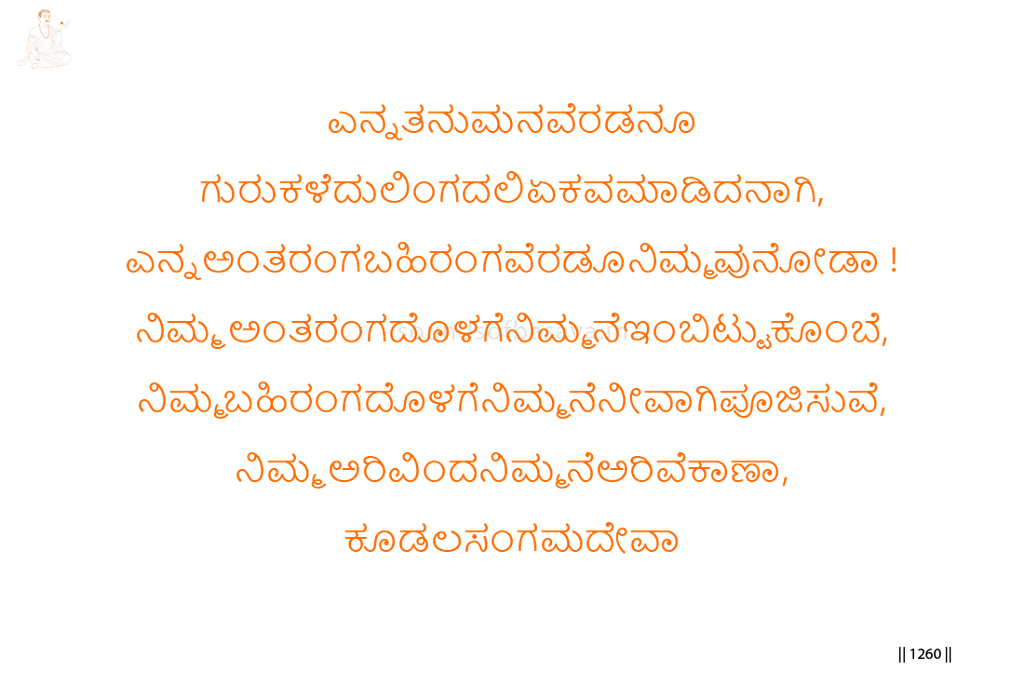
Through the Guru, the division between Basavanna’s body and mind is removed, and both are made one in Linga.
With this integration, his inner and outer life are no longer privately his; both belong to Kudalasangama Deva. He abides within the Lord’s inward reality, worships the Lord through outward life, and knows Him through the awareness the Lord Himself gives.
The vachana therefore presents a complete unity of body, mind, inner awareness, outward conduct, worship, and knowledge in Linga.
Imagery & Symbolic Relevance
The vachana begins with the body and mind.
The body acts outwardly, while the mind carries intention, thought, and desire. When they move in different directions, spiritual life becomes divided.
Basavanna says that the Guru has removed this division and made body and mind one in Linga. The Guru does not destroy either of them. He brings their movements into one centre.
The body no longer performs worship while the mind remains elsewhere. What Basavanna thinks inwardly and lives outwardly now arise from the same Linga-relation.
He then declares that both his inner and outer life belong to Kudalasangama Deva.
The inner life includes awareness, feeling, remembrance, and intention. The outer life includes the body, speech, action, worship, and relationship with others.
Basavanna does not reserve the inward life for the Divine while treating outward life as personal. Nor does he perform outward worship while keeping a separate inward identity. Both fields are the Lord’s.
The next line says that he dwells within Kudalasangama Deva’s inner reality. The devotee’s inward home is no longer a private self-contained mind. He lives within the Lord’s awareness.
The outward field also belongs to Kudalasangama Deva. Basavanna worships the Lord there “as You.” This means that the act of worship, its outward expression, and the One worshipped are no longer treated as unrelated.
The final statement gives the deepest movement: “Through Your awareness, I know You.”
Basavanna does not claim that his individual intelligence has grasped the Lord. Even the power by which he knows Kudalasangama Deva comes from Kudalasangama Deva.
The Lord is therefore both what is known and the awareness through which the knowing takes place.
The complete movement is from body and mind becoming one in Linga, to inner and outer life belonging to the Lord, to worship arising within that undivided field, and finally to Kudalasangama Deva knowing Himself through the awareness given to Basavanna.
Lingayoga
In Lingayoga, bodily worship and inward attention must not move separately.
The seeker should allow Linga-remembrance to shape intention, action, speech, and daily conduct. Worship becomes whole when the mind is present in what the body performs.
The vachana also removes pride in spiritual knowledge. The seeker knows Linga not by independent ability, but through the awareness received from Linga.
Editorial Commentary
The Guru “removing” body and mind does not mean their destruction. It means removing their division and making them one in Linga.
Inner and outer do not cease to function. Their separate ownership ends, and both are recognized as belonging to Kudalasangama Deva.
“Through Your awareness, I know You” should remain central. Basavanna surrenders not only action and worship, but also the claim that he independently knows the Lord.
Related Vachana
Supporting Vachana
Sharana Sthala Vachana 1382 — When Word, Mind, and Deed Become One
Sharana Vachana 1382 warns against saying “Linga, Linga” with the mouth while falsehood remains in the mind and the body follows another direction.
Basavanna teaches that mind, speech, and bodily conduct must become one. Only when these three agree can Kudala Sangamayya be pleased.
This prepares Vachana 1088 directly.
In Sharana Sthala, the division between sacred speech, inward intention, and bodily action is exposed and corrected.
In Vachana 1088, the Guru completes that integration. Body and mind become one in Linga, and inner and outer life are recognized as belonging entirely to Kudalasangama Deva.
What begins as the discipline of truthful alignment in Sharana matures in Aikya into undivided worship and knowing.
Advancing Vachana
Aikya Sthala Vachana 1235 — The Symphony of the Integrated Self
Vachana 1088 establishes unity within the devotee: body and mind become one, and inner and outer life belong to Kudalasangama Deva.
Vachana 1235 shows how this inward unity becomes visible. Conduct reveals the truth of speech, and speech reveals the truth of conduct. Spiritual language no longer hides inward fragmentation because the whole person stands integrated.
The continuation is precise. Vachana 1088 describes integration created by the Guru within Linga. Vachana 1235 reveals the outward evidence of that integration: word and life confirm one another.
Knowing Kudalasangama Deva through His awareness therefore matures into a life whose speech and conduct express the same undivided truth.
