

Summary
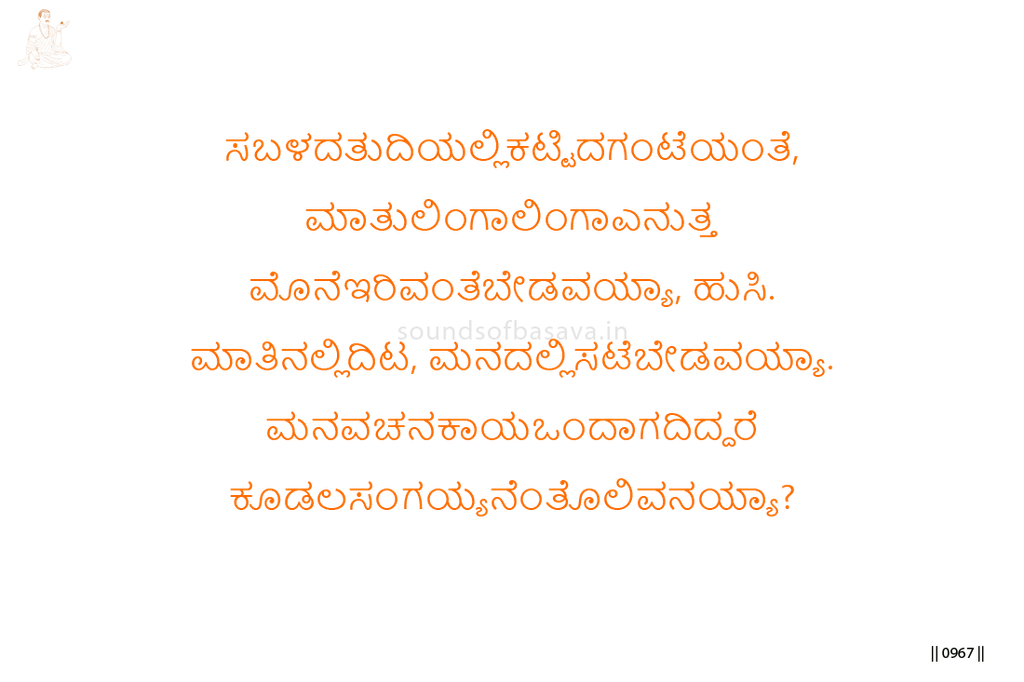
Basavanna warns against devotion that rings aloud while carrying harm within. To say “Linga, Linga” with the mouth, while the mind remains false and the body does not follow truth, is spiritual contradiction. Sacred speech alone cannot please Kudala Sangamayya.
The teaching is simple and severe: speech must be truthful, the mind must be free from deceit, and action must align with both. If mind, word, and body do not become one, devotion remains divided. Kudalasangama Deva is pleased only where inner intention, spoken word, and lived conduct arise from one truth.
Imagery & Symbolic Relevance
The first image is the bell tied to the tip of a spear. A bell gives sound, but the spear wounds. Basavanna uses this image to expose the contradiction of sacred speech joined to harmful inwardness or action.
The second image is the mouth saying “Linga, Linga.” The utterance is sacred, but it becomes false when it is not supported by the mind and body. Basavanna does not reject the Name; he rejects the gap between the Name and the life of the one who speaks it.
The third image is truth in speech. Speech must not merely sound devotional. It must carry firmness, truth, and responsibility.
The fourth image is deceit in the mind. Basavanna places the test inward. Even if speech is sacred, the mind may remain crooked. If deceit remains there, the word spoken outwardly has not become devotion.
The final image is mind, word, and body becoming one. This is the heart of the vachana. The mind must not think one thing, the mouth speak another, and the body act a third way. Only when these three become one can Kudala Sangamayya be pleased.
Lingayoga
In Lingayoga, this vachana teaches integrity of the whole being. Linga-remembrance must not remain on the tongue alone. It must enter the mind and become visible in bodily conduct.
For Sharana Sthala, the practice-point is direct: do not let sacred language outrun inner truth. Let the word “Linga” become mind, speech, and action together. Where these remain divided, the seeker cannot stand as a true Sharana before Kudalasangama Deva.
Editorial Commentary
This vachana should remain centered on the contrast between sound and sharpness, truth and deceit, word and life. The bell-and-spear image is not ornamental; it is the whole warning. Devotional speech becomes dangerous when it hides contradiction. Basavanna’s final test is not eloquence, but unity of mind, word, and deed.
Related Vachana
Supporting Vachana
Pranalingi Sthala Vachana 797 — The Inseparable Abidance in the Linga
Pranalingi Vachana 797 supports this teaching by saying that after receiving Prana-Linga, walking, speaking, sensing, and even the smallest bodily act cannot remain separate from the Linga. This prepares Vachana 1382 directly. In Vachana 797, ordinary movement and speech must not become Linga-virahita; in Vachana 1382, Basavanna gives the Sharana form of the same discipline by insisting that mind, word, and body must become one before Kudala Sangamayya can be pleased.
Advancing Vachana
Aikya Sthala Vachana 1235 — The Symphony of the Integrated Self
Aikya Vachana 1235 advances this teaching by showing the fulfilled state where conduct reveals the beauty of speech and speech reveals the beauty of conduct. In Sharana Vachana 1382, Basavanna rejects the divided condition where the mouth says “Linga, Linga” while mind and body remain unaligned. In Aikya Vachana 1235, those who are complete without inner division are revered, and their fellowship alone is sought. Thus the Sharana-stage demand for unity of mind, word, and body advances into Aikya as complete integration of speech, conduct, and realized being.
