

Summary
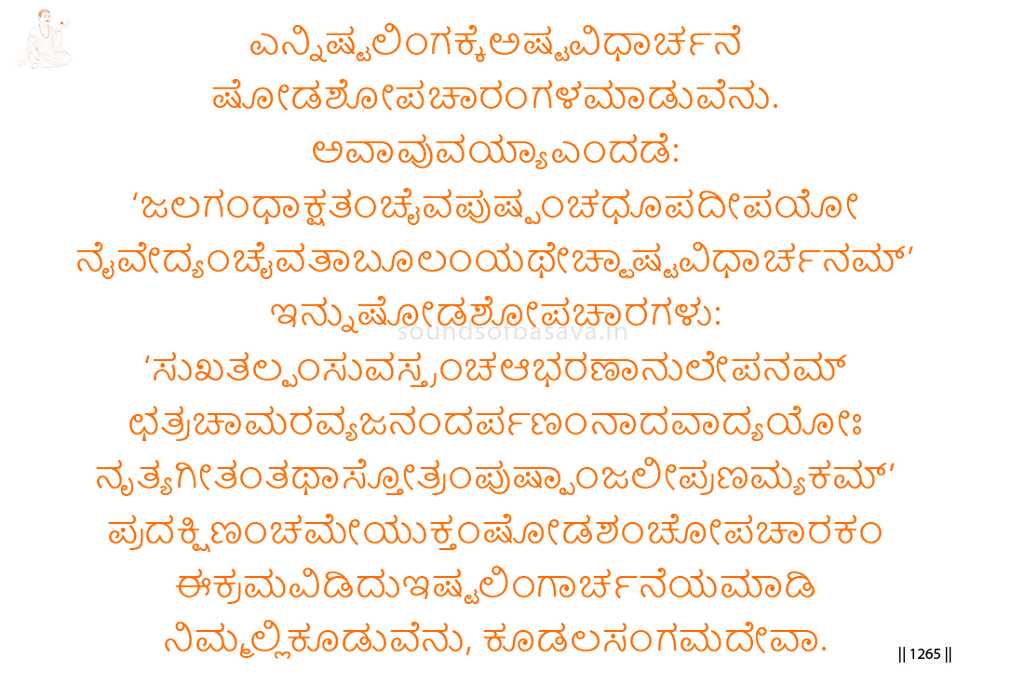
Basavanna declares that he will perform the eightfold worship and the sixteen sacred services for his Ishtalinga. He will carry out Ishtalinga-archana in its proper order and, through that worship, join Kudalasangama Deva.
The vachana does not reject prescribed worship, nor does it allow worship to remain an external accomplishment. Every act is directed toward one conclusion: the distance between the worshipper and Kudalasangama Deva must end.
The future form of Basavanna’s declaration is important. He does not claim that union has already been attained through ritual performance. He states the purpose with which worship must be undertaken: ordered Linga-archana must culminate in joining the Lord.
Imagery & Symbolic Relevance
“My Ishtalinga” gives the worship an intimate and personal centre. Basavanna is not speaking of a remote sacred form or a general religious observance. He addresses the Linga personally received, borne, and worshipped.
The Ashtavidha Archana, or eightfold worship, is the first named form of observance. The vachana does not enumerate its individual acts. Its significance here lies in the completeness of worship directed toward the Ishtalinga.
The Shodashopachara, or sixteen sacred services, extends that completeness. Upachara means reverent attendance or service. The sixteen services therefore show worship expressed through careful and comprehensive offering rather than casual attention.
The two numbers—eight and sixteen—give the worship order and fullness. Basavanna does not use them to display ritual learning. They show that nothing in the act of reverence is to be careless, incomplete, or omitted.
The phrase “following the proper order” gives discipline to the worship. Basavanna does not present devotion as random feeling. The acts are to be performed attentively and in their proper sequence.
Ishtalinga-archana is named again after the eightfold worship and sixteen services. This repetition keeps the Ishtalinga at the centre. The sequence of observances does not become more important than the Linga to whom they are offered.
The final movement, “I shall join in You,” gives the purpose of everything that precedes it. Worship does not end in the completion of prescribed acts, the satisfaction of the worshipper, or the accumulation of merit. It ends in Kudalasangama Deva.
The verb expresses joining rather than mere approach. Basavanna does not say only that he will stand before the Lord, remember the Lord, or offer something to the Lord. Through rightly directed Ishtalinga worship, he seeks the ending of separation.
The complete movement is therefore clear: the personal Ishtalinga is worshipped; the eightfold archana and sixteen services are performed; the proper order is maintained; and the worshipper joins Kudalasangama Deva.
Lingayoga
In Lingayoga, this vachana teaches that Ishtalinga worship must be complete, attentive, and directed beyond the performance itself. The Anga worships the Linga, but the relation cannot remain permanently divided into an independent worshipper and a distant object of worship.
The practical relevance is direct: perform Linga-archana with order and reverence, while keeping its purpose clear. Every act must gather the practitioner toward Kudalasangama Deva rather than strengthen pride in ritual observance.
Worship fulfils its purpose when the Anga no longer preserves separation from the Linga.
Editorial Commentary
The opening expression refers to “my Ishtalinga.” It should not be altered into a separate category. The same Ishtalinga remains the centre throughout the vachana.
Ashtavidha Archana and Shodashopachara are named forms of complete worship. Since the Kannada does not list their individual components, no additional ritual catalogue is required here.
The repeated future form—“I shall perform,” “I shall worship,” and “I shall join”—makes this a declaration of devotional intention. Basavanna does not claim that the outward completion of ritual automatically proves union.
“Joining in You” refers to the spiritual culmination of Ishtalinga worship in Kudalasangama Deva. It is not a physical joining or a claim of self-created identity with God.
Related Vachana
Supporting Vachana
Sharana Sthala Vachana 303 — The Boundless Fellowship
Sharana Vachana 303 says that dancing, singing, archana, pujana, and daily Linga-archana each have a measure. These are valid devotional acts, but each has a beginning, an ending, and a form that can be counted. When Kudalasangama Deva’s Sharanas arrive, however, ordinary measurement no longer contains the fellowship that opens through their presence.
This prepares Vachana 1101 by showing that formal worship cannot remain its own final measure. Sharana Vachana 303 moves beyond measurable acts through living fellowship with the Sharanas. Aikya Vachana 1101 gives that movement its inward culmination: the eightfold worship, sixteen services, and ordered Ishtalinga-archana must lead beyond completed observance into joining Kudalasangama Deva.
Advancing Vachana
Aikya Sthala Vachana 1367 — The Treasure Found in the Field of the Formless
Vachana 1101 declares the intention to worship the Ishtalinga through Ashtavidha Archana and Shodashopachara and finally join Kudalasangama Deva.
Vachana 1367 advances this intention into realised experience. After performing the same complete worship and attaining its fruits, Basavanna enters the field of the Formless and discovers Chara-Linga as the living treasure. Through its Padodaka and Prasada, worship ripens into the recognition that Linga is Anga and Prana is Linga.
Thus ordered Ishtalinga worship matures into living Guru–Linga–Jangama participation and realised non-separation before Kudalasangama Deva.
