

Summary
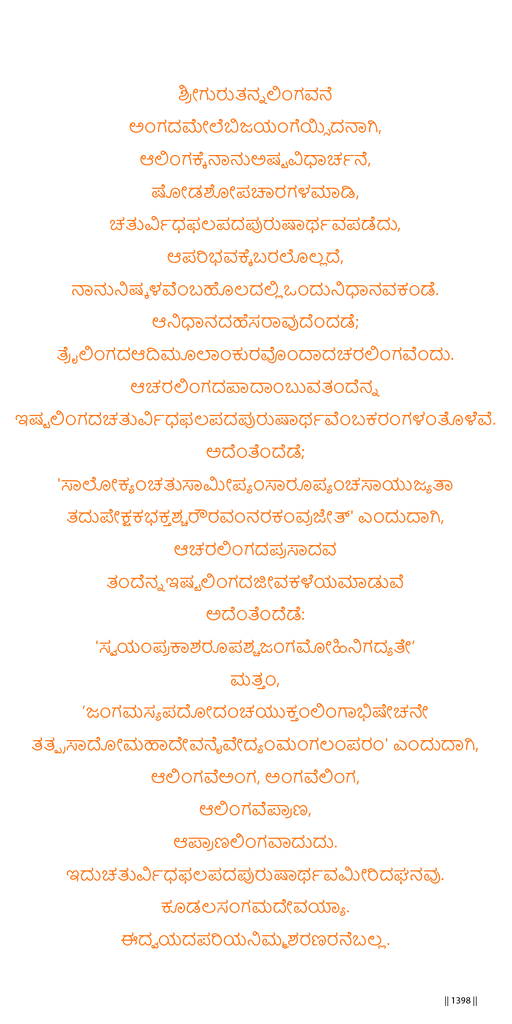
The revered Guru establishes his Linga upon Basavanna’s Anga. Basavanna worships that Ishtalinga through the eightfold worship and the sixteen services, attaining the recognised fruits and aims of human life.
Yet he does not remain content with those attainments. Entering the field of Nishkala, the Formless, he discovers a hidden treasure: Chara-Linga, the primal root-sprout of the Three Lingas.
The Padodaka of Chara-Linga purifies the hands engaged in Ishtalinga worship, and Chara-Linga’s Prasada nourishes the living vitality of that worship. Through this living relation, Linga is known as Anga, Anga as Linga, Linga as Prana, and Prana as Linga.
This greatness surpasses the fruits and aims already attained. The nature of this apparent twoness is known only to Kudalasangama Deva’s Sharanas.
Imagery & Symbolic Relevance
The Vachana moves from Guru-given Ishtalinga worship, through recognised attainment, into the field of the Formless, where the treasure of Chara-Linga transforms and fulfils the entire Linga-relation.
The Guru Establishing Linga upon Anga
The movement begins with Sri Guru.
The Guru establishes his Linga upon Basavanna’s Anga. The Linga is therefore received through Guru, not independently chosen or produced by the worshipper.
Anga becomes the embodied field upon which the Linga is established. This begins the living relation between Guru, Linga, and the seeker.
The phrase carries more than the physical placing of Ishtalinga. The Guru causes Linga to become the governing sacred presence upon embodied life.
Eightfold Worship and Sixteenfold Service
Basavanna worships the Linga through Ashtavidha Archane, the eightfold worship, and Shodashopachara, the sixteen forms of service.
These acts express complete and disciplined reverence. Worship engages body, attention, offering, and conduct in the service of the Guru-given Linga.
The Vachana recognises the validity and fruit of this worship. Basavanna does not pass beyond it because it has failed. He passes beyond the limitation of remaining satisfied with its attainments.
The Fourfold Fruits and the Aims of Human Life
Through worship, Basavanna attains the recognised fruits and Purusharthas.
The attainment is real. Worship has borne its proper results. Yet these fruits still remain within the field of something obtained by the worshipper.
Basavanna refuses to settle there. His movement is not from failure to success, but from successful attainment to a reality beyond attainment.
The fruits and aims of life may fulfil religious and human aspiration, but they do not exhaust the relation between Anga, Linga, Prana, and the living Sharana.
Entering the Field of Nishkala
Basavanna enters the field called Nishkala, the Formless.
The field-image is important. A field is a place in which something hidden may be found, cultivated, or brought to manifestation.
Nishkala is beyond differentiated form, yet what Basavanna finds there is not an abstraction. He discovers a treasure with a living identity: Chara-Linga.
The movement into the Formless therefore leads him toward the living Linga rather than away from embodied sacred presence.
The Hidden Treasure
The treasure signifies a reality already present but not previously recognised.
Basavanna does not manufacture it through ritual or obtain it as another reward. He finds it after passing beyond contentment with the fruits of worship.
The question, “What is the name of that treasure?” gives the discovery precision. The treasure is named Chara-Linga.
It is not left as an undefined mystical experience. It is the living, moving Linga revealed through Sharana and Jangama.
Chara-Linga as the Primal Root-Sprout
Chara-Linga is called the Ādi-Mūlāṅkura—the primal root-sprout of the Three Lingas.
The root-sprout holds origin and unfolding together. It is rooted in the primal source while carrying the living power through which that source becomes manifest.
Chara-Linga is therefore presented as the living source through which the full Linga-relation unfolds.
The treasure found in Nishkala is not inert. It is a living source capable of purifying, nourishing, and bringing the relations of Linga, Anga, and Prana into realised unity.
Padodaka Cleansing the Worshipping Hands
Basavanna brings the Padodaka from Chara-Linga and washes the hands connected with his Ishtalinga worship.
The hands represent worship in action. They have performed the eightfold offerings and the sixteen services and have received the recognised fruits of those acts.
Yet the hands themselves must now be cleansed through Chara-Linga’s Padodaka.
The image gives a clear order of sacred fulfilment. Ishtalinga worship becomes purified through reverent receiving from the living Chara-Linga.
The worshipper does not abandon Ishtalinga. His relation with Ishtalinga is renewed and deepened through the Padodaka of Jangama.
Prasada Nourishing the Life of Ishtalinga
Basavanna then receives the Prasada of Chara-Linga and nourishes the Jīva-kalā, the living vitality, of his Ishtalinga.
Padodaka purifies the worshipping hands; Prasada nourishes the life of worship.
Ishtalinga is no longer approached as a sacred form maintained only through the worshipper’s offerings. Its living significance is continually renewed through Chara-Linga.
A sacred circulation is established:
Guru establishes Ishtalinga upon Anga;
Anga worships Ishtalinga;
Chara-Linga gives Padodaka and Prasada;
Padodaka purifies the worship;
Prasada nourishes its living vitality.
Thus personal worship becomes participation in the living relation of Guru, Linga, and Jangama.
Linga Is Anga; Anga Is Linga
The Vachana now declares that Linga is Anga and Anga is Linga.
The Anga that first appeared as the receiver and worshipper of Linga is no longer known as standing outside it.
Embodied life continues, but its centre is no longer independent of Linga. The one who worships and the Linga worshipped are known through a realised relation without separation.
The reciprocal wording must remain intact. It is not only that Anga belongs to Linga; Linga is Anga, and Anga is Linga.
Linga Is Prana; Prana Becomes Linga
The recognition then enters the living principle itself.
Linga is Prana, and Prana becomes Linga.
Prana is no longer held as the private life of the individual. The very living current of the Sharana is known through Linga.
This completes the movement begun by the Guru’s establishment of Linga upon Anga. Linga is first received and worshipped; through Chara-Linga, Padodaka, and Prasada, the relation reaches Prana and becomes living realization.
Beyond the Fruits and Purusharthas
Basavanna calls this condition a greatness surpassing the fourfold fruits and Purusharthas.
The contrast is between attainment and transformed relation.
Fruits may be received by a worshipper. Purusharthas may be pursued and accomplished. Here, however, the distinction between the one who attains and the sacred reality attained no longer governs experience.
The treasure is therefore greater than every reward because it changes the very ground from which reward is sought.
The Nature of the Two
Basavanna concludes that only Kudalasangama Deva’s Sharanas know the nature of this dvaya, this apparent twoness.
The Vachana has named several paired relations:
Ishtalinga and Chara-Linga;
Linga and Anga;
Linga and Prana;
worshipper and worshipped;
receiving and offering.
Their functions remain visible, but the Sharana knows their inward non-separation.
This cannot be known through terminology alone. It is known through the living experience in which Ishtalinga worship, Jangama relation, Padodaka, Prasada, Anga, and Prana become one continuous sacred reality.
Lingayoga
Lingayoga begins through Guru-given Ishtalinga and disciplined worship. The eightfold offerings and sixteen services gather the practitioner’s body, attention, and conduct into the Linga-relation.
The Vachana then gives the essential further movement: Ishtalinga worship must open into Chara-Linga. The living Jangama purifies worship through Padodaka and gives it vitality through Prasada.
The practitioner must therefore examine whether worship remains private and self-contained or has become receptive to the living Sharana. Ishtalinga, Jangama, Padodaka, and Prasada must function as one sacred path.
The identity of Linga, Anga, and Prana belongs to realised experience. It matures through the complete relation received from Guru and lived through worship, Jangama-reverence, Prasada, and transformed conduct.
Editorial Commentary
Ashtavidha Archane means eightfold worship.
Shodashopachara means the sixteen reverential services offered in worship.
Purusharthas are the recognised aims of human life. In this Vachana, they represent genuine attainments that are nevertheless surpassed by living Linga-realization.
Nishkala means the Formless or that which is without differentiated parts.
Nidhi means treasure—something of immeasurable value found within the field of Nishkala.
Chara-Linga is the living or moving Linga encountered through the realised Sharana and Jangama.
Ādi-Mūlāṅkura means the primal root-sprout: the originating source carrying the power of living unfolding.
Padodaka is the sacred water received from the feet of Chara-Linga.
Jīva-kalā indicates living vitality or life-giving power.
Dvaya means the apparent twofold relation. Its inner nature is known through Sharana-Anubhava rather than verbal classification.
Related Vachana
Supporting Vachana
Sharana Sthala Vachana 833 — Who Revealed This Path?
Sharana Vachana 833 asks who revealed the paths of Guru, Linga, Jangama, Padodaka, and Prasada.
Each is presented as part of one sacred path revealed through Kudalasangama Deva. The seeker does not invent these relations or divide them into independent observances.
This prepares Vachana 1367 directly. What is revealed in Sharana Sthala as the complete path becomes lived fulfilment in Aikya:
Guru establishes Linga upon Anga;
Ishtalinga is worshipped;
Chara-Linga is discovered as the living treasure;
Padodaka purifies;
Prasada nourishes;
Linga, Anga, and Prana are known without separation.
The path shown in Vachana 833 becomes the treasure experienced in Vachana 1367.
Advancing Vachana
Aikya Sthala Vachana 1190 — The Prasada of Jangama and the Prasada of Linga Are One
Vachana 1367 shows Chara-Linga’s Padodaka purifying Ishtalinga worship and Chara-Linga’s Prasada nourishing its living vitality.
Vachana 1190 carries this relation into an explicit declaration concerning sacred receiving. Jangama is known as Pranalinga; therefore Jangama-Prasada cannot be separated from Linga-Prasada.
The movement advances from sacred circulation to inseparable recognition. In Vachana 1367, Chara-Linga gives what purifies and nourishes Ishtalinga worship. In Vachana 1190, the two Prasadas are known as one in sacred significance because the living Jangama is recognised as Pranalinga.
The treasure discovered in the field of Nishkala thus becomes continuous understanding: worship of Linga, receiving from Jangama, and life in Prana are no longer separate acts.
