

Summary
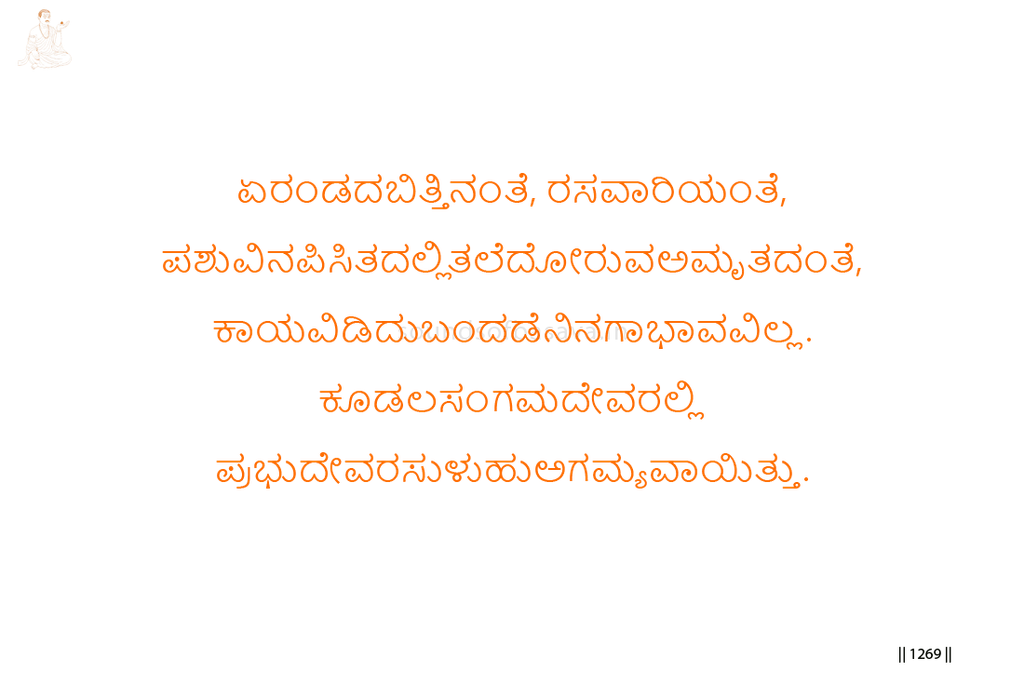
Basavanna describes Prabhudeva through three images of an essence concealed within a visible form: the inner potency of the castor seed, rasa within flowing sap, and nectar arising from the cow’s bodily substance as milk. In each image, what is most valuable is present within, though it cannot be separated and displayed as an independent object.
In the same way, Prabhudeva came bearing a body, yet bhava did not govern him. Embodiment remained, but the movement of conditioned becoming and separate identity found no ground in him.
Basavanna therefore says that Prabhudeva’s trace or mode of being in Kudalasangama Deva became unfathomable. His state cannot be measured from the body he bears or grasped through outward appearance.
Imagery & Symbolic Relevance
The castor seed forms the first image. The seed is outwardly small and enclosed, but it carries its potency within itself. That potency is not added from outside and cannot be identified merely by looking at the seed’s surface.
The image establishes the vachana’s central movement: visible form may contain an inward reality that is not openly displayed. What is hidden is not absent; it is present in a concentrated and inseparable manner.
Rasa within flowing sap gives the second image. The rasa is not another substance attached externally to the sap. It belongs to the sap’s own movement and is known through what the sap contains.
This image adds living flow to the first comparison. The seed holds its inner potency in enclosed form; the sap carries its essence while moving. Hiddenness therefore does not mean lifeless concealment. The inward essence remains active.
The third image is nectar arising within the cow’s bodily substance as milk. What nourishes and sustains emerges from within the living body, though it cannot be understood merely by examining the body’s outward form.
The word amrita, or nectar, gives the image its force. Basavanna is not making an anatomical argument. He points to a precious and sustaining essence that becomes manifest from within embodied life.
The three images form a deliberate progression. The castor seed holds its potency; the flowing sap carries rasa; the living body yields nourishing nectar. In each case, the inward essence is inseparable from the form in which it is present, yet it exceeds what the surface reveals.
The statement that Prabhudeva came bearing a body applies these images directly to a realized person. Prabhudeva is not described as bodiless, absent from the world, or separated from embodied life.
The body therefore remains an actual part of the vachana. Basavanna does not teach that realization requires the destruction or rejection of embodiment.
The decisive statement is that, although Prabhudeva bore a body, bhava was not present in him. Bhava here concerns the movement of conditioned becoming—the formation of separate identity, attachment, possession, and self-centred continuity.
The line does not mean that Prabhudeva lacked feeling, devotion, compassion, or awareness. It means that bodily existence did not generate a separate centre governed by worldly becoming.
The relation between body and bhava is therefore precise. The body remains, but bhava does not take possession of it. Embodiment continues without becoming the ground of an independent self.
The final line turns to Prabhudeva’s suluhu in Kudalasangama Deva. Suluhu may indicate a trace, clue, discernible sign, or way by which something can be followed and understood.
Basavanna says that this trace became agamya—beyond ordinary approach, reach, or comprehension. Prabhudeva’s state cannot be followed to a measurable conclusion through outward observation.
This does not mean that Prabhudeva is unrelated to Kudalasangama Deva. The opposite is stated: it is precisely in Kudalasangama Deva that his mode of being becomes unfathomable.
The body can be seen, but the state cannot be confined to the body. Prabhudeva moves within embodied life, yet the bhava by which ordinary identity is traced is absent. Therefore no familiar measure can contain him.
The complete movement is restrained and exact: hidden potency within seed, rasa within sap, nectar within embodied life, Prabhudeva bearing the body without bhava, and his trace becoming unfathomable in Kudalasangama Deva.
Lingayoga
In Lingayoga, this vachana teaches that the body need not be rejected for bhava to cease. The practical concern is not escape from embodiment, but freedom from allowing the body to become the centre of separate identity and becoming.
The Linga-relation must become as inward and inseparable as potency within seed, rasa within sap, and nectar within milk. It cannot remain an external mark or occasional observance.
The direct practice-relevance is to bear embodied life without allowing possessive bhava to govern it. When Anga no longer establishes itself as an independent centre apart from Linga, the inward essence may remain active even though it cannot be outwardly displayed or personally claimed.
Editorial Commentary
The three comparisons should be read together as images of concealed yet active essence. They do not establish three separate doctrines or technical stages.
Bhava in this vachana means conditioned becoming and the formation of separate identity. It should not be translated merely as emotion or feeling.
Suluhu indicates a trace, sign, clue, or discernible mode by which a state might ordinarily be followed. Agamya means beyond ordinary approach or comprehension. The conclusion therefore states that Prabhudeva’s state in Kudalasangama Deva cannot be measured through familiar signs.
Prabhudeva here is the proper name of Allama Prabhudeva. It is not the general address “O Lord.” Kudalasangama Deva remains the Divine ground in whom Prabhudeva’s realized state becomes unfathomable.
The vachana does not claim that the physical body becomes God. It shows that Prabhudeva bears a body without being governed by the bhava of separate embodied identity.
Related Vachana
Supporting Vachana
Sharana Sthala Vachana 883 — The Fire Born of Sacred Friction
Sharana Vachana 883 asks whether fire does not arise when wood rubs against wood and whether that fire does not burn the very wood from which it arose. Basavanna then applies the image to association with the Mahānubhāvas: through their company, the fire of knowledge arises and burns away the qualities attached to embodied selfhood.
For this reason, Basavanna asks Kudalasangama Deva to show him the Mahānubhāvas. Their company is sought not for reputation or comfort, but because living contact with realization removes what binds the seeker to body-centred identity.
This prepares Vachana 1106 directly. Sharana Vachana 883 presents the transformative process: jnana-fire arising through the Mahānubhāvas burns the tendencies and identifications associated with the body.
Aikya Vachana 1106 shows the fulfilled condition in Prabhudeva. The body remains, but bhava does not arise as its governing identity. What is burned away as body-bound quality in the Sharana vachana is seen here as complete freedom from becoming within embodied life.
Advancing Vachana
Aikya Sthala Vachana 1242 — Beyond the “I” Before the Linga
Aikya Vachana 1242 asks where the separate “I” can remain before the great reality called Linga. It then explains that although the Sharana may continue to bear a body, he is not therefore ordinary or established in separate bhava. The way of Kudalasangama Deva’s Sharanas is altogether different.
Vachana 1106 presents this truth through the particular state of Prabhudeva. Like potency in the seed, rasa in sap, and nectar within embodied life, his realized essence is present but cannot be confined to outward form. He bears a body, yet bhava does not govern him.
Vachana 1242 advances the teaching by stating its Aikya consequence directly. When the separate “I” has no place before Linga, the continued presence of the body does not recreate ordinary individuality. The hidden and unfathomable state embodied by Prabhudeva in Vachana 1106 thus deepens into the general recognition that the true Sharana lives bodily without standing apart from Linga as a separate self.
