

Summary
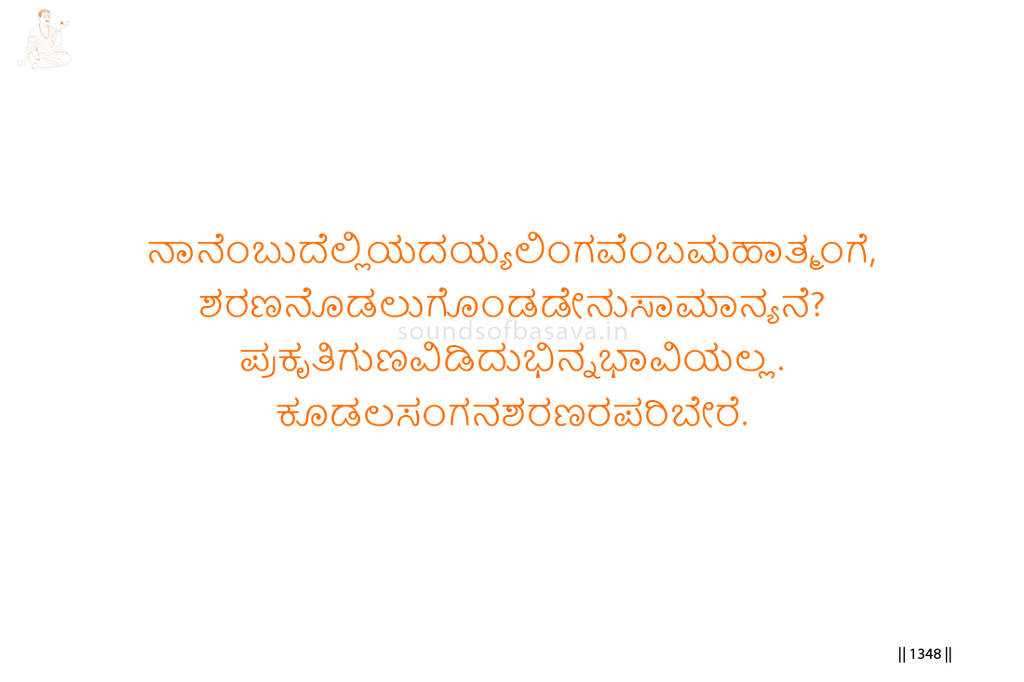
Before the great reality called Linga, Basavanna asks where the separate “I” can remain.
The Sharana may continue to bear a body and the qualities belonging to embodied nature. This does not make him ordinary, because he does not live through bhinna-bhava—the inward sense of being separate from Linga.
The distinctive condition of Kudalasangama Deva’s Sharanas is therefore not bodilessness, but embodied life without a separately established “I.”
Imagery & Symbolic Relevance
The vachana contains no material image. Its movement is formed through two questions, one clarification, and a concluding declaration.
The first question places the “I” before the Mahatma called Linga. The question leaves no independent ground upon which the “I” may establish itself. Linga is not approached as an external object before which a separate person merely stands; the very claim of separate identity becomes untenable.
The second question turns to the Sharana’s body. Basavanna asks whether one becomes ordinary merely because one continues to possess embodied form. The implied answer is no.
The body therefore remains within the vachana. Basavanna does not say that realization destroys embodiment, removes bodily function, or makes the Sharana invisible within the world.
The following statement explains why the embodied Sharana is not ordinary. The qualities of Prakriti may remain, but he is not a bhinna-bhavi—one whose inward disposition is founded upon difference.
The distinction is precise. Natural qualities and embodied actions may continue, but they no longer create an independently centred person standing apart from Linga.
The final declaration gathers the entire movement: the way or condition of Kudalasangama Deva’s Sharanas is different. Their difference does not lie in outward appearance, extraordinary display, or the rejection of nature. It lies in the absence of separative Bhava while embodied life continues.
Lingayoga
In Lingayoga, the body and its natural faculties are not enemies to be destroyed. The decisive question is whether they remain governed by a separately claiming “I.”
The practitioner may act, perceive, speak, work, and respond through the qualities of embodied nature. These movements must not become evidence for an identity independent of Linga.
The relation matures when Anga no longer claims a separate ground before Linga. Embodiment remains, but ownership of embodied existence as “I alone” falls away.
The practical discipline is therefore to live fully without establishing difference: natural action may continue, while thought, conduct, and Bhava remain rooted in Linga.
Editorial Commentary
Prakriti-guna means the qualities or functions belonging to embodied nature. The Kannada does not state that these qualities disappear.
Bhinna-bhavi means one whose Bhava is separate, divided, or difference-making. The absence of bhinna-bhava must not be confused with the absence of the body, faculties, or lived action.
Pari indicates the Sharana’s way, condition, or mode of being. The closing declaration concerns the distinctive manner in which Kudalasangama Deva’s Sharanas live.
Related Vachana
Supporting Vachana
Sharana Sthala Vachana 881 — The Vision of the Ever-Abiding Ones
Sharana Vachana 881 asks Kudalasangama Deva to reveal those truly joined with the supreme principle: the Mahānubhāvas, Lingaikyas, those abiding in Linga-sukha, those joined with Linga, and those whose whole orientation rests in Linga. Basavanna asks especially to see those in whom the divisive force of “I” and “You” no longer governs, and to remain day and night in the service of the Sharanas.
This prepares Vachana 1242 through lived recognition rather than abstract doctrine. In Vachana 881, Basavanna seeks the sight and service of those whose relation to Linga has overcome separation.
Vachana 1242 reveals their condition. Although the Sharana bears a body and the qualities of nature, the separate “I” has no ground before Linga, and bhinna-bhava does not govern him.
The movement is from seeking and serving the realized Sharanas to understanding why their embodied condition cannot be measured as ordinary.
Advancing Vachana
Aikya Sthala Vachana 941 — See the Sahaja Sharana
Aikya Vachana 941 asks us to behold the Sharana who is not governed by dying and being born, is unstained by doubt, and cannot be confined either to form or formlessness. He does not deceive the body or life, but abides in uninterrupted Sahaja and stands beyond comparison.
Vachana 1242 establishes that bodily existence and the qualities of nature may remain without making the Sharana ordinary, because separative Bhava is absent.
Vachana 941 advances this into a fuller portrait of embodied realization. Body and life are not rejected or contradicted; they remain truthful within uninterrupted Sahaja. Form and formlessness no longer divide the Sharana, and no ordinary comparison can measure his state.
The distinctive way of Kudalasangama Deva’s Sharanas declared in Vachana 1242 thus becomes visible in Vachana 941 as continuous, embodied, doubtless Sahaja.
