

Summary
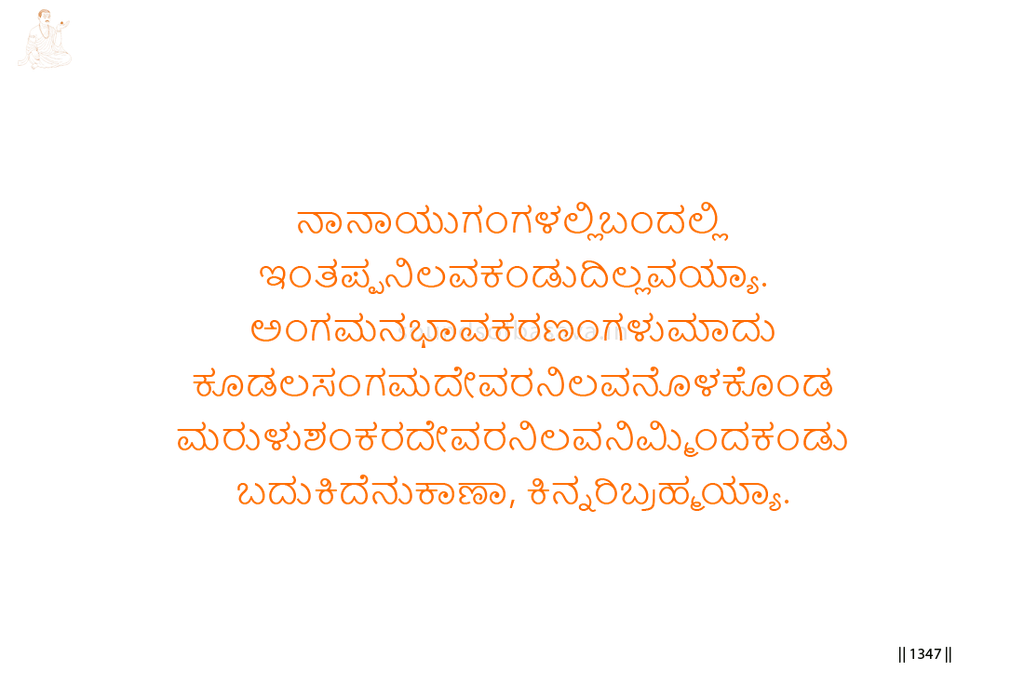
Across the many ages through which he has passed, Basavanna says that he has never encountered such a state.
Anga, mind, Bhava, and the inner faculties are absorbed into the state of Kudalasangama Deva. Addressing Kinnari Brahmayya, Basavanna declares that through him he has seen and lived the state of Marulashankaradeva.
The vachana moves from wonder at an unprecedented state to total inward assimilation and lived realization through sacred relationship.
Imagery & Symbolic Relevance
The opening reference to many ages gives scale to Basavanna’s declaration. He is not comparing this state with one recent experience; after all that has been encountered across time, nothing like it has previously been seen.
The vachana contains no material image. Its structure is formed through four inward fields:
Anga — embodied being;
mind — thought, intention, and inward movement;
Bhava — formed feeling and devotional orientation;
karanas — the faculties through which perception and cognition operate.
These are not presented as separate systems requiring individual interpretation. They are gathered together and absorbed into the state of Kudalasangama Deva.
Absorption does not mean that the body physically disappears or that the faculties are destroyed. They no longer operate as independent centres standing outside the Divine ground. Embodiment, thought, feeling, and perception are all contained within one state.
The state is then named as that of Marulashankaradeva. Basavanna is not discussing an abstract doctrine of union; he identifies a realized condition made known through a particular Sharana.
The final address preserves the agents precisely. Kudalasangama Deva is the state into which the whole inward field is absorbed. Marulashankaradeva is the realized Sharana whose state is named. Kinnari Brahmayya is the person directly addressed, through whom Basavanna has seen and lived that state.
The final verb is therefore essential. Basavanna has not merely heard about or observed Marulashankaradeva’s condition. He says that he has lived it.
Lingayoga
In Lingayoga, this vachana shows the gathering of the whole being into one Divine orientation.
Anga, mind, Bhava, and the faculties must not continue as competing centres—one acting, another thinking, another desiring, and another perceiving independently. Their movement becomes whole when all are established within Kudalasangama Deva.
This is not produced merely through ritual practice, mantra, bodily discipline, or inward vision. The Kannada states a realized condition of absorption and lived participation.
The role of Kinnari Brahmayya also shows that realization is not always disclosed through isolated effort. The state becomes visible and livable through relation with a realized Sharana. Such relation does not replace Kudalasangama Deva; it reveals how the whole being may abide within Him.
The practical significance is undivided participation: body, mind, Bhava, and perception must serve one sacred ground rather than sustaining separate claims.
Editorial Commentary
Nila means the state, condition, or abiding ground.
Karanas refers here to the operative inner faculties. The term does not authorize the introduction of chakras, subtle channels, or an independent yogic system.
The distinctions among Kudalasangama Deva, Marulashankaradeva, and Kinnari Brahmayya must remain clear. Kudalasangama Deva is the Divine ground of absorption; Marulashankaradeva’s state is seen and lived; Kinnari Brahmayya is directly addressed as the one through whom that state becomes known.
Related Vachana
Supporting Vachana
Sharana Sthala Vachana 1099 — The Grace That Restores Life
In Sharana Vachana 1099, Madivala Ayya cherishes Basavanna’s vachanas, repeatedly cleanses the impurity of his mind, restores the life that had departed, and protects him. Through Madivala Ayya’s compassion, Basavanna beholds the state of Marulu Shankara Deva and calls Kinnari Brahmayya to behold what has occurred.
This prepares Vachana 1238 directly. In the Sharana vachana, grace restores life and first opens the vision of Marulashankaradeva’s state.
In Aikya Vachana 1238, that state is no longer only beheld. Anga, mind, Bhava, and the faculties are absorbed into Kudalasangama Deva, and Basavanna tells Kinnari Brahmayya that through him he has seen and lived the state.
The movement is from restoration through Sharana-grace to full participation in the realized state.
Advancing Vachana
Aikya Sthala Vachana 1344 — When Linga Is Anga and Anga Is Linga
Aikya Vachana 1344 declares that Linga is Anga and Anga is Linga; Linga is Prana and Prana is Linga. Nothing must be demonstrated as separately existing, and nothing must be sought as absent. Uninterrupted Linga alone abides.
Vachana 1238 presents Anga, mind, Bhava, and the faculties as absorbed into Kudalasangama Deva’s state. Although the several fields are named, they are gathered into one abiding ground.
Vachana 1344 carries this further by removing the need to speak of separate fields entering that ground. Anga and Prana are known directly as Linga, and the distinction between what is present and what must be sought comes to an end.
The absorption lived in Vachana 1238 thus advances into uninterrupted Linga-presence.
