

Summary
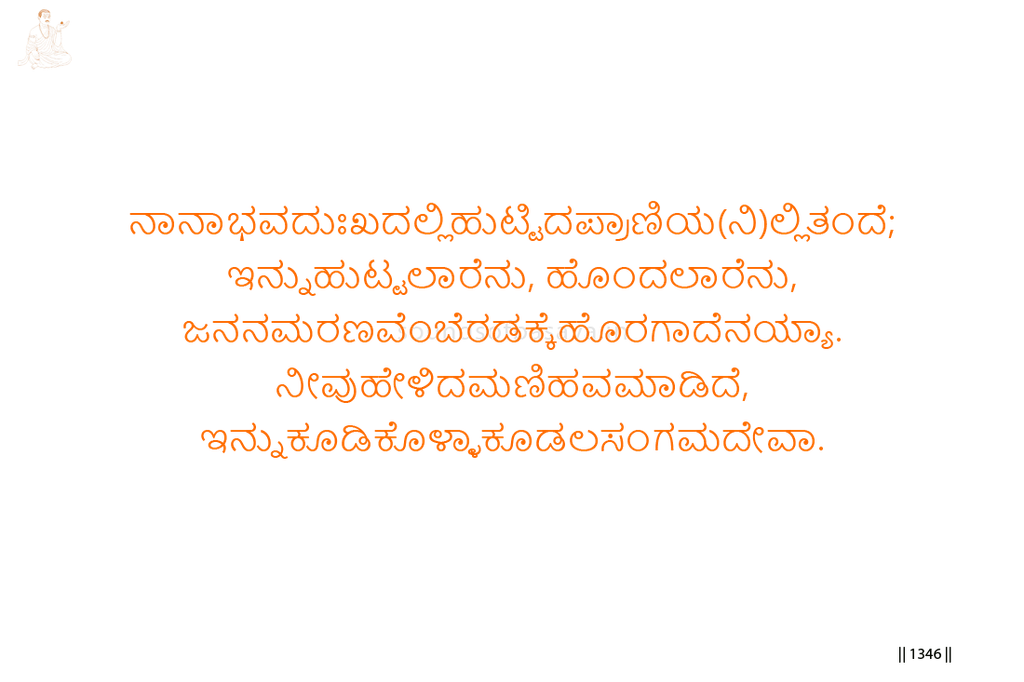
Basavanna recalls being born amid the many sorrows of bhava, but now declares that he has passed beyond the two conditions called birth and death.
He has performed the service entrusted to him by Kudalasangama Deva. Having completed it, he does not claim the final consummation as his own achievement; he asks the Lord to gather him.
The vachana moves from suffering and becoming, through freedom from birth and death, to fulfilled service and final surrender.
Imagery & Symbolic Relevance
The opening refers to birth within the many sufferings of bhava. Birth is presented as entry into the changing conditions, attachments, and pains of becoming.
The address to the Father places this history before Kudalasangama Deva. Basavanna does not examine birth and death as abstract ideas; he speaks from within his relation to the Lord.
His declaration that he will no longer be born or undergo death is clarified by the statement that he has gone outside the two called birth and death. They no longer enclose or govern his condition.
This does not require the denial of visible bodily birth and death. The vachana states that their twofold hold has been crossed: neither beginning nor ending can finally determine the speaker’s relation to Kudalasangama Deva.
The next line turns from realization to responsibility. Basavanna has performed the service directed by the Lord. Freedom from birth and death does not result in withdrawal from action; the entrusted work is completed.
Yet completion does not become self-claim. Basavanna does not say that his service has enabled him to gather himself into the Lord. His final words are a prayer: “Now gather me.”
Kudalasangama Deva remains the completing agent. Basavanna performs what is entrusted to him, but the final gathering belongs to the Lord.
Lingayoga
In Lingayoga, the vachana distinguishes fulfilled action from ownership of its result.
The Anga carries out the work given by Linga without treating service as personal achievement. Practice is completed through obedience and availability, not through the construction of an independent spiritual identity.
Passing beyond birth and death is the realized condition explicitly stated in the vachana. The practitioner is no longer governed by repeated becoming or by fear of personal beginning and ending.
The final appeal preserves surrender even after realization. The Anga does not claim the power to complete Aikya. Having fulfilled the entrusted service, it remains available to the gathering action of Linga.
Editorial Commentary
The “many sufferings of bhava” indicate the painful field of becoming, not merely a passing emotional state.
The service performed is the work directed by Kudalasangama Deva. The final request to be gathered prevents that fulfilment from becoming self-congratulation: action belongs to the servant, but consummation belongs to the Lord.
Related Vachana
Supporting Vachana
Sharana Sthala Vachana 57 — The Illusion of Ownership
Sharana Vachana 57 states that Basavanna is born where Kudalasangama Deva causes him to be born, dies where the Lord causes him to die, and remains where the Lord places him. He therefore asks what can truly be called his own.
This prepares Vachana 1237 by removing personal ownership of birth, death, and placement. The Sharana does not command these conditions independently.
Aikya Vachana 1237 deepens that surrender. Birth and death are no longer only governed by Kudalasangama Deva; Basavanna declares that he has passed outside their twofold hold. What begins in Sharana as relinquishment of control ripens in Aikya as fulfilled service followed by the prayer to be gathered.
Advancing Vachana
Aikya Sthala Vachana 1103 — Where There Is No Death
Aikya Vachana 1103 declares that one established in true Aikya within Linga has no death and no second destination apart from Linga. Soddala Bacharasa is described as having entered the body of the Nija-Linga and abiding in an incomparable condition.
Vachana 1237 presents the movement toward that consummation: birth and death have been crossed, the entrusted service has been completed, and Kudalasangama Deva is asked to gather the speaker.
Vachana 1103 reveals the fulfilled state of that gathering. Death cannot establish another abode because the realized Sharana remains within Nija-Linga. The prayer of Vachana 1237 thus advances into unbroken abidance in Linga.
