

Summary
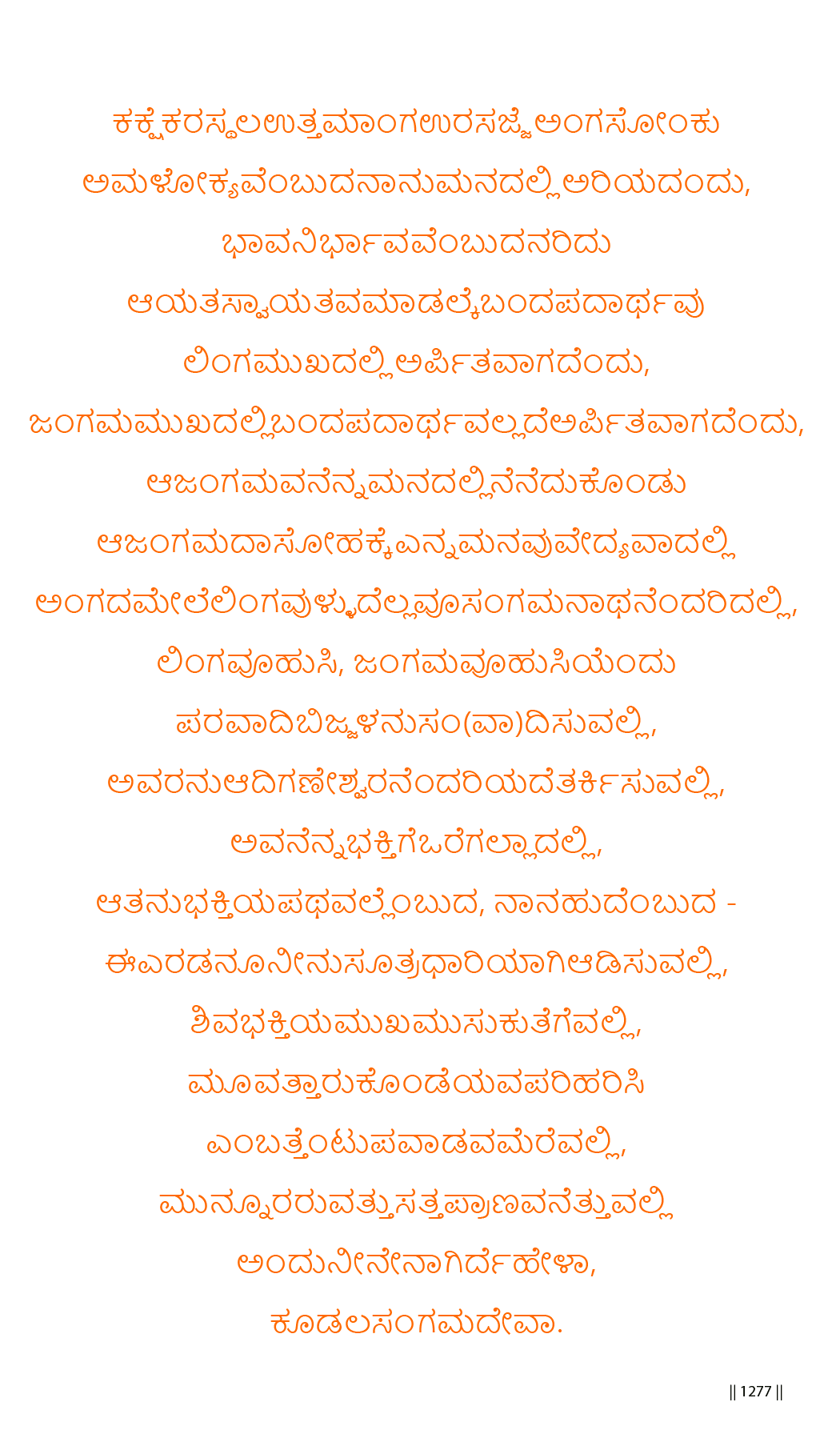
Basavanna recalls a time when he did not understand the inward meaning of the various bodily locations, contacts, and acts through which the Linga is borne and beheld. After recognizing the movement of bhava and nirbhava, he examines what makes an offering complete.
A substance does not become truly offered through an isolated act. It must pass through Linga-mukha and Jangama-mukha. Basavanna therefore holds the Jangama in his mind and makes the mind itself fit for Jangama-Dasoha.
He then recognizes that the Linga upon the Anga is Sangamanatha. Kudalasangama Deva is the Sutradhari who moves the apparent two. When the veil covering Shiva-bhakti is lifted, the divisions between worship, offering, service, Anga, Linga, and Jangama no longer remain separate centres.
Imagery & Symbolic Relevance
The opening gathers several concrete locations and acts connected with the Linga: kaksha, Karasthala, uttamanga, the chest, bodily contact, and beholding. These expressions keep the teaching within embodied worship.
Basavanna confesses that he had not understood their meaning inwardly. The problem was not the forms themselves, but that they remained separate actions without a unifying realization.
Karasthala is the palm-field in which the Ishtalinga is borne and beheld. Uttamanga, the head, introduces reverence. The chest and bodily contact bring Linga-relation into embodied nearness. Beholding completes the movement through sight.
The sequence therefore gathers bearing, bowing, touching, and seeing. Basavanna’s question is whether these remain separate observances or become one Linga-centred awareness.
The recognition of bhava and nirbhava marks the inward turn. Bhava concerns conditioned becoming and self-formation; nirbhava indicates freedom from that movement. Basavanna does not remain with the words as opposing doctrines. He applies their meaning to offering and Dasoha.
The paired expression āyata–svāyata introduces the movement between what is brought into sacred relation and what becomes inwardly assimilated. The vachana tests whether offering remains external or becomes part of one’s own awareness and conduct.
The padartha, the substance brought for offering, is then examined. Its mere arrival or presentation does not make it Arpita.
Linga-mukha, the face of the Linga, gives one essential direction of offering. The substance must be turned toward the Linga rather than retained under personal ownership.
The next line adds Jangama-mukha. What is offered cannot remain separated from the living sacred presence. Linga-directed offering and Jangama-directed receiving must not become rival or unrelated acts.
The word mukha, “face” or “entrance,” is important in both expressions. Offering reaches its sacred purpose through relation, not through possession or private performance.
Basavanna then holds the Jangama within his mind. The Jangama is no longer treated as an external recipient remembered only when an object is given.
The mind itself becomes vedya, fit, available, or offered, for Jangama-Dasoha. This is the deepest offering in the vachana. Basavanna does not give an object while withholding the inner person.
Jangama-Dasoha therefore gathers remembrance, service, giving, and inward surrender. The offering becomes whole only when the mind participates in it.
The recognition that the Linga upon the Anga is Sangamanatha brings the movement into Aikya. The Anga bears the Linga, but the relation is no longer understood as two independent possessions—the body belonging to the seeker and the Linga belonging to the Lord.
Everything present in the Anga–Linga relation is recognized as Sangamanatha. The worshipper cannot stand outside that field and claim the offering as his own action.
Kudalasangama Deva is then called the Sutradhari, the holder of the strings. The image is concrete: the Sutradhari directs the movement while remaining the unseen source of its coordination.
The “two” refers immediately to Anga and Linga, now moved by one Sutradhari. The earlier lines also show that Linga-mukha and Jangama-mukha cannot remain divided within this movement.
The image removes personal authorship. Basavanna does not say that he unites Anga and Linga or coordinates Linga and Jangama. Kudalasangama Deva is the one who makes their movement possible.
The veil over the face of Shiva-bhakti is the final image. The veil represents what conceals devotion even while worship and offering appear to be present.
That veil is division: external worship separated from inward realization, Linga separated from Jangama, offering separated from Dasoha, and action claimed by the individual.
When the veil is removed, Shiva-bhakti shows its true face. Devotion is no longer one act among several; it becomes the undivided ground of bearing, seeing, offering, remembering, serving, and receiving.
The concluding question asks Kudalasangama Deva what He had become in that moment. Basavanna does not answer by naming another form. The Lord has already been revealed as Sangamanatha and the Sutradhari within the entire movement.
Lingayoga
In Lingayoga, this vachana requires worship to become integrated. Bearing the Linga, touching it, bowing, beholding, offering, and serving Jangama cannot remain separate religious compartments.
The practical direction is to offer the mind along with the substance. An outward gift remains incomplete when inward ownership, preference, or separation is retained.
Linga-mukha and Jangama-mukha must remain joined in one sacred movement. When Anga recognizes the Linga it bears as Sangamanatha and yields its authorship to Kudalasangama Deva, worship becomes Dasoha and offering becomes Aikya-oriented.
Editorial Commentary
The opening expressions refer to embodied locations and acts of Linga-relation. They should not be converted into an unsupported system of subtle anatomy.
Bhava–nirbhava names the contrast between conditioned becoming and freedom from it. The vachana moves beyond merely naming this contrast by testing it through offering and Dasoha.
Āyata–svāyata should be retained as a paired movement between what is brought into sacred relation and what becomes inwardly one’s lived condition. The Kannada does not require a long independent doctrinal classification.
Arpita means offered or dedicated. Dasoha is not only material giving; here the mind itself becomes available to Jangama-service.
The Sutradhari image identifies Kudalasangama Deva as the one who directs the movement. It does not reduce the devotee to lifeless passivity; it removes the claim of independent authorship.
Related Vachana
Supporting Vachana
Sharana Sthala Vachana 977 — The Dharma Beyond Division
Sharana Vachana 977 rejects divided knowing. Inward Advaita cannot remain a private realization while conduct, service, correction, receiving, and relation to the Sharanas continue through separation.
The vachana asks to remain within the hearts of the Sharanas, where realization is tested through shared Dharma. Its serpent-and-staff image requires action that is firm without becoming destructive and compassionate without abandoning discipline.
This prepares Vachana 1126 directly. Sharana Vachana 977 first requires inward unity to become outward Dasoha. Aikya Vachana 1126 shows how this occurs: the offering passes through Linga-mukha and Jangama-mukha, the Jangama is held within the mind, and the mind itself becomes fit for Jangama-Dasoha.
What is demanded as consistency in Sharana Sthala becomes undivided offering in Aikya. The seeker no longer says, “I know Advaita” while retaining private ownership of mind, substance, worship, or action.
Advancing Vachana
Aikya Sthala Vachana 1196 — Beyond the Five Impurities
Aikya Vachana 1196 declares that there is no difference between the Bhakta and the Linga and no difference between the Bhakta and the Jangama. When Guru, Linga, Jangama, and Bhakta partake together as one, division, separateness, impurity, and sin have no place.
Vachana 1126 establishes the integrated movement of offering. Linga-mukha and Jangama-mukha are joined, the mind enters Jangama-Dasoha, and Anga and Linga move under Kudalasangama Deva as the one Sutradhari.
Vachana 1196 advances this integration into shared participation without distinction. What Vachana 1126 presents as one offering becomes, in Vachana 1196, one partaking in which Guru, Linga, Jangama, and Bhakta no longer stand as separate recipients, giver, or sacred centres.
The veil over Shiva-bhakti is lifted in Vachana 1126; in Vachana 1196, the divisions that veil it have no remaining ground.
