

Summary
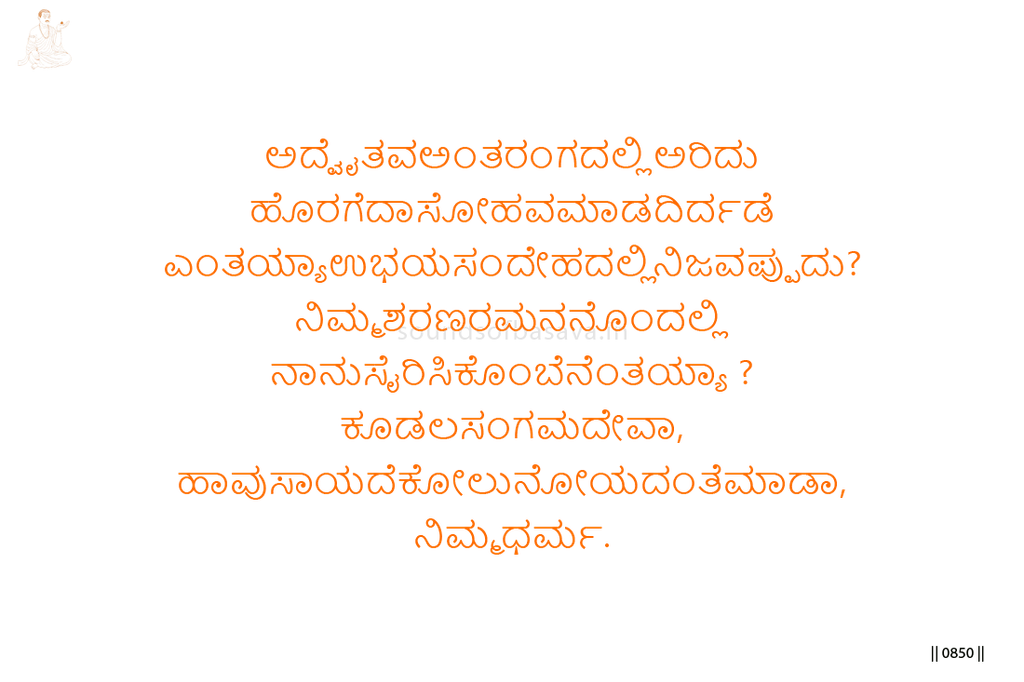
Basavanna questions a realization that remains only inward. If Advaita is known within, but does not become Dasoha outwardly, then the knowing remains divided. The vachana does not reject inward realization; it tests whether that realization has entered conduct, service, relationship, and the shared life of the Sharanas.
The central movement is from inward non-division to outward participation. To know non-duality inwardly while living separately, harshly, possessively, or indifferently would be a contradiction. Such knowing has not become whole. For Basavanna, truth must flow from the inner chamber into the field of life.
The prayer to remain within the hearts of Kudalasangama Deva’s Sharanas is therefore essential. Realization is not guarded as private attainment. It is held, tested, softened, and fulfilled in the living field of Sharana-sanga.
The final image gives the vachana its ethical refinement: let the serpent not die, and let the staff not break. Basavanna asks for a Dharma that corrects without violence and preserves firmness without cruelty. True Dharma does not destroy life in the name of discipline, nor break discipline in the name of gentleness. It acts with exact balance before Kudalasangama Deva.
Imagery & Symbolic Relevance
The first image is non-duality (Advaita) known inwardly. Basavanna begins from a high spiritual claim, not from ordinary ignorance. The seeker may have recognized non-division within the inner being. Yet Basavanna immediately asks whether such recognition has become Dasoha.
Dasoha is the outward test of inward truth. It is not merely charity, nor social generosity alone. It is the movement by which what is known inwardly becomes shared, offered, and lived without possessiveness. If inward unity does not become outward offering, the realization remains incomplete.
The phrase “divided knowing” carries the sharpness of the vachana. Knowing cannot be whole if the life that follows it remains divided. A person may speak of non-duality, yet still live through separation. Basavanna refuses this split. The inner and outer must not stand apart.
The prayer to remain in the hearts of the Sharanas shifts the vachana from private realization to living communion. The hearts of the Sharanas are not a decorative image. They are the field where truth is lived without isolation. To remain there is to be held within a realized community, where inward knowledge must become conduct, service, humility, and shared Dharma.
The serpent and staff form the closing image. The serpent may suggest danger, living force, instinct, conflict, or a condition that must be handled carefully. The staff suggests correction, firmness, discipline, authority, or action. Basavanna does not ask that the serpent simply be killed. Nor does he allow the staff to be broken. He seeks a Dharma in which correction does not become destruction and compassion does not become weakness.
This image preserves the maturity of the vachana. The answer to division is not passivity. Nor is it violence. True Dharma moves with such precision that life is not crushed and discipline is not lost.
Lingayoga
In Lingayoga, this vachana tests whether inward realization has entered the whole person. Arivu must not remain as inner knowledge alone. It must shape Achara, Kayaka, Dasoha, and relation to Jangama.
The practice-point is direct: do not keep Advaita as a private inward attainment. Let it become Dasoha. Let it appear in the way one serves, speaks, gives, corrects, receives, and remains with the Sharanas.
For Sharana Sthala, the importance lies in the surrender of private spiritual ownership. The Sharana does not say, “I have known inwardly; that is enough.” The Sharana allows that knowing to be tested in life. Inward unity must become outward non-division.
The serpent-and-staff image also gives a discipline of conduct. The seeker must not use truth as a weapon, nor compassion as an excuse for disorder. The Dharma of Kudalasangama Deva preserves both firmness and tenderness.
Editorial Commentary
The phrase “Advaita” should not be treated here as mere philosophical doctrine. In this vachana, its truth is tested by Dasoha. Likewise, “serpent and staff” should remain a practical ethical image: the action must be firm enough to correct, but gentle enough not to destroy.
Related Vachana
Supporting Vachana
Pranalingi Sthala Vachana 797 — The Inseparable Abidance in the Linga
Pranalingi Vachana 797 supports this teaching by saying that one who has received Prana-Linga cannot walk, speak, experience the senses, or perform even ordinary acts apart from Linga. It brings Linga-awareness into movement, speech, sensory life, and bodily conduct. This prepares Vachana 977 directly. In Vachana 797, inward reception of Prana-Linga must not remain separated from life; in Vachana 977, inward Advaita must not remain separated from outward Dasoha.
Advancing Vachana
Aikya Sthala Vachana 1126 — When All Offering Becomes One Offering
Aikya Vachana 1126 advances this teaching by making offering whole through Linga and Jangama. It says that what comes is not truly offered unless it is offered through the face of Linga and through the face of Jangama, and it brings the mind itself into Jangama-Dasoha. This is the natural Aikya fulfillment of Vachana 977. In Sharana Vachana 977, inward Advaita must flow outward as Dasoha; in Aikya Vachana 1126, all offering becomes one movement, and the separate “I” that could claim realization or offering begins to disappear before Kudalasangama Deva.
