

Summary
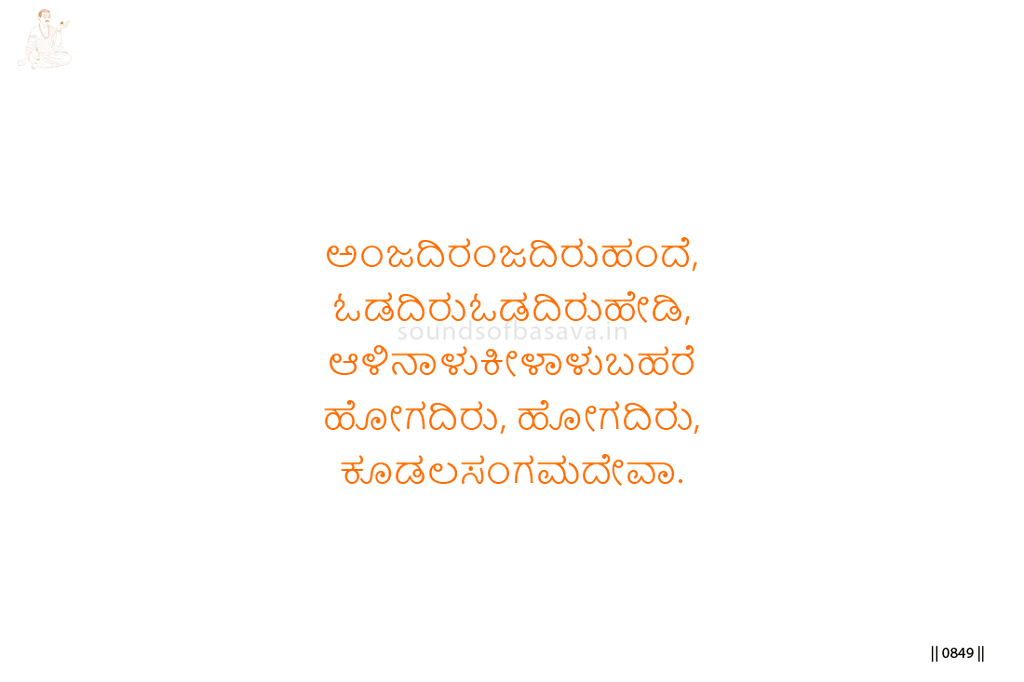
This vachana gives a direct instruction to the embodied seeker: do not tremble, do not run, and do not go after what pulls attention away. Basavanna addresses the body and mind at the point where disturbance begins. Fear makes the body tremble; desire and restlessness make the mind run. Both movements draw the seeker away from steady abidance in Kudalasangama Deva.
The teaching is not withdrawal from life, nor suppression of bodily and mental movement. It is the refusal to be carried away by reaction. The body may be touched by fear, and the mind may feel the impulse to move, but the Sharana is instructed not to follow these movements as truth. The repeated command “do not go” becomes the heart of the vachana.
The references to higher and lower movements are important. Basavanna does not simply tell the seeker to avoid what is low and pursue what is high. He warns against being drawn away by either. Whether the pull appears as elevation, ambition, decline, temptation, fear, or disturbance, the instruction remains the same: remain steady in Kudalasangama Deva.
Thus the vachana establishes the Sharana’s discipline of non-deviation. The seeker does not measure the path by movement upward or downward, but by inward steadiness. Where body does not tremble into fear and mind does not run into pursuit, the Linga remains unobscured.
Imagery & Symbolic Relevance
The first image is trembling. Trembling belongs to the body’s response before fear. Basavanna does not describe an elaborate outer danger; he goes directly to the bodily sign of disturbance. The body is told not to yield itself to this shaking movement.
The second image is running. The mind runs more subtly than the body. It runs toward what attracts, away from what frightens, and into imagined alternatives. Basavanna’s repetition shows the force of this habit. The mind does not run once; it runs again and again.
The third image is the call of higher and lower movement. These are not merely physical directions. They indicate the forces that pull the seeker out of steadiness. One may be drawn upward by spiritual ambition, pride, or the idea of gain; one may be drawn downward by old habit, fear, or desire. Both movements become distractions when they take the seeker away from the Lord.
The final image is refusal. “Do not go” is the governing instruction of the vachana. Basavanna does not ask the seeker to argue with the pull, analyze it, or replace it with another movement. He asks for non-participation. The pull may arise, but the Sharana does not follow it.
The symbolic force of the vachana is therefore simple and sharp: disturbance begins when body and mind leave their center. Abidance begins when the seeker refuses to be drawn away.
Lingayoga
In Lingayoga, this vachana teaches steadiness of perception and conduct. The body, mind, and awareness must not be ruled by reactive movement. Fear, pursuit, attraction, and aversion are not treated as independent authorities.
For Sharana Sthala, the practice-point is direct: remain with Kudalasangama Deva when body trembles and mind runs. Do not turn the trembling into identity. Do not turn the running into guidance. Let the movement arise and pass without allowing it to govern the inward relation to Linga.
This is also why the vachana aligns with Drishtiyoga. Seeing must not become entanglement. The seeker sees what pulls, but does not follow it. When seeing remains steady, action may continue, but awareness is not displaced.
Editorial Commentary
The “higher” and “lower” should be handled carefully. The vachana is not rejecting genuine discipline, devotion, or right action. It is warning against being pulled away from steadiness by any movement that becomes more important than abidance in Kudalasangama Deva.
Related Vachana
Supporting Vachana
Pranalingi Sthala Vachana 1061 — The Monkey-Mind’s Restless Leap
Pranalingi Vachana 1061 supports this teaching by showing the mind as monkey-like, unable to stand, sit, or remain where it is placed. It leaps downward, upward, and outward toward the directions, and Basavanna asks Kudalasangama Deva to remove its mischief and gather him into nearness. This prepares Vachana 969 clearly. In Vachana 1061, the restless mind must be gathered by grace; in Vachana 969, the Sharana receives the direct instruction not to tremble, not to run, and not to go after the movements that draw awareness away.
Advancing Vachana
Aikya Sthala Vachana 970 — The Ground of Undisturbed Abiding
Aikya Vachana 970 advances this teaching by carrying non-deviation into deeper undisturbed abidance. It instructs the seeker not to be shaken, disturbed, bent, or diminished, not to fall into restless questioning, and not to allow “I” or “mine” to arise. This is the natural Aikya fulfillment of Vachana 969. In Sharana Vachana 969, the body and mind are stopped from trembling and running; in Aikya Vachana 970, disturbance itself is further refined until self-reference and possessive thought no longer take hold before Kudalasangama Deva.
