

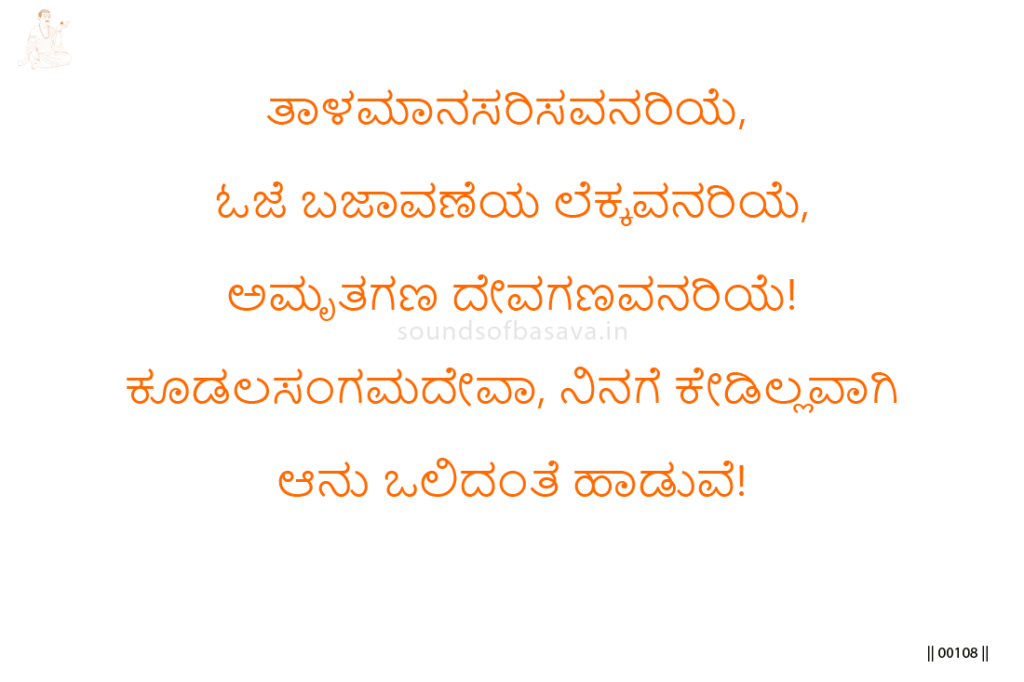
The poet states that if a king becomes hostile, one cannot live in his land; if a husband becomes hostile, one cannot live in his home. But if the Jangama the living presence of the Divine were to withdraw its grace, he questions how he could even continue to exist, implying that this grace is the very source of his life.
Spiritual Context
Core Spiritual Principle: All worldly dependencies are relative and conditional, but the soul’s dependence on Divine Grace is absolute and essential. The Jangama’s grace is not a commodity but the very substrate of consciousness and life; to be severed from it is spiritual death.
Cosmic Reality Perspective: The Cosmic Reality (Linga) is not a separate entity but the ground of all being. The Jangama is the functional aspect of this reality the dynamic channel of its sustaining energy (Shakti). To be disconnected from this flow is to be cut off from existence itself.
Historical Reality (Anubhava Mantapa context): This vachana reflects the absolute surrender required of a Sharana. It moves beyond social rebellion (rejecting the king) and personal attachments (the husband) to establish the one non-negotiable relationship: the soul’s connection to the Divine flow, embodied by the Guru and the Sangha (Jangama).
Interpretation
1. “When the king turns against you, life in his land becomes unlivable.” : The “king” represents all external, political, and social power. This dependency is geographical and legal. Its loss means exile from a certain mode of life.
2. “When the husband turns against you, the home itself grows unbearable.” : The “husband” represents the most intimate human relationship. This dependency is emotional and personal. Its loss means exile from love and psychological refuge.
3. “But if the Jangama… turns away its grace, how could I even breathe…?” : This is the quantum leap. The Jangama is not an external ruler or an intimate partner, but the source of life itself . The “grace” is the animating principle (Prana/Chaitanya). The question is rhetorical: without this grace, the “I” that speaks, breathes, and exists would simply cease to be. The dependency is not conditional but ontological.
Practical Implications: The seeker must transfer their sense of security and identity from all worldly relationships and supports to the one, essential relationship with the Divine Grace, perceived through the Jangama. All other attachments must be seen as relative and secondary to this absolute dependence.
The Cosmic Reality
Anga (Human Dimension): The human as a contingent being, wholly dependent on a source beyond itself for its very existence and consciousness. The Anga is the recipient of grace.
Linga (Divine Principle): Kudalasangama Deva as the ultimate, inexhaustible source of grace and being.
Jangama (Dynamic Interaction): The Jangama is the active, flowing current of grace that connects the Anga to the Linga. It is the “breath” of the soul, the dynamic sustenance without which the Anga cannot function or exist in a state of spiritual life.
Shata Sthala
Primary Sthala: Prasadi. This vachana is the ultimate expression of the Prasadi stage, where the seeker realizes that every moment of awareness and life is a gift (Prasada) from the Divine. The ego’s claim to ownership completely dissolves.
Supporting Sthala: Aikya. The rhetorical question points toward the state of Aikya. In full union, the question of grace “turning away” becomes meaningless, because the seeker has realized their identity as that grace. The river has merged with the ocean.
Practical Integration
Arivu (Awareness): Practice seeing every breath, every thought, and every moment of existence as a direct manifestation of the Jangama’s grace. Cultivate a constant, grateful awareness of this fundamental dependence.
Achara (Personal Discipline): The primary discipline is surrender (Sharanagati). Each day, consciously offer your life, your breath, and your actions to the Jangama, acknowledging that you are an instrument of this grace.
Kayaka (Sacred Action): Perform all work as an offering to sustain the flow of this grace both in yourself and in the world. See your labor as participating in the Jangama’s work of sustaining creation.
Dasoha (Communal Offering): The highest Dasoha is to become a clear channel for this grace to flow to others. Your presence, words, and actions should help others recognize and connect with the sustaining power of the Divine in their own lives.
Modern Application
We place our sense of security in external validations: our career (the “king”), our family and relationships (the “husband”), our financial portfolio, or our social status. When these fail us when we are fired, divorced, or face a market crash we experience a profound existential crisis, feeling as if our very world has ended.
This vachana offers the ultimate liberation from existential anxiety. It teaches us to anchor our identity not in the fragile supports of the world, but in the one, unshakable source: the conscious, loving intelligence that animates the universe. By realizing our absolute dependence on this grace, we become independent of the world’s vicissitudes. We can lose a job, a home, or a relationship, but we can never be separated from the source of our own breath and being, unless we choose to turn away from it.
Essence
The king’s land lost, the husband’s door,
Are wounds that time can yet restore.
But if Your grace should cease to be,
The self itself would cease in me.
Metaphysically, this vachana describes the relationship between Jiva (individual soul) and Shiva (universal consciousness). The “king” and “husband” represent dependencies within the realm of Maya (Prakriti). The Jangama’s grace is the power of Chit-Shakti (consciousness-energy) that sustains the Jiva. The “breath” is a symbol for Prana, the nexus between consciousness and the physical body. The vachana asserts that the Jiva’s existence is a continuous act of God’s grace (Sattā); to be cut off from this is not annihilation into nothingness, but a fall into unconsciousness, a state of being spiritually “un-alive.”
Our deepest security cannot be found in anything the world can give or take away. It is found only in our conscious connection to the source of life itself. To make this connection the central fact of our existence is to become truly fearless and free, no longer a victim of circumstance, but a living expression of a grace that is infinitely resilient and ever-present.

Views: 0