

Summary
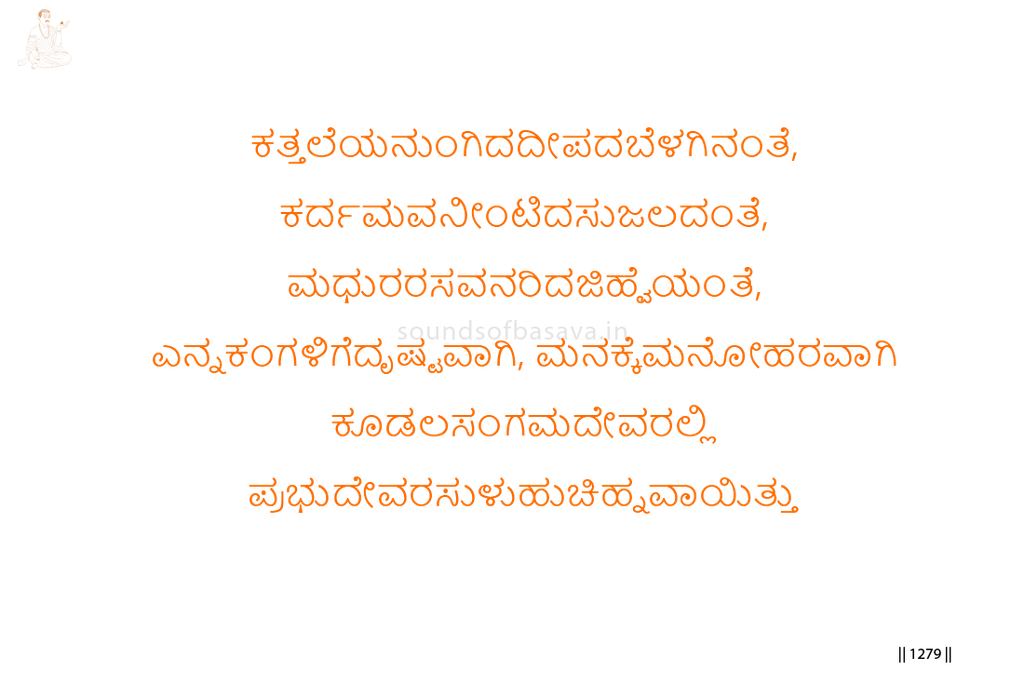
Basavanna compares the revelation before him to the light of a lamp that has consumed darkness, clear water unstained by mud, and a tongue that has directly known sweetness.
Through these images, he describes recognition that is clear, stainless, and experientially certain. The sign of Prabhudeva becomes visible to his eyes and delightful to his mind within Kudalasangama Deva.
The vachana does not present this recognition as an intellectual conclusion. It is directly seen and inwardly received.
Imagery & Symbolic Relevance
The first image is the light of a lamp that has swallowed darkness. Once the lamp shines, darkness cannot remain before it. The image conveys clarity in which uncertainty is removed by the appearance of light itself.
The second image is clear water unstained by mud. Mud represents what would cloud or contaminate the water. The water’s clarity expresses a recognition that remains free from confusion and distortion.
The third image is a tongue that has known sweet rasa. Sweetness is not established through argument. The tongue knows it through tasting.
This image gives the most immediate measure of the vachana. What has been tasted does not require second-hand confirmation. In the same way, the sign of Prabhudeva is known through direct experience.
The three images carry distinct functions:
the lamp gives clarity;
the water gives purity;
the tongue gives experiential certainty.
Basavanna then joins outward and inward recognition. The sign becomes visible to his eyes and delightful to his mind.
The eyes indicate that the recognition is not imaginary or hidden from awareness. The response of the mind shows that the vision has been inwardly accepted and has become a source of joy.
The terms suluhu and chihna indicate a clue, sign, distinguishing indication, or recognizable mark. Basavanna recognizes the characteristic sign of Prabhudeva within Kudalasangama Deva.
Prabhudeva is not introduced as an abstract spiritual principle. He is Allama Prabhudeva, the realized Sharana whose state and guidance have become unmistakable to Basavanna.
Kudalasangama Deva remains the Divine ground in whom this sign becomes visible. The present vachana reveals the sign within the Lord; it does not yet fully explain the relation between the sign and its source. That further clarification appears in the Advancing Vachana.
Lingayoga
In Lingayoga, realization must become directly evident rather than remain a conclusion produced by reasoning.
The practitioner’s seeing must gain the clarity of light, the stainlessness of pure water, and the certainty of tasted sweetness. Such recognition engages both vision and mind: it is perceived and inwardly assimilated.
The practical direction is to remain attentive to the realized sign revealed through the Guru-Sharana without replacing direct recognition with argument, imagination, or spiritual claim.
Editorial Commentary
The three comparisons should remain distinct. The lamp concerns the removal of darkness, the water concerns freedom from impurity, and the tongue concerns direct taste.
The phrase concerning the tongue does not merely mean pleasant speech. It refers to the certainty produced by actual tasting.
Suluhu–chihna should be understood as the recognizable indication or distinguishing mark of Prabhudeva.
Prabhudeva refers to Allama Prabhudeva. Kudalasangama Deva is the Lord in whom Basavanna beholds Prabhudeva’s sign.
The present vachana should not be made to say prematurely that Prabhudeva and Kudalasangama Deva are identical. It says that Prabhudeva’s sign becomes visible within Kudalasangama Deva. The later Vachana 1143 explicitly develops this into non-difference between the sign and its source.
Related Vachana
Supporting Vachana
Sharana Sthala Vachana 1360 — O My Supreme Guru
In Sharana Vachana 1360, Basavanna examines his condition without making a false claim. Though he may say that he has grasped the Sign, it has not yet become firmly established in his hand. Though he may speak of entering union, that completion still remains beyond him.
He identifies ego as the obstruction and calls upon the Guru—his Supreme Guru—to come. He stands before Kudalasangama Deva as an unknowing child rather than declaring realization prematurely.
This prepares Vachana 1128 precisely. In the Sharana vachana, the Sign has been approached but has not yet settled. The seeker recognizes his incompleteness and turns to the Guru.
In Aikya Vachana 1128, what had not yet become firmly established now becomes unmistakable. The sign of Prabhudeva is visible to Basavanna’s eyes and delightful to his mind, with the certainty of light, clear water, and tasted sweetness.
The Sharana-stage refusal of premature claim thus matures into direct Aikya recognition.
Advancing Vachana
Aikya Sthala Vachana 1143 — No Difference Between the Sign and the Source
Aikya Vachana 1143 asks whether the rainbow exists separately from the sky or belongs to something other than it. Though the rainbow appears as a visible form, it has no independent existence apart from the sky in which it appears.
Basavanna applies this image directly to the sign received from Prabhudeva. That sign stands in Kudalasangama Deva without difference, while the body remains only as its bearer.
Vachana 1128 establishes the direct revelation of the sign. It is clearly seen, inwardly delightful, and known with the certainty of tasted sweetness.
Vachana 1143 advances this recognition by explaining the relation between the revealed sign and Kudalasangama Deva. The sign is not an independent possession, attainment, or reality standing apart from its Divine source.
The movement is exact:
in Sharana Vachana 1360, the Sign has not yet become established;
in Aikya Vachana 1128, the Sign becomes directly visible;
in Aikya Vachana 1143, the Sign is known as non-different from the source in which it appears.
