

Summary
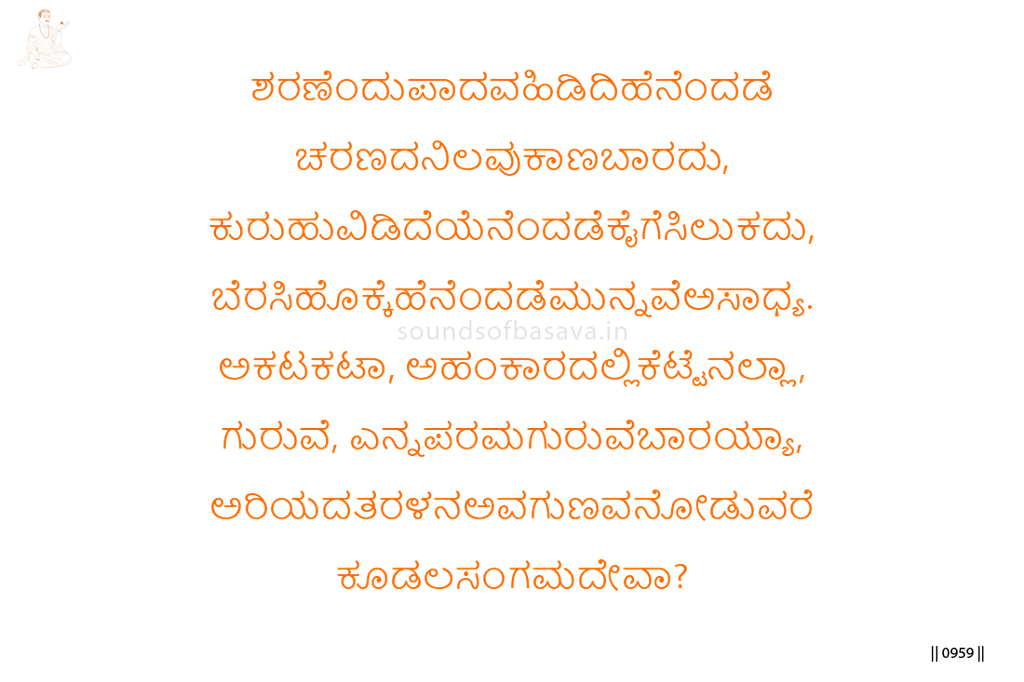
Basavanna examines his own state without self-deception. If he says he has held the feet as a Sharana, the true state of those feet has not yet been fully seen. If he says he has grasped the Sign, it has not yet settled into his hand. If he says he has entered and become one, that too still remains beyond him.
The root obstruction is ego. Basavanna does not hide it or convert it into spiritual claim. He cries, “O Guru, my Supreme Guru, come.” Before Kudalasangama Deva, he stands like an ignorant child and asks whether the Lord will look only at his faults.
Imagery & Symbolic Relevance
The first image is holding the feet as a Sharana. The act of holding suggests surrender and refuge. Yet Basavanna immediately corrects any premature claim: the true state of those feet is not yet seen. Holding is not the same as full realization.
The second image is grasping the Sign. The Sign has been received or recognized, but it has not yet become fully established in the hand. What has been touched has not yet become permanent possession or stable realization.
The third image is entering and becoming one. This is the language of union, but Basavanna refuses to claim it lightly. To speak of entering is not the same as completion. The final consummation still remains beyond him.
The fourth image is being ruined in ego. The obstacle is not lack of words, forms, or claims. The subtle persistence of ego stands between the seeker and completion.
The fifth image is the call to the Guru, the Supreme Guru. Basavanna does not attempt to free himself by his own claim. He calls the Guru to come, because only the Guru can complete what remains incomplete.
The final image is the ignorant child. The child is not presented as evil, but as unable to complete the path by its own strength. Basavanna asks Kudalasangama Deva not to look only at his defects, but to see the sincere turning hidden beneath them.
Lingayoga
In Lingayoga, this vachana teaches radical honesty about one’s own state. The seeker may have held, received, and entered, yet still must ask whether the state has become fully realized. Spiritual nearness should not be mistaken for completion.
For Sharana Sthala, the practice-point is humility before the Guru. The Sharana must not claim attainment while ego remains. The correct movement is confession, surrender, and prayer: “O Guru, my Supreme Guru, come.”
Editorial Commentary
This vachana should not be read as despair. Basavanna’s confession is itself a sign of refined awareness. He does not deny the feet, the Sign, or the movement toward union; he refuses to claim their completion before they have become fully established. The child-image keeps the prayer tender rather than self-condemning.
Related Vachana
Supporting Vachana
Pranalingi Sthala Vachana 1004 — Chennabasavanna Revealed the Hidden Fire
Pranalingi Vachana 1004 supports this teaching by showing that realization becomes complete through living revelation, not self-claim. There, Chennabasavanna reveals Sujñāna-Linga within true life-force, brings it into the palm, establishes it throughout the whole being, shows the path of continuous true Linga-union, and proclaims the greatness of Pranalinga. This prepares Vachana 1360 directly. In Vachana 1004, completion comes through the revealer who establishes Linga through the whole being; in Vachana 1360, Basavanna admits that holding, grasping, and entering are still incomplete and cries for the Supreme Guru to come.
Advancing Vachana
Aikya Sthala Vachana 1143 — No Difference Between the Sign and the Source
Aikya Vachana 1143 advances this teaching by fulfilling what remains unsettled in Sharana Vachana 1360. In Vachana 1360, Basavanna says the Sign has not yet settled fully in his hand and that entering into union still remains beyond him. In Aikya Vachana 1143, the sign received from Prabhudeva stands in Kudalasangama Deva without difference, like the rainbow appearing in the sky without separate existence. Thus the Sharana-stage confession of incomplete grasp advances into Aikya as the realization that the Sign, the source, and the body bearing it stand without separation.
