

Summary
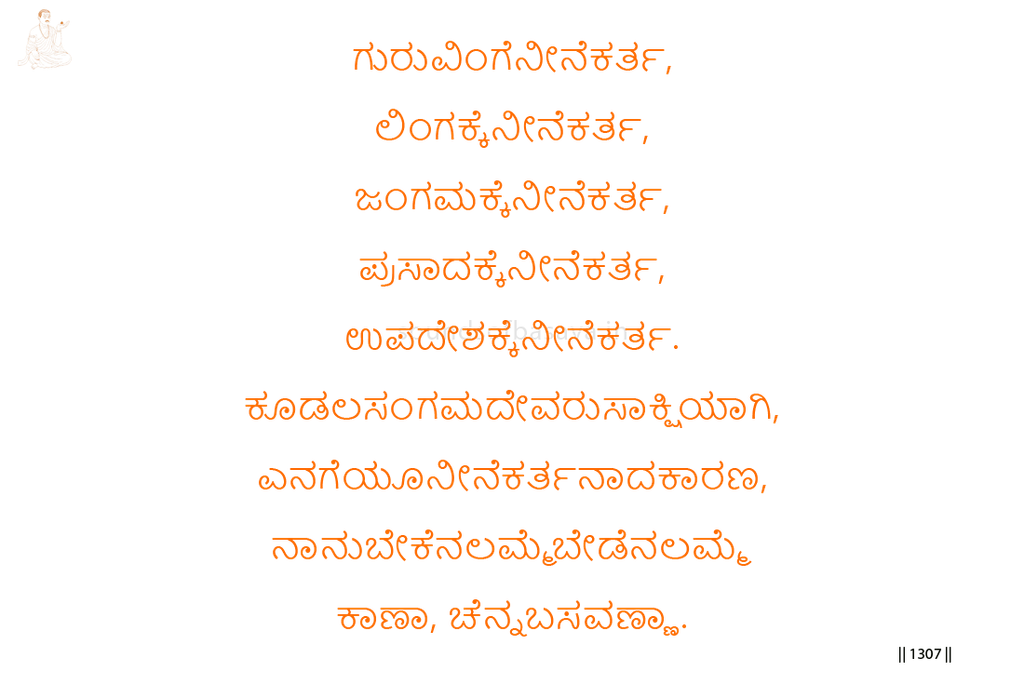
Basavanna addresses Chennabasavanna directly and declares him to be the karta—the effective agent—for Guru, Linga, Jangama, Prasada, and Upadesha. He then extends the declaration to himself: Chennabasavanna has become the agent responsible for Basavanna’s own sacred formation and direction.
Kudalasangama Deva stands as witness to this complete entrustment. Since Chennabasavanna has assumed responsibility for the whole sacred movement and for Basavanna himself, Basavanna can no longer establish an independent preference by saying, “I want this” or “I do not want that.”
The vachana is therefore an acknowledgement of Chennabasavanna’s complete revelatory and guiding agency, accompanied by Basavanna’s surrender of personal choice and self-direction.
Imagery & Symbolic Relevance
The vachana contains no external image. Its force lies in the fivefold repetition of the declaration: “You are the karta.”
The first declaration concerns Guru. Chennabasavanna is recognized as the effective agent through whom the Guru-relation becomes established and meaningful for Basavanna.
The second concerns Linga. Chennabasavanna does not replace the Linga; he is the revealer and agent through whom Basavanna’s relation to Linga is made clear and living.
The third concerns Jangama. Chennabasavanna himself stands within the realized Jangama-state and reveals how the living sacred presence must be recognized.
The fourth concerns Prasada. Prasada is not merely something outwardly received. Through Chennabasavanna, its meaning, reception, assimilation, and fulfilment become possible.
The fifth concerns Upadesha. Chennabasavanna is not merely repeating received instruction. He is the one through whom instruction becomes effective, enters Basavanna’s understanding, and directs his life.
The sequence gathers the complete sacred field:
Guru gives awakening and direction;
Linga gives the Divine ground;
Jangama gives living presence;
Prasada gives accepted and assimilated grace;
Upadesha makes their meaning known.
Basavanna recognizes Chennabasavanna as the active agent through whom all five become operative.
He then says that Chennabasavanna has become the karta for him as well. Basavanna is no longer standing outside these sacred relations as one who independently chooses, arranges, or controls them. His own life has entered Chennabasavanna’s guidance.
Kudalasangama Deva is invoked as witness. The Lord’s witnessing confirms the sacred truth of this entrustment. Kudalasangama Deva is not being replaced by Chennabasavanna; rather, before the Lord, Basavanna acknowledges what Chennabasavanna has done and continues to do for him.
The final contrast between wanting and not wanting reveals the consequence. Where Chennabasavanna has become the complete agent, Basavanna’s personal demand and refusal no longer govern the movement.
He does not say, “This I accept because I desire it,” or “That I reject because it does not suit me.” Both preference and resistance are surrendered before Chennabasavanna’s realized direction.
Lingayoga
In Lingayoga, Guru, Linga, Jangama, Prasada, and Upadesha must not remain disconnected elements administered according to personal preference.
The realized Guru-Sharana integrates them and reveals their living relation. The seeker must therefore allow guidance to enter not only worship or instruction, but the entire direction of life.
Basavanna’s surrender does not mean inactivity or neglect of responsibility. He continues to act, worship, serve, receive, and learn. What falls away is the independent claim that he alone decides the sacred path according to personal desire.
The practical discipline is to release both selective acceptance and resistant refusal. The seeker cannot receive the Guru while resisting Upadesha, honour the Linga while neglecting Jangama, or seek Prasada while refusing the transformation it requires.
Editorial Commentary
The repeated second-person expression “you are the karta” is addressed throughout to Chennabasavanna. The concluding vocative identifies the addressee clearly.
The roles must therefore remain distinct:
Chennabasavanna is the karta for Guru, Linga, Jangama, Prasada, Upadesha, and Basavanna.
Kudalasangama Deva is the Divine witness.
Basavanna is the one who entrusts himself and relinquishes independent wanting and refusal.
The source commentary’s movement toward an unnamed abstract Divine agency must not override the Kannada grammar. Basavanna is specifically acknowledging Chennabasavanna’s agency before Kudalasangama Deva.
Karta means doer, agent, cause, or one who bears responsibility. It does not mean that Chennabasavanna materially creates Guru, Linga, Jangama, or Prasada. It means that he is the effective revealer and guiding agent through whom these sacred relations become established for Basavanna.
The final words do not abolish discernment or ethical responsibility. They remove personal preference as the ruling authority after Basavanna has entrusted himself to Chennabasavanna’s realized guidance.
Related Vachana
Supporting Vachana
Sharana Sthala Vachana 1271 — Salutations to Chennabasavanna, the Embodiment of Prasada
In Sharana Vachana 1271, Basavanna recognizes Chennabasavanna not merely as one who has received Prasada, but as one in whom Prasada has become fully manifest. Chennabasavanna is described through the Prasada of the Mahaprasadi and the immeasurable Prasada in which Kudalasangama Deva abides. When words prove insufficient, Basavanna ends with repeated salutation: “Namo, Namo.”
This prepares Vachana 1177 directly. The Sharana vachana first establishes Chennabasavanna as the living embodiment of Divine Prasada rather than a separate individual possessing grace.
In Aikya Vachana 1177, Basavanna entrusts the whole sacred movement to him. The one recognized as embodied Prasada becomes the karta for Guru, Linga, Jangama, Prasada, Upadesha, and Basavanna himself.
Reverence before Chennabasavanna in Sharana thus matures into complete entrustment in Aikya.
Advancing Vachana
Aikya Sthala Vachana 1178 — Established in the Fourfold Fulfillment
Aikya Vachana 1178 presents Chennabasavanna’s settled condition: intimate belonging in Guru, abiding nearness in Linga, right understanding in Jangama, and ripened fulfilment in Prasada. Holding these four attainments together, Chennabasavanna stands established in Kudalasangayya.
Vachana 1177 declares Chennabasavanna to be the karta through whom the whole sacred relation becomes effective for Basavanna. Vachana 1178 reveals the realized ground from which that agency arises.
Chennabasavanna can guide Basavanna across Guru, Linga, Jangama, and Prasada because he is himself fully established in each:
belonging in Guru;
nearness in Linga;
right understanding in Jangama;
ripened fulfilment in Prasada.
The progression is exact. Vachana 1177 acknowledges Chennabasavanna’s complete agency; Vachana 1178 reveals his integrated and fulfilled state within Kudalasangayya.
