

Summary
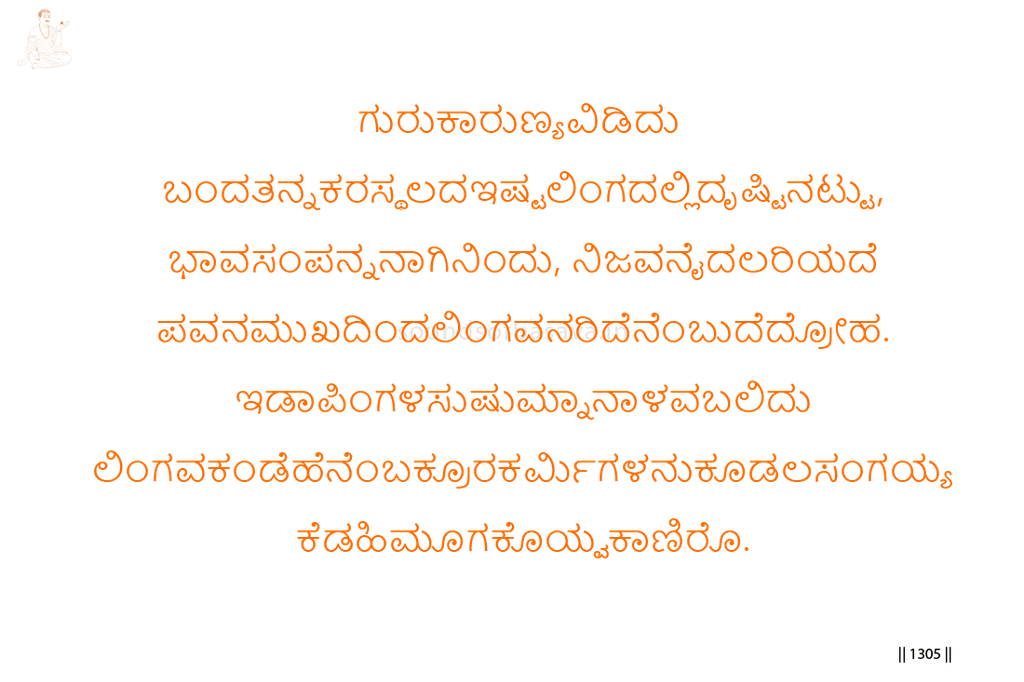
The seeker has come through Guru’s compassion, fixes the gaze upon the Ishtalinga in the Karasthala, and stands filled with bhava. Yet without truly reaching the Real, to claim, “I have known the Linga through the path of breath,” is treachery.
Basavanna then condemns those who force or manipulate Ida, Pingala, and Sushumna and declare, “I have seen the Linga.” Kudalasangayya will bring down such cruel practitioners and cut off their noses—the vachana’s severe image of their false spiritual claim being exposed and disgraced.
Imagery & Symbolic Relevance
The vachana begins with Guru’s compassion. Entry into sacred practice does not originate in self-achievement; it begins through grace.
The Ishtalinga rests in the Karasthala, and the seeker fixes the gaze upon it. Basavanna does not reject Ishtalinga worship or the discipline of concentrated seeing. These belong to the proper sacred relation established through Guru’s compassion.
The seeker is also described as bhava-sampanna—filled or endowed with inward devotional feeling. Yet even sacred feeling and concentrated worship do not permit a premature claim of realization.
The decisive phrase is “without knowing or reaching the Real.” The difference is between practices associated with the path and the actual realization of Linga.
The path of breath is then introduced. To say, “I have known the Linga through breath,” while the Real has not been attained, converts a means or bodily process into proof of realization. Basavanna calls this droha—betrayal or treachery.
The second movement names Ida, Pingala, and Sushumna. These channels are not explained as the Linga itself. The criticism falls upon those who force or master them and then claim that the resulting experience is direct vision of Linga.
The expression krūra-karmigaḷu identifies such persons as practitioners of harsh or cruel action. Their error is not merely technical misunderstanding. They use spiritual technique to support a false declaration of attainment.
The concluding image is severe. Kudalasangayya brings them down and cuts off their noses. The nose-cutting image signifies exposure, disgrace, and the destruction of the pride through which false realization is publicly claimed.
Lingayoga
In Lingayoga, Guru’s grace, Karasthala Ishtalinga worship, concentrated gaze, breath discipline, and inward bhava may belong to spiritual practice. None of them, however, may be presented as automatic proof of realization.
Kriya must serve realization; it cannot replace it. Bodily or breath-related experiences must not be converted into the declaration, “I have known the Linga.”
The practitioner must therefore distinguish among:
receiving Guru’s compassion;
worshipping the Ishtalinga;
standing within devotional bhava;
undergoing breath or channel-related experiences;
and actually reaching the Real.
The first four cannot be used to falsely claim the fifth.
Editorial Commentary
The vachana does not reject Guru, Ishtalinga, Karasthala worship, inward feeling, breath, or disciplined practice. It rejects the substitution of technique for realization.
Pavana-mukha refers to the path or movement of breath. Basavanna’s criticism is directed toward claiming that Linga has been known merely through that route.
Ida, Pingala, and Sushumna must remain as the three channels explicitly named in the Kannada. They should not be expanded into elaborate subtle-body anatomy beyond the vachana’s purpose.
Droha is stronger than ordinary error. It means betrayal or treachery because the seeker falsely represents technique as realization.
The final action belongs to Kudalasangayya. The nose-cutting image should not be softened away, but neither should it be treated as a literal instruction for violence. Within the vachana, it expresses the complete exposure and humiliation of false spiritual pride.
Related Vachana
Supporting Vachana
Sharana Sthala Vachana 1365 — My Inner Faults Still Cling
In Sharana Vachana 1365, Basavanna confesses that merely reciting Shatsthala is useless while inward faults continue to cling. Knowledge of the sacred path has not become realization if Dasoha before Jangama-Linga remains absent. The test is whether knowledge has entered conduct, offering, humility, and transformation.
This prepares Vachana 1169 directly. Sharana Vachana 1365 rejects the substitution of recitation for lived transformation. Aikya Vachana 1169 rejects the substitution of breath and channel techniques for true Linga-realization.
In both, the sacred practice itself is not condemned. The false claim that practice has already become realization is exposed.
Advancing Vachana
Aikya Sthala Vachana 1415 — One Moment of Living Experience
Aikya Vachana 1415 places one day of Linga worship above long austerity, one day of Guru-service above accumulated worship, and one day of fulfilling Jangama above prolonged Guru-service. It finally places even one moment of the living Anubhava of Kudalasangama Deva’s Sharanas above all accumulated practice.
Vachana 1169 clears away the false measure of realization. Breath control, manipulation of Ida, Pingala, and Sushumna, and the experiences arising through them cannot authorize the claim, “I have seen the Linga.”
Vachana 1415 gives the positive measure: direct living Anubhava, even for one moment, surpasses duration, accumulation, austerity, and technique.
The movement is exact. Vachana 1169 removes counterfeit realization; Vachana 1415 reveals the incomparable value of actual experience in the living field of Kudalasangama Deva’s Sharanas.
