

Summary
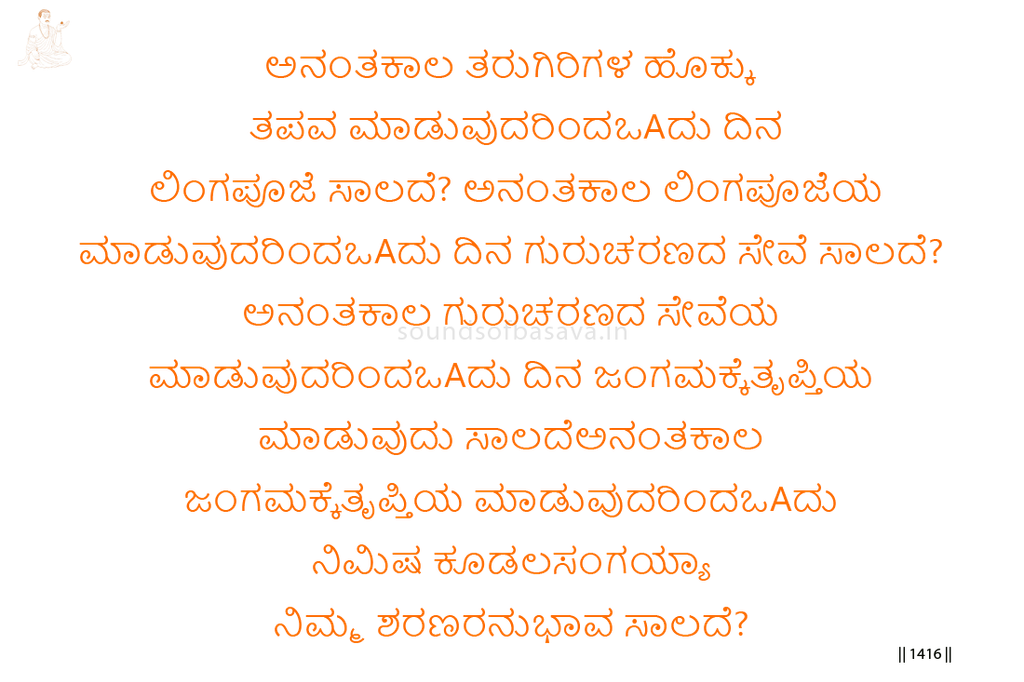
Is not one day of Linga-puja greater than entering caves and practising austerity for endless time?
Is not one day of service at the Guru’s feet greater than performing Linga-puja for endless time?
Is not one day of bringing fulfilment to Jangama greater than serving the Guru’s feet for endless time?
And is not one moment of the living Anubhava of Kudalasangayya’s Sharanas greater than satisfying Jangama for endless time?
Basavanna presents an ascending order of spiritual fulfilment. Duration alone does not determine depth. Each sacred practice reaches completion through a more immediate living relationship, culminating in one moment of Sharana-Anubhava.
Imagery & Symbolic Relevance
The Vachana is formed through four rhetorical questions. Each contrasts endless duration with a brief but more complete sacred experience.
Endless Austerity in Mountain Caves
The opening refers to entering mountain caves and practising tapas for endless time.
The cave represents withdrawal, solitude, discipline, and prolonged inward effort. Such tapas may demand immense endurance, but Basavanna asks whether one day of Linga-puja is not greater.
The comparison shifts the centre from solitary effort to direct Divine relationship. Tapas disciplines the seeker; Linga-puja places the seeker consciously before the Lord.
The question does not measure spiritual value by the number of years spent in seclusion. It asks whether the practice has entered an immediate relation with Linga.
One Day of Linga-Puja
One day of genuine Linga-puja carries greater value than endless austerity.
The emphasis is not merely upon the shortness of one day. It lies in the quality of direct worship.
In Linga-puja:
the Anga turns toward Linga;
the body participates in worship;
the mind becomes attentive;
the offering is placed before the Divine;
the seeker enters a conscious sacred relationship.
The first movement therefore passes from prolonged self-discipline to direct encounter with Linga.
Endless Linga-Puja and One Day of Guru-Seva
Basavanna then carries the comparison further.
Even Linga-puja performed for endless time is placed below one day of service at the Guru’s feet.
The Guru is the living source through whom Linga is given, revealed, and rightly understood. Service at the Guru’s feet brings worship into humility, receptivity, obedience, and embodied relationship.
Linga-puja may still remain centred upon the worshipper’s own act. Guru-seva tests whether the seeker can surrender personal preference and receive living guidance.
The movement is therefore from worship performed before Linga to service offered before the living revealer of Linga.
Service at the Guru’s Feet
The Guru’s feet signify refuge, guidance, and the foundation of the sacred path.
To serve them is not merely to perform an external act of reverence. It is to allow the Guru’s teaching to govern conduct and understanding.
One day of such service may transform the whole direction of life because it joins devotion with humility and obedience.
The value lies not in counting the hours of service, but in the completeness of surrender present within it.
Endless Guru-Seva and One Day of Jangama-Tṛpti
The third question places one day of satisfying Jangama above endless service at the Guru’s feet.
The movement now passes from receiving guidance to responding to living Divine presence.
Jangama-tṛpti means bringing fulfilment or contentment to Jangama through reverence, service, Dasoha, and right receiving.
Jangama does not remain an object of worship positioned before the seeker. Jangama comes, moves, receives, speaks, corrects, and participates in embodied life.
To satisfy Jangama is to allow sacred recognition to become active through relationship and offering.
Bringing Fulfilment to Jangama
Jangama-tṛpti is not limited to feeding the body of a visitor. Food may form part of Dasoha, but the deeper fulfilment involves complete and respectful reception.
The seeker must offer without pride, calculation, superiority, or the expectation of spiritual reward.
The movement from Guru-seva to Jangama-tṛpti shows that sacred teaching must become living hospitality, Dasoha, fellowship, and responsibility.
What is received through Guru and worshipped in Linga must be recognised in the moving sacred presence of Jangama.
Endless Jangama-Tṛpti and One Moment of Sharana-Anubhava
The final question gives the Vachana its highest point.
Even if one were to satisfy Jangama for endless time, is not one moment of the Anubhava of Kudalasangayya’s Sharanas greater?
The movement passes from serving the living sacred presence to directly sharing its realised truth.
Anubhava is not information received from the Sharana. It is not admiration, conversation, association, or outward nearness alone. It is living participation in the truth that has become established in the Sharana.
One moment is sufficient because true Anubhava is not measured chronologically. It reveals in immediacy what prolonged practice has been preparing the seeker to receive.
The Meaning of One Moment
The nimisha, the moment, is the shortest measure named in the Vachana.
Basavanna places it against ananta-kāla, endless time.
This contrast overturns accumulated spiritual accounting. Endless duration may remain external if practice has not ripened into living realization. One moment may contain completeness when the truth is directly revealed and received.
The moment is not praised merely because it is brief. It is praised because it is filled with Sharana-Anubhava.
The Ascending Sacred Movement
The Vachana forms a precise ascent:
Tapas disciplines the seeker.
Linga-puja establishes direct worship.
Guru-seva brings humility and living guidance.
Jangama-tṛpti fulfils worship through Dasoha and sacred relationship.
Sharana-Anubhava makes realised truth directly present.
Each movement contains and fulfils what came before it.
Linga-puja does not make tapas meaningless; it gives tapas a Divine centre. Guru-seva does not discard Linga-puja; it reveals how Linga must be understood and lived. Jangama-tṛpti does not abandon Guru-seva; it carries the teaching into living relation. Sharana-Anubhava does not reject Jangama; it reveals the realised truth embodied in Jangama.
Kudalasangayya’s Sharanas
The culmination belongs specifically to the Anubhava of Your Sharanas, the Sharanas of Kudalasangayya.
Their Anubhava is not self-created knowledge. It is realised life established in relation with the Lord.
Through them, the seeker encounters:
worship that has become life;
service that has become humility;
Dasoha that has become non-possession;
knowledge that has become conduct;
Linga that has become living presence.
The Vachana therefore culminates not in a private mystical state, but in the living field of the Lord’s Sharanas.
Lingayoga
Lingayoga must progress from duration to depth.
The practitioner may undertake discipline, worship Linga, serve Guru, and offer Dasoha to Jangama. Each remains essential, but each must ripen into the next living relation rather than becoming an accumulated spiritual achievement.
The practical test is whether worship changes the seeker’s conduct and capacity to receive the Sharana. Long practice without humility, service, Dasoha, and transformation remains incomplete.
Sharana-Anubhava cannot be manufactured through impatience or imitation. The seeker prepares for it through faithful Linga-puja, Guru-seva, reverence for Jangama, and freedom from personal claim.
When readiness and living Sharana-presence meet, even one moment may transform the whole understanding of the path.
Editorial Commentary
Ananta-kāla means endless or immeasurably prolonged time.
Tarugirigaḷa hokku indicates entering mountains or mountain caves for austerity and withdrawal.
Linga-puja is direct worship of the Linga through reverence, attention, and offering.
Guru-caraṇa-seve means service at the Guru’s feet, expressing humility, refuge, and receptivity to living guidance.
Jangama-tṛpti means bringing fulfilment or satisfaction to Jangama through reverent receiving, service, and Dasoha.
Sharana-Anubhava is direct participation in the lived realization embodied by Kudalasangayya’s Sharanas.
Nimisha means a moment. Its value here lies in the completeness of living Anubhava, not merely in short duration.
The repeated sālade? preserves the rhetorical force: is this not sufficient—does it not surpass the accumulated practice named before it?
Related Vachana
Supporting Vachana
Sharana Sthala Vachana 1331 — Gather What Has Been Deposited in the Eternal Treasury
Sharana Vachana 1331 speaks of the immense treasury of vachanas already deposited. Yet verbal abundance alone can remain like the cry of a fox before an unmoved mountain if the words are not gathered into awareness, conduct, and living realization. This prepares Vachana 1415 directly. Sharana Vachana 1331 asks that sacred utterance cease to remain accumulated speech and become lived truth.
Vachana 1415 gives the measure of that ripening: one moment of Sharana-Anubhava surpasses endless accumulation of austerity, worship, service, and offering when these have not yet become direct experience.
The treasury of words reaches fulfilment only when it becomes the living Anubhava revealed through Kudalasangayya’s Sharanas.
Advancing Vachana
Aikya Sthala Vachana 1383 — Where Is Anubhava?
Vachana 1415 declares the incomparable value of one moment of Sharana-Anubhava.
Vachana 1383 gives the test by which such Anubhava is recognised. It asks where Anubhava can be while self-praise, slander, falsehood, crooked reasoning, the six inner enemies, pride, jealousy, disturbed inward forces, and misconduct continue to govern life.
The movement advances from value to evidence.Vachana 1415 shows that one moment of true Anubhava exceeds endless practice. Vachana 1383 shows that such a moment is genuine only when it enters the whole person as equanimity, right understanding, truthful speech, inward balance, and worthy conduct. The experience of Kudalasangayya’s Sharanas is therefore not a passing emotional impression. Its truth becomes visible through transformation.
