

Summary
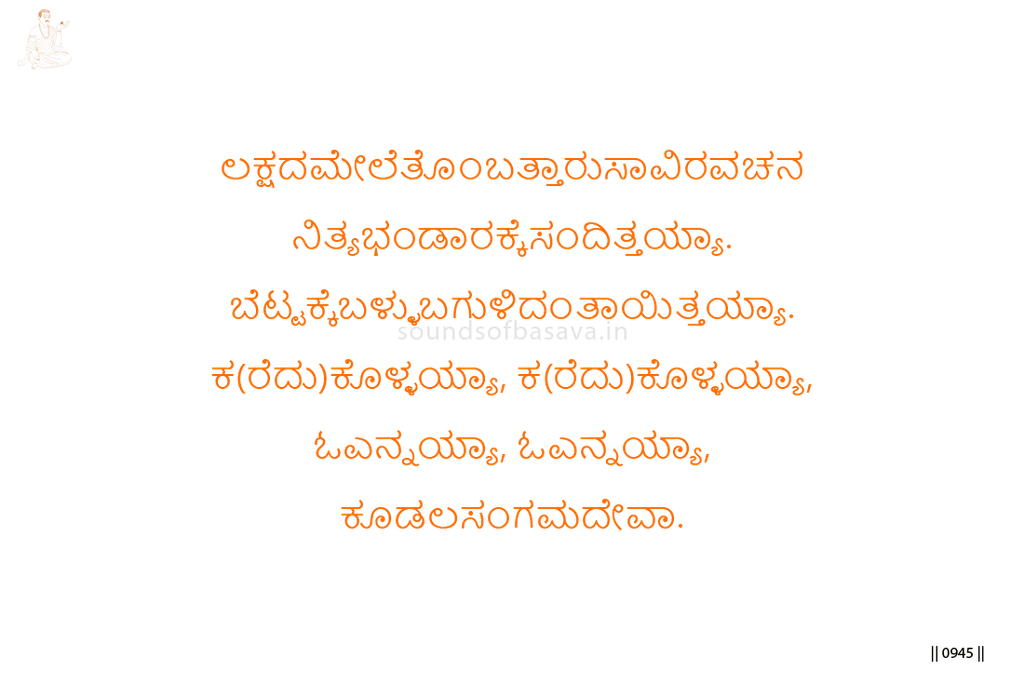
Basavanna speaks of a vast spiritual inheritance: more than a lakh and ninety-six thousand vachanas have been deposited in the eternal treasury. The treasure is already present. The problem is not scarcity of teaching, but the failure to gather and assimilate what has been given.
The image then turns severe. This abundance has become like a fox howling before a mountain. Sound is present, but the mountain is not moved. In the same way, sacred words may be many, yet if they do not become realization, they remain outside their own depth. Basavanna therefore cries to Kudalasangama Deva: “Gather it, gather it.” The prayer is not for more words, but for the living reception of the truth already deposited.
Imagery & Symbolic Relevance
The first image is the vast multitude of vachanas. Basavanna does not speak of a small teaching or a limited inheritance. The number expresses abundance. The path has already been filled with utterance, wisdom, and realized testimony.
The second image is the eternal treasury. A treasury stores what is valuable. Here, the vachanas are not treated as casual speech; they are placed in the nitya-bhandara, the lasting treasury of spiritual wealth. The treasure has already been deposited.
The third image is the fox howling before a mountain. A fox may cry loudly, but the mountain remains unmoved. The image shows the gap between sound and transformation. Words may be uttered, repeated, or preserved, yet realization may still remain untouched.
The repeated plea, “Gather it, gather it,” gives the vachana its urgency. Basavanna does not ask Kudalasangama Deva to create new treasure. He asks that what is already deposited may be gathered, received, and made inwardly alive.
The final repeated cry, “O my Lord, O my Lord,” turns the whole vachana into prayer. The seeker cannot gather the treasury by mere possession of words. He turns to Kudalasangama Deva for the grace of assimilation.
Lingayoga
In Lingayoga, this vachana teaches that sacred utterance must become lived realization. The vachanas may be many, and the treasury may be full, but the seeker must not remain at the level of hearing, reciting, or storing.
For Sharana Sthala, the practice-point is direct: do not mistake access to sacred words for inward realization. Gather what has been given. Let the deposited treasure become living awareness, conduct, and transformation before Kudalasangama Deva.
Editorial Commentary
The eternal treasury should not be read as a mere archive of written words. Its value lies in the living truth carried by the vachanas. The fox and mountain image prevents romanticizing verbal abundance. The issue is not whether the words exist, but whether they have been gathered into life.
Related Vachana
Supporting Vachana
Pranalingi Sthala Vachana 979 — Without Experience, Nothing Ripens
Pranalingi Vachana 979 supports this teaching by placing Anubhava at the center of spiritual life. There, Bhakti, Linga, Prasada, knowledge, and Sharana-sanga remain incomplete unless they become lived experience, and Divine Anubhava cannot be reduced to the churning of words. This prepares Vachana 1331 directly. In Vachana 979, words and sacred relations must ripen into experience; in Vachana 1331, the immense treasury of vachanas must be gathered into living realization rather than remaining like sound before an unmoved mountain.
Advancing Vachana
Aikya Sthala Vachana 1415 — One Moment of Living Experience
Aikya Vachana 1415 advances this teaching by showing the supreme value of direct Sharana-Anubhava. In Sharana Vachana 1331, Basavanna asks that the vast treasury of vachanas already deposited may be gathered into lived realization. In Aikya Vachana 1415, even one moment of the living experience of Kudalasangama Deva’s Sharanas is placed above endless austerity, Linga worship, Guru-service, and Jangama-satisfaction. Thus the Sharana-stage plea to gather the treasury advances into Aikya as the recognition that one moment of true Anubhava surpasses accumulated practice and stored utterance.
