

Summary
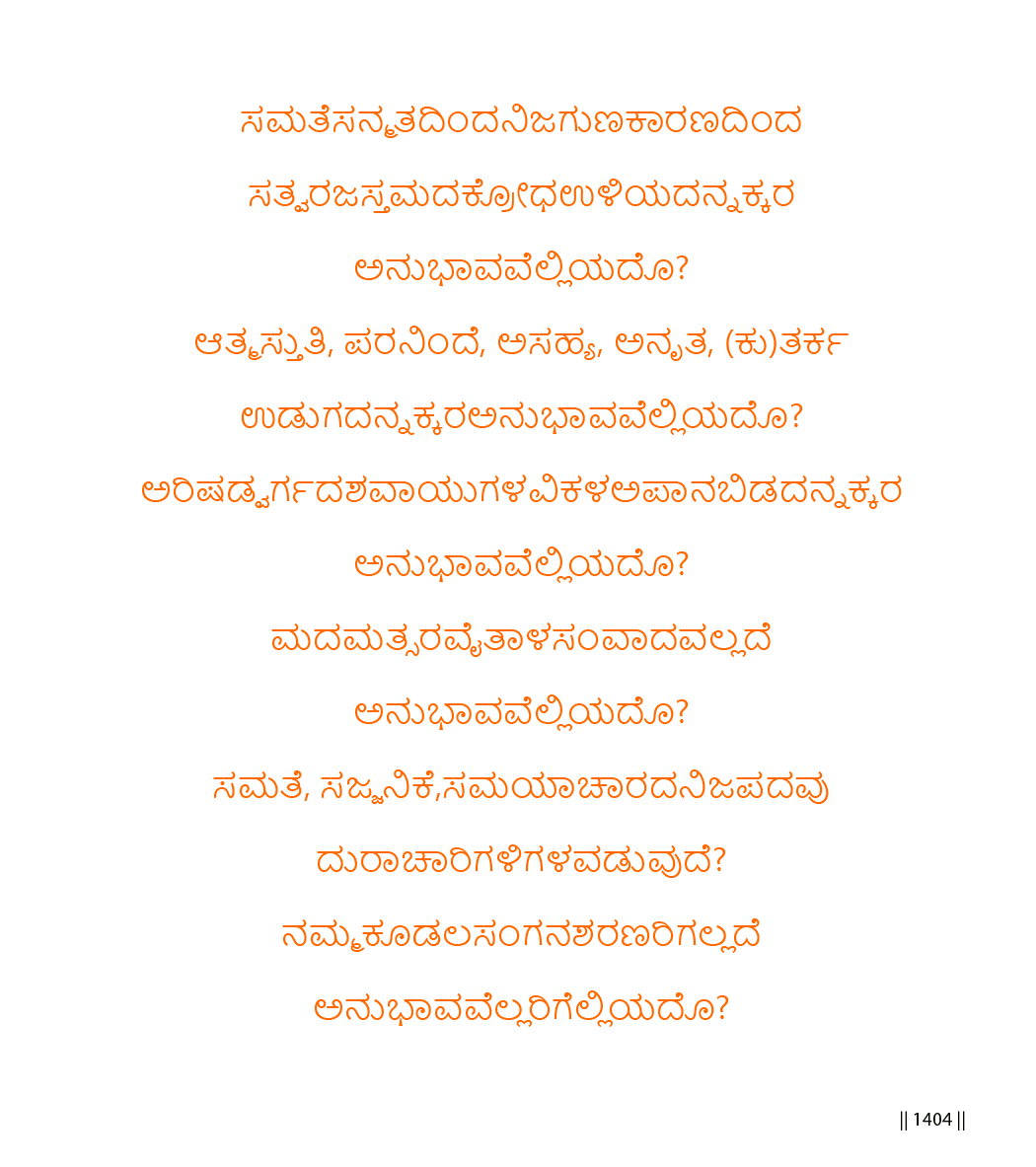
Where is Anubhava while equanimity, right understanding, and the truth of one’s inner nature have not become established? Where is Anubhava while the movements of Sattva, Rajas, and Tamas continue to generate anger and agitation?
Where is Anubhava while self-praise, slander of others, aversion, falsehood, and crooked reasoning remain? Where is it while the six inner enemies disturb the ten vital currents and disordered Apana continues?
Where is Anubhava when pride and jealousy conduct their haunting dialogue?
Can the true state of equanimity, goodness, and Samayachara belong to those established in misconduct?
Basavanna’s repeated questions lead to one conclusion: Anubhava is present among the Sharanas of Kudalasangama because their inner life, speech, conduct, and relationship with others bear the evidence of transformation.
Imagery & Symbolic Relevance
The Vachana unfolds through a series of searching questions. Each question tests a different field of life and asks whether Anubhava can be present while contradiction remains.
Equanimity, Right Understanding, and True Nature
The first question brings together:
Samate—equanimity;
Sanmati—right or noble understanding;
Nijaguna—the truth of one’s inherent spiritual nature.
Anubhava cannot remain merely an inward claim while thought, feeling, and conduct continue to move without balance.
Equanimity establishes steadiness. Right understanding gives clear direction. Nijaguna brings life into agreement with its true ground.
These are not separate virtues collected for display. Together, they reveal whether realization has entered the person’s actual manner of being.
Sattva, Rajas, Tamas, and Anger
Basavanna next names Sattva, Rajas, and Tamas.
These three qualities influence perception, emotion, action, and judgment. While their movements continue to generate anger and inner agitation, Anubhava has not become the governing state.
Even Sattva can become a source of subtle superiority when it is possessed as “my purity” or “my goodness.” Rajas drives restless assertion, while Tamas clouds understanding and steadiness.
Anubhava is recognised when their fluctuating power no longer determines the person’s centre.
Self-Praise and Slander of Others
The next test concerns speech and self-regard.
Atma-stuti, praise of oneself, strengthens the one who wishes to be recognised as realised. Para-ninde, disparagement of another, creates superiority by diminishing someone else.
The two movements belong together. The person raises the self and lowers the other.
Where these continue, Anubhava remains only a claim. Genuine experience does not require the enlargement of one’s own importance or the reduction of another’s dignity.
Aversion, Falsehood, and Crooked Reasoning
Basavanna then names:
Asahya—aversion, intolerance, or the inability to receive another;
Anrita—falsehood;
Kutarka—crooked or misleading reasoning.
Aversion distorts relationship. Falsehood separates speech from truth. Crooked reasoning uses intelligence to defend what inward clarity would expose.
Anubhava must bring feeling, speech, and understanding into one truthful movement. Where these remain divided, realization has not entered the whole person.
The Six Inner Enemies
The Arishadvarga are the six inner enemies:
desire;
anger;
greed;
delusion;
pride;
jealousy.
They are called enemies because they repeatedly seize the inner field and redirect life toward possession, reaction, comparison, and self-importance.
Basavanna’s question is practical: if these forces continue to rule inwardly, where is Anubhava?
Realization must be visible in the changed authority of these movements. They can no longer govern the person as before.
The Ten Vital Currents and Disordered Apana
The Vachana also names the ten vital currents and Apana.
The reference brings the examination into embodied life. Anubhava is not confined to thought or devotional feeling; it must bring balance into the living person.
Disordered inner movement reveals that the person has not yet become integrated. The body, Prana, mind, disposition, and conduct must cease moving as unrelated fields.
Basavanna therefore places inward realization and embodied balance within the same examination.
The Vetala-Dialogue of Pride and Jealousy
The sharpest image is the dialogue between Mada and Matsara—pride and jealousy.
Their conversation is described as Vetala-samvada, a haunting or spectre-like dialogue.
Pride says, “I am greater.” Jealousy responds, “Why is the other honoured?” Each feeds the other and keeps comparison alive.
This conversation may remain hidden from outward view, yet it continually shapes perception and conduct.
Where pride and jealousy continue this haunting dialogue, Anubhava has not brought silence to the inner field.
The True State and Misconduct
Basavanna then asks whether the true state of:
equanimity;
goodness;
Samayachara;
can belong to those established in misconduct.
The question carries its answer. The true state cannot be separated from the manner in which one lives.
Durachara, misconduct, is not only the violation of an external rule. It is the contradiction between claimed experience and actual conduct.
Anubhava must become Achara. The truth realised inwardly must appear in relationship, speech, response, restraint, and responsibility.
Anubhava Among Kudalasangama’s Sharanas
The final question gathers the entire Vachana:
Other than among the Sharanas of our Kudalasangama, where is Anubhava?
Basavanna does not identify the Sharanas merely by name, dress, association, or proclamation. They are known through the transformation already tested in the preceding questions.
In them:
equanimity has become established;
understanding has become clear;
self-praise and slander have fallen away;
falsehood and crooked reasoning no longer rule;
the inner enemies have lost their authority;
pride and jealousy no longer conduct their hidden dialogue;
Anubhava has become conduct.
The Sharanas do not merely speak about experience. Their lives make it visible.
Lingayoga
Lingayoga requires continuous examination of the distance between spiritual claim and lived condition.
The practitioner must observe speech, reaction, comparison, bodily agitation, reasoning, and relationship. Self-praise, slander, resentment, pride, jealousy, and falsehood show where the Linga-relation has not yet entered fully.
The discipline is not self-condemnation but truthful correction. Equanimity must become stable, speech truthful, reasoning straight, and conduct worthy of the experience being claimed.
Anubhava ripens through the complete relation of Linga, Prana, Achara, and Sharana-sanga. Its evidence is a transformed life whose inward realization and outward conduct no longer oppose each other.
Editorial Commentary
Anubhava means direct, lived realization. It is recognised through transformation rather than assertion.
Samate means equanimity or balanced regard.
Sanmati means right, noble, or truthful understanding.
Nijaguna means one’s true spiritual quality or nature.
Atma-stuti means self-praise.
Para-ninde means blame, slander, or disparagement of others.
Asahya indicates aversion, intolerance, or inability to receive another.
Anrita means falsehood.
Kutarka means crooked, misleading, or self-serving reasoning.
Arishadvarga refers to desire, anger, greed, delusion, pride, and jealousy.
Dashavayu means the ten vital currents of embodied life.
Apana is named within this embodied field as a vital downward-moving current.
Vetala-samvada describes the haunting inner dialogue through which pride and jealousy continually sustain each other.
Samayachara indicates conduct in harmony with sacred truth and right relationship.
Durachara means conduct that contradicts that truth.
Related Vachana
Supporting Vachana
Sharana Sthala Vachana 1208 — The Tiger That Passed Unseen
Sharana Vachana 1208 contrasts direct seeing with borrowed proclamation. A person loudly announces that the tiger has passed, yet has not encountered its living force.
Basavanna gives direct seeing a severe test: if Kudalasangama Deva has truly been seen, the nose of pride and social self-importance is cut away.
This prepares Vachana 1383 precisely. Vachana 1208 establishes that genuine seeing removes the one who wishes to display realization. Vachana 1383 expands that test across the whole person: self-praise, slander, falsehood, crooked reasoning, the inner enemies, pride, jealousy, and misconduct cannot remain as the governing marks of Anubhava.
The false proclamation of Sharana Vachana 1208 is therefore answered in Aikya by complete inward and ethical transformation.
Advancing Vachana
Aikya Sthala Vachana 1415 — One Moment of Living Experience
Vachana 1383 tests Anubhava through its lived signs: equanimity, truthful conduct, freedom from self-praise, slander, falsehood, pride, jealousy, and the inner enemies.
Vachana 1415 advances this into positive fulfilment. It declares that one moment of the living Anubhava of Kudalasangayya’s Sharanas surpasses prolonged austerity, Linga-puja, Guru-service, and Jangama-service.
Thus the ethical transformation required by Vachana 1383 culminates in direct participation in Sharana-Anubhava before Kudalasangama Deva.
