Summary
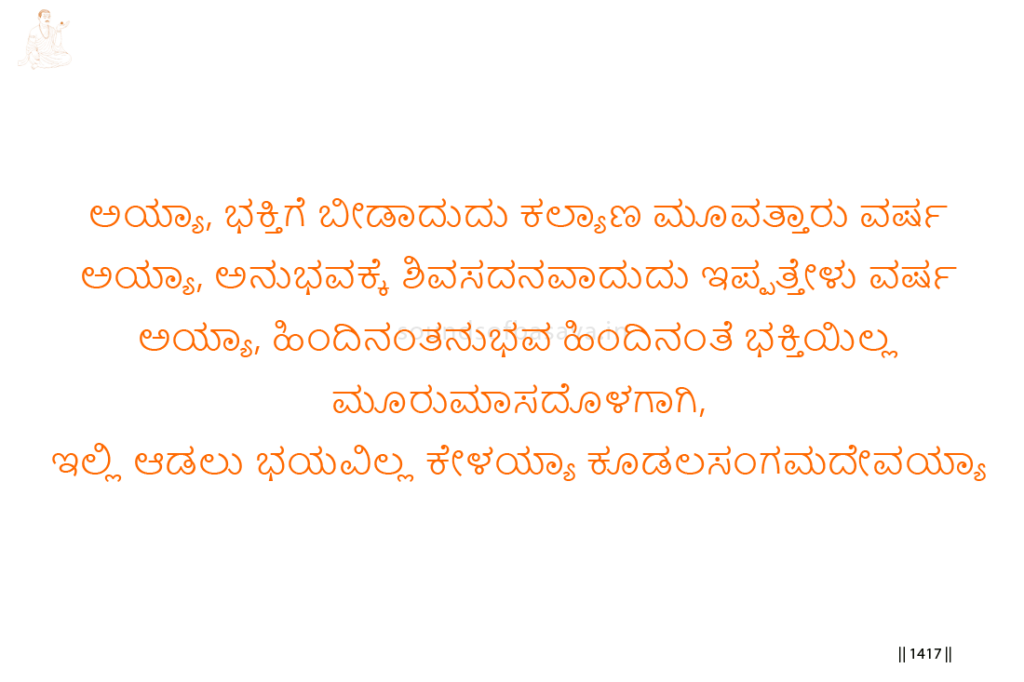
For thirty-six years, Kalyana was the dwelling place of Bhakti. For twenty-seven years, it became Shiva-sadana, the sacred abode of Anubhava.
Basavanna now sees that neither the former Anubhava nor the former Bhakti remains as it once did. Within only three months, the spiritual condition of Kalyana has changed.
Yet he continues to move and speak there without fear. His courage no longer depends upon the strength of the community or the preservation of earlier circumstances. It rests in Kudalasangama Deva.
The Vachana thus records the movement from devotion to living experience, the sudden weakening of a spiritual fellowship cultivated over decades, and Basavanna’s fearless continuance when the world around him no longer remains as before.
Imagery & Symbolic Relevance
The Vachana is a direct recollection of Kalyana through three exact periods: thirty-six years, twenty-seven years, and three months.
These periods reveal three distinct movements:
the establishment of Bhakti;
the maturation of Bhakti into Anubhava;
the sudden change in the spiritual life of Kalyana.
Kalyana as the Dwelling of Bhakti
Basavanna first remembers Kalyana as the dwelling place of Bhakti for thirty-six years.
Bhakti was not confined to the private devotion of isolated individuals. It had found a dwelling—a shared sacred field in which devotion could be practised, expressed, tested, and lived.
The word bīḍadudu, dwelling or abode, indicates that Bhakti had become established there. Kalyana had become a living home for devotion over a long period.
This was Bhakti entering collective life. The heart’s relation with the Divine was being given expression through worship, conduct, fellowship, work, service, and shared spiritual commitment.
Thirty-Six Years
The exact period of thirty-six years gives historical and experiential weight to Basavanna’s recollection.
He is not describing a brief devotional awakening. Bhakti had been sustained long enough to shape the life and identity of Kalyana.
The number must therefore remain concrete. It bears witness to the long labour through which devotion was given a stable dwelling within human life.
Kalyana as Shiva-Sadana for Anubhava
Basavanna then says that Kalyana became Shiva-sadana for Anubhava for twenty-seven years.
Bhakti had matured into Anubhava. Devotion had become direct, lived spiritual experience.
Kalyana was no longer only a place in which Shiva was worshipped. It became a sacred dwelling in which the truth of Shiva was experienced, shared, examined, and made visible through the lives of the Sharanas.
The movement from Bhakti to Anubhava is central:
Bhakti turns the heart toward the Divine;
Anubhava makes that Divine relation directly lived and known;
lived experience enters conduct, relationship, service, work, speech, and fellowship.
Bhakti is not rejected when Anubhava arises. It reaches its fulfilment through experience.
What was loved inwardly becomes visible through life.
Twenty-Seven Years
The twenty-seven years show that Anubhava became an established collective reality.
It was not one passing revelation or the private experience of a single Sharana. For a substantial period, Kalyana remained a place where living spiritual experience formed the centre of sacred fellowship.
The Sharanas did not gather only to repeat inherited teaching. They sought to make truth directly present through experience and conduct.
The contrast with the final three months makes this earlier continuity especially significant.
“Not as Before”
Basavanna then looks upon the present condition.
The former Anubhava is no longer as it was before. The former Bhakti too is no longer as it was before.
He does not say merely that a few individuals have changed. He recognises a change in the spiritual atmosphere that had sustained devotion and living experience.
The repetition of “as before” carries grief, clarity, and acceptance. What had once flourished can no longer be assumed to remain unchanged.
Basavanna does not deny the truth of the earlier years. Nor does he pretend that the present is the same as the past. He sees both without turning away.
The Three Months
The change has taken place within three months.
After thirty-six years of Bhakti and twenty-seven years of Anubhava, three months appear strikingly brief.
The contrast reveals how swiftly a long-established sacred condition can be disturbed:
Bhakti was cultivated over decades;
Anubhava matured over decades;
the outward spiritual condition changed within months.
The Vachana holds long cultivation and sudden disruption together.
Basavanna does not say that the decades of devotion and experience have become meaningless because the present has changed. What was realised remains true, even when the collective form that sustained it no longer remains as before.
Moving and Speaking Without Fear
Despite the altered condition, Basavanna says that he has no fear in moving and speaking there.
His fearlessness does not arise because nothing has happened. He has already acknowledged the loss of the former spiritual atmosphere.
Nor does he withdraw into silence merely to preserve himself. He continues to move among the people and to speak.
This is not the courage of one protected by favourable circumstances. It is the courage of one whose inward ground remains firm when external support has weakened.
Basavanna’s activity continues because his relation with Kudalasangama Deva does not depend upon the survival of a particular social condition.
Kudalasangama Deva as the Unchanging Ground
Basavanna places the entire recollection before Kudalasangama Deva.
Kalyana has changed. Bhakti and Anubhava no longer appear as they did before. The fellowship that once carried them may have weakened.
Yet Kudalasangama Deva remains.
The Vachana therefore does not conclude in nostalgia, bitterness, or despair. It concludes in fearless presence.
What was once supported by a flourishing spiritual community now stands directly upon Basavanna’s unbroken relation with the Lord.
Lingayoga
Lingayoga begins in Bhakti and must mature into Anubhava.
Worship, remembrance, and devotion must enter conduct and become directly lived. Otherwise, they remain inherited observances, emotional attachment, or collective enthusiasm without complete inward transformation.
The Vachana also asks whether spiritual steadiness depends upon favourable surroundings.
A strong community may nourish and protect practice. Yet the practitioner cannot make the continued strength of that community the final ground of the Linga-relation.
When outer circumstances change, the deeper test begins:
Does remembrance remain?
Does truthful speech remain?
Does courage remain?
Does conduct continue to express the Linga-relation?
Can one walk without fear when collective approval has disappeared?
Basavanna continues to move and speak because his relation with Kudalasangama Deva has become inwardly established.
The practical movement is therefore twofold: allow Bhakti to ripen into Anubhava, and allow Anubhava to remain steady when the conditions that once supported it no longer remain as before.
Editorial Commentary
Kalyana is the place Basavanna remembers as the established dwelling of Bhakti and Anubhava.
Bīḍadudu means a dwelling, abode, or established home. It indicates that Bhakti had found a sustained collective expression in Kalyana.
Shiva-sadana means the abode or sacred house of Shiva. Here it describes Kalyana as the dwelling place of living Anubhava.
Bhakti is devotion—the turning of the whole being toward the Divine.
Anubhava is direct, lived spiritual experience. It is Bhakti ripened into awareness, conduct, relationship, and truth.
The periods of thirty-six years, twenty-seven years, and three months are essential to the movement of the Vachana and must remain exact.
They bear witness to the long labour required to establish a culture of devotion and living experience, and to the painful truth that what has been cultivated over decades may outwardly change within a very short period.
The closing fearlessness is expressed while Basavanna remains within the changed condition, not after withdrawing from it.
Basavanna’s Activity and Its Enduring Gift to Humanity
This final Vachana quietly reveals the immense height of Basavanna’s activity.
He did not seek only his own liberation. He laboured to create a human environment in which devotion could become life, spiritual insight could become shared experience, and every person could awaken to the Divine dignity present within embodied existence.
For thirty-six years, Kalyana was made a dwelling place of Bhakti.
This was not merely the cultivation of private religious feeling. It was the turning of human life toward reverence, responsibility, truth, compassion, service, and surrender to Kudalasangama Deva.
For twenty-seven years, Bhakti matured into Anubhava.
What had first been worshipped became directly lived. Spiritual truth entered work, speech, relationship, Dasoha, fellowship, and the recognition of the sacred presence within the Sharana.
This movement from Bhakti to Anubhava reveals Basavanna’s enduring method for the evolution of humanity:
devotion must awaken the heart;
the awakened heart must transform conduct;
transformed conduct must become lived experience;
lived experience must become shared wisdom;
shared wisdom must serve the dignity and awakening of all.
Human consciousness does not evolve through belief alone. It evolves when what is believed becomes what is lived.
Basavanna therefore did not separate inward realization from the transformation of human relationships.
The awakening of the individual and the ethical awakening of the community were parts of one sacred movement. A consciousness that beholds Linga must also honour life. A heart filled with Bhakti must become capable of service. Anubhava must flower as truthfulness, equality, compassion, meaningful work, sharing, and fearless speech.
The Vachana also reveals the cost of such work.
What is established through decades of devotion and living experience may outwardly weaken within months. Communities may scatter. Institutions may change. The atmosphere that once nourished realization may no longer remain.
Yet Basavanna does not abandon the path.
He continues to walk.
He continues to speak.
He remains without fear.
This is among the deepest inheritances he leaves to humanity: the evolution of consciousness must not depend entirely upon favourable circumstances.
When collective strength diminishes, the awakened person must still preserve truth.
When the outer dwelling changes, the inner Shiva-sadana must remain.
When former structures disappear, Anubhava must continue through conduct, courage, compassion, and remembrance.
Basavanna’s greatness lies not only in what he established at Kalyana, but in the consciousness from which he continued when Kalyana was no longer what it had been.
He shows that true spiritual work is not defeated when its outward structures are disturbed. Once Bhakti has ripened into Anubhava, its truth can travel through every sincere human being, every act of dignity, every fearless word, every offering of service, and every life centred in the Divine.
Kalyana belongs to a particular historical place, but Basavanna’s method belongs to every age.
Wherever devotion becomes lived truth, Kalyana arises again.
Wherever human dignity is honoured, Shiva-sadana is rebuilt.
Wherever experience overcomes empty profession, Anubhava lives again.
Wherever a person continues to walk and speak without fear, rooted in the Divine while the world changes around them, Basavanna’s work continues.
The Vachana therefore does not close merely with the memory of a spiritual age that has passed. It entrusts the work of awakening to every future generation.
Basavanna’s activity becomes a continuing method for humanity: transform devotion into experience, experience into awakened consciousness, and awakened consciousness into compassionate life.
Before Kudalasangama Deva, he stands as the fearless servant of an ever-evolving humanity.
Related Vachana
Supporting Vachana
Pranalingi Sthala Vachana 979 — Without Experience, Nothing Ripens
Pranalingi Vachana 979 declares that Bhakti, Linga, Prasada, knowledge, and even the company of Shiva’s Sharanas remain incomplete unless they become Anubhava.
Sacred words, outward observance, and association cannot replace lived realization.
Advancing Vachana
The Aikya collection therefore concludes with Basavanna standing within a changed Kalyana.
The earlier collective forms of Bhakti and Anubhava no longer remain as before, but he does not surrender to fear. He continues to move and speak before Kudalasangama Deva. This final position itself becomes the advancement. Bhakti has become Anubhava. Anubhava has become courage. Courage has become continued service to humanity. And that service remains grounded in Kudalasangama Deva.