

Summary
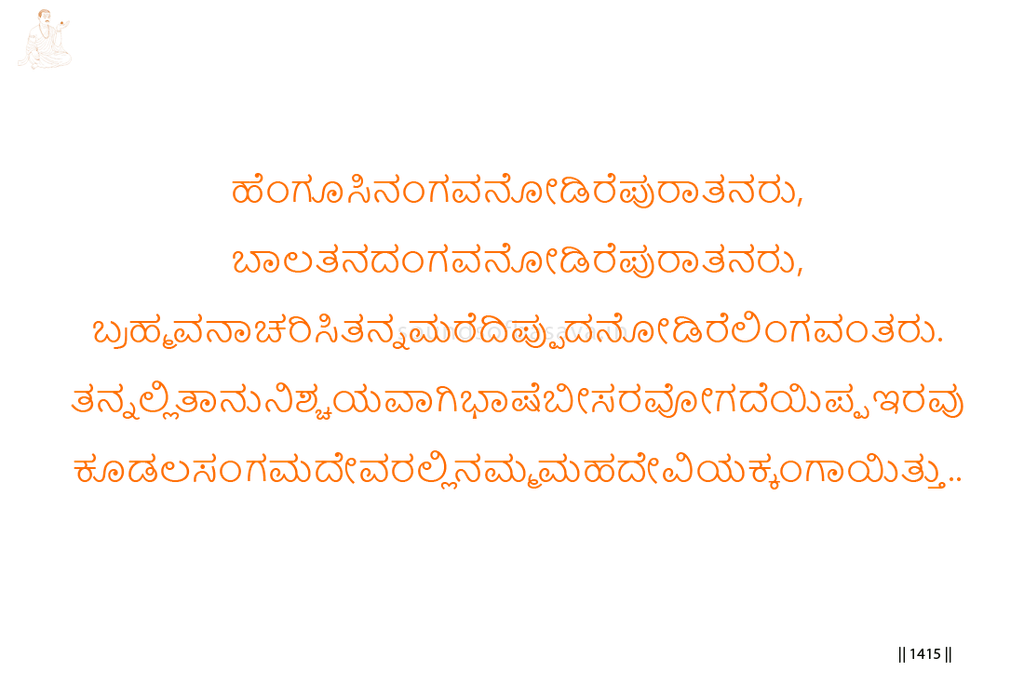
The realised elders behold Mahadeviyakka’s womanly Anga and recognise her. They behold the childlike innocence and transparency of her being and recognise her again.
The Lingavantas perceive the deeper truth: through living Brahma-Jnana, she has forgotten the separate self that seeks recognition, protection, and display.
Firmly established within herself, her speech does not become restless or scattered. Her awareness remains gathered in one certainty.
Such was Mahadeviyakka’s abiding state in Kudalasangama Deva.
Imagery & Symbolic Relevance
The Vachana moves through Mahadeviyakka’s womanly embodiment, her childlike simplicity, the recognition of the Puratanas and Lingavantas, the realization of Brahma, self-forgetting, inner certainty, disciplined speech, and her abiding in Kudalasangama Deva.
Mahadeviyakka’s Womanly Anga
Basavanna first directs attention toward Mahadeviyakka’s womanly Anga.
Her realised condition does not require the rejection of her embodied womanhood. The Divine truth shines through the Anga in which she lives.
The Puratanas—the ancient realised elders—recognise her spiritual stature through this embodied presence. Womanhood does not become a limitation placed upon realization; it becomes the living field in which her realization is visible.
The Childlike Anga
Basavanna then asks us to behold her childlike condition.
Childlikeness here signifies innocence, openness, simplicity, and freedom from calculated self-presentation. Mahadeviyakka does not construct an image of spiritual greatness for others to admire.
Her womanly maturity and childlike transparency remain together. She possesses the steadiness of realization without losing directness and purity of being.
The Puratanas recognise this quality because her simplicity is not ignorance. It is the natural transparency of one who no longer protects a separate identity.
The Recognition of the Puratanas
The Puratanas recognise Mahadeviyakka through what they behold.
Their recognition is not based upon social rank, inherited authority, verbal learning, or outward display. They discern the realised quality appearing through her Anga and conduct.
The repeated reference to their seeing gives the recognition a living basis. Her state is evident to those whose own vision has become mature.
The Recognition of the Lingavantas
The Vachana then turns from the Puratanas to the Lingavantas.
The Puratanas recognise the qualities visible in her embodied presence. The Lingavantas recognise the inward completion from which those qualities arise.
They see that Mahadeviyakka has lived Brahma-Jnana so completely that she has forgotten herself.
This is not loss of awareness. It is the ending of self-consciousness as a separate centre that continually says:
“I know”;
“I have attained”;
“I must be recognised”;
“This experience belongs to me.”
The Lingavantas recognise that the claimant behind realization has fallen away.
Realising Brahma
Mahadeviyakka does not merely speak about Brahma. She lives and realizes that truth.
Knowledge has entered her being so fully that it no longer stands apart as something she possesses. It has become the ground from which she abides.
The Vachana therefore joins realization and self-forgetting. When Brahma-Jnana becomes complete, there is no separate person left to display that knowledge as an achievement.
Forgetting Herself
Mahadeviyakka has forgotten herself.
The forgotten self is the constructed identity that measures, compares, claims, and seeks confirmation. Its disappearance leaves her free from the burden of continually referring experience back to herself.
She continues to live in embodied form, yet the thought of herself as an independent spiritual centre no longer governs her.
Her self-forgetting is therefore the freedom through which her true being becomes steady in Kudalasangama Deva.
Firmly Established Within Herself
Basavanna says that she remains certain and established within herself.
This certainty is not personal stubbornness or confidence in an isolated ego. It is the steadiness of one whose inward axis rests in realised truth.
She is not displaced by the judgments of others, by the conditions surrounding her, or by the need to explain herself. Her ground has become inwardly certain because her being is established in Linga.
She does not search outside herself for the confirmation of what has already become directly known.
Speech That Does Not Scatter
Her speech does not become dispersed, restless, or wasteful.
Words do not flow from anxiety, self-display, argument, or the desire to convince others of her realization. Speech remains rooted in the same certainty in which she abides.
This does not mean that she is defined merely by silence. Her speech has ceased to scatter awareness. When she speaks, the word arises from an established centre and remains aligned with truth.
Her language does not carry her away from herself.
Mahadeviyakka in Kudalasangama Deva
The concluding line places the whole state in Kudalasangama Deva.
Mahadeviyakka’s certainty, innocence, self-forgetting, and disciplined speech are not independent personal qualities. They belong to her realised establishment in the Lord.
Kudalasangama Deva remains the Divine ground. Mahadeviyakka remains the realised Sharana whose state Basavanna presents for recognition.
Her self-abidance is therefore also Linga-abidance. She rests within herself because no separate ground remains apart from Kudalasangama Deva.
Lingayoga
Lingayoga must bring the practitioner from self-conscious effort into inward certainty.
The body, speech, awareness, and conduct must cease moving in different directions. What is known before Linga must become the ground from which one lives and speaks.
The practitioner should observe how often speech arises from the desire to explain, defend, impress, or gain recognition. Gathered awareness gives rise to measured speech, while scattered identity produces scattered words.
Mahadeviyakka also reveals the union of maturity and innocence. Spiritual steadiness need not become hardness. As self-claim recedes, openness and simplicity return without weakening discernment.
The fulfilled state described here is recognised through natural abidance: the seeker no longer constructs a spiritual identity but lives from the certainty established by Linga.
Editorial Commentary
Heṅgūsina Anga indicates Mahadeviyakka’s womanly embodied form.
Bālatanada Anga indicates childlike innocence, simplicity, and transparency of being.
Puratanas are the ancient or realised elders capable of recognising spiritual maturity.
Lingavantas are those in whom Linga-awareness is established and who discern the inward state of realization.
Brahmavanācarisi indicates living, practising, and realising Brahma-Jnana rather than possessing conceptual knowledge alone.
Tanna maredippudu means forgetting the separate, self-conscious claimant.
Niścaya means settled certainty or unwavering inward establishment.
The expression concerning speech indicates language that does not become restless, wasteful, or dispersive.
Related Vachana
Supporting Vachana
Sharana Sthala Vachana 153 — The Threefold Wisdom
Sharana Vachana 153 rejects singing and skilful speech as sufficient measures of wisdom. The truly wise one trusts the Linga firmly, spends himself in service to Jangama, and cuts away attachment even while its force remains strong.
This prepares Vachana 1412 by moving wisdom from verbal expression into lived establishment.
What Sharana Vachana 153 defines through trust, service, and freedom from attachment becomes visible in Mahadeviyakka. Her knowledge has become life; the separate self has been forgotten; and her speech no longer scatters the awareness established in Kudalasangama Deva.
Advancing Vachana
Aikya Sthala Vachana 1415 — One Moment of Living Experience
Vachana 1412 reveals Mahadeviyakka established in Brahma-Jnana, free from self-conscious claim, and unwavering in Kudalasangama Deva.
Vachana 1415 advances this realised state into direct Sharana-Anubhava, declaring that one moment of living experience with Kudalasangayya’s Sharanas surpasses prolonged austerity, worship, and service.
Thus the realization embodied and recognised in Mahadeviyakka deepens into direct participation in the living Anubhava of the Sharanas.
