

Summary
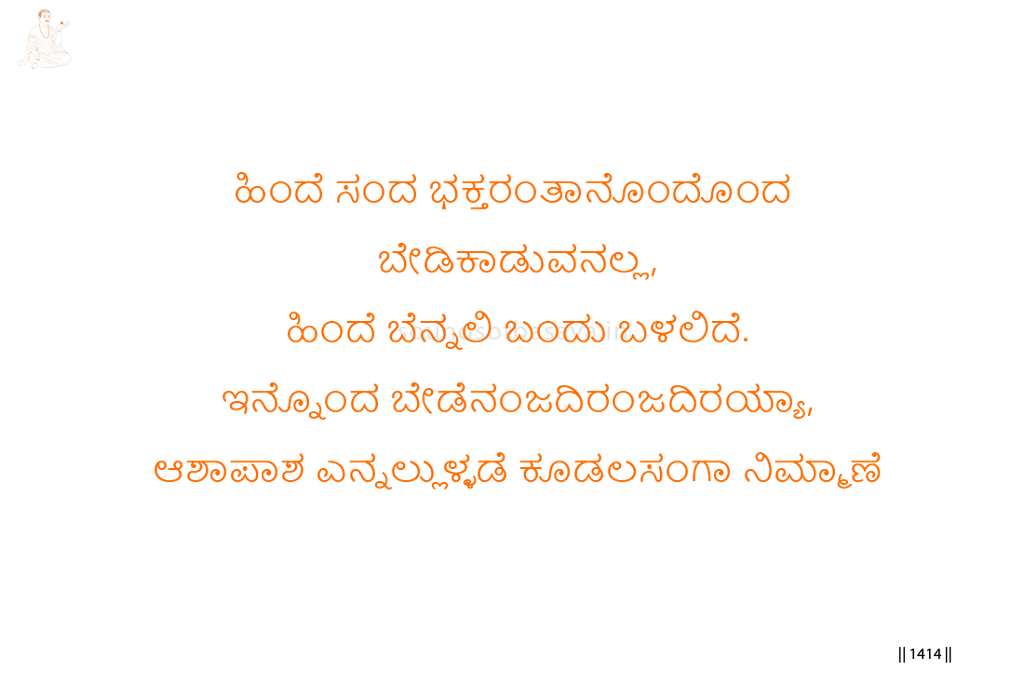
Basavanna says that he is not one who repeatedly troubles the Lord by asking for one thing after another.
He has already followed behind, asking and longing, and has grown weary of that movement. He now assures the Lord twice: “I shall ask for nothing more; do not fear, do not fear, O Ayya.”
He seals the declaration with an oath before Kudalasangama Deva: if any bond of desire or expectation still remains within him, the Lord’s own word is witness.
The Vachana reveals a devotion that no longer approaches the Divine through demand. Asking has ended because the bond that produces repeated asking has fallen away.
Imagery & Symbolic Relevance
The Vachana contains no material image. Its movement passes through repeated petition, weary following, the refusal to ask again, the repeated reassurance to the Lord, and the final oath concerning Āśā-pāśa.
Not One Who Keeps Asking
Basavanna begins by distinguishing himself from the one who asks for one thing after another and continually presses the Lord with requests.
Repeated asking preserves a transactional relation:
the devotee remains the petitioner;
the Lord remains the giver;
desire continually produces another request.
Even when one request is fulfilled, another may arise. The relation then remains governed by what is still wanted.
Basavanna says that this is no longer his way.
Following Behind and Growing Weary
He says that he has followed behind and become weary.
This weariness reveals the exhaustion contained within endless desire. The one who follows behind asking never truly arrives, because every fulfilled request gives way to another expectation.
Basavanna has passed through that movement and recognised its incompleteness. He no longer wishes to sustain devotion through pursuit and petition.
The weariness therefore becomes a turning point. What had moved outward through repeated asking now comes to rest before Kudalasangama Deva.
“I Shall Ask for Nothing More”
Basavanna does not replace one request with a greater or more spiritual request. He says that he will ask for nothing further.
The words carry finality. The movement of “one more thing” has ended.
This does not mean that Basavanna has withdrawn from the Lord. He continues to address Kudalasangama Deva directly and intimately. What has ceased is not relationship, but demand within the relationship.
He remains before the Lord without placing a condition upon Divine nearness.
“Do Not Fear, Do Not Fear, O Ayya”
The repeated reassurance gives the Vachana tenderness and intimacy.
Basavanna tells the Lord twice not to fear. The devotee who formerly followed behind with repeated requests now assures the Lord that no further demand will arise.
The repetition confirms the firmness of his declaration. He is not momentarily silent while secretly preserving another hope. He wishes the Lord to know that the asking itself has ended.
The relationship is no longer burdened by expectation.
Āśā-pāśa: The Bond of Desire
The final line names the source of repeated asking: Āśā-pāśa.
Āśā is hope, desire, longing, or expectation.
Pāśa is a bond, cord, or snare.
Āśā becomes a bond when fulfilment is always placed in something yet to be received. The mind remains tied to a future answer, gain, blessing, or condition.
Basavanna declares that this bond no longer remains within him.
The absence of Āśā-pāśa is not despair or loss of devotion. It is freedom from the expectation that Kudalasangama Deva must provide something further before the relationship can be complete.
“By Your Oath”
Basavanna seals his declaration with nimmāṇe—“by Your oath” or “Your word is witness.”
He places the truth of his inner condition before Kudalasangama Deva. If even a trace of the bond of desire remains, the Lord’s own word stands as the measure.
The oath prevents the declaration from becoming casual spiritual language. Basavanna does not merely say that he is content; he places the statement under the highest sacred witness.
The Vachana therefore concludes not with self-congratulation, but with accountability before Kudalasangama Deva.
Lingayoga
In Lingayoga, prayer may begin through need, longing, and request. Yet the practitioner must observe whether the Linga-relation remains dependent upon receiving desired outcomes.
The subtle test is the movement of “one more thing.” Even after worship, offering, and Prasada, the mind may continue to wait for another blessing, experience, recognition, or assurance.
The practice is not to suppress every need through force. Desire must be recognised, offered into Linga, and received back without bargaining. Prasada teaches the devotee to receive what comes without making expectation the condition of devotion.
The fulfilled state described here is beyond petition. The devotee remains intimately before Kudalasangama Deva, but nothing further is demanded to complete that nearness.
Editorial Commentary
Bēḍi kāḍuvanu indicates one who repeatedly asks and troubles or presses another through continual requests.
Baḷalide means that Basavanna has grown weary or exhausted through the former movement of following and asking.
Āśā-pāśa means the bond or snare created by desire, hope, and expectation.
Nimmāṇe means “by Your oath,” “by Your word,” or “You are witness.” It gives solemn force to Basavanna’s declaration that no bond of expectation remains.
The repeated “do not fear” must be preserved. It expresses the intimate assurance that Basavanna will not return with another demand.
Related Vachana
Supporting Vachana
Sharana Sthala Vachana 442 — The Warrior-Devotee
Sharana Vachana 442 declares that one who runs is not a warrior and one who begs is not a Bhakta. A true warrior does not flee, and a true Bhakta does not reduce devotion to begging. Basavanna concludes: “I shall not run; I shall not beg, O Kudalasangama Deva.”
This prepares Vachana 1410 exactly. In Sharana Sthala, Basavanna makes the vow not to beg. In Aikya Vachana 1410, that vow has ripened into an established condition: he no longer asks for one thing after another, and the bond of expectation itself has disappeared.
Advancing Vachana
Aikya Sthala Vachana 1010 — The End of Division, the Ocean of Bliss
Vachana 1410 ends repeated petition and the Āśā-pāśa that sustains it.
Vachana 1010 carries this inwardly further. The disturbance of “I want” and “I do not want” has ended; divided perception and the noise of speech subside; vision becomes unwavering; and Kudalasangama Deva removes the two karmas and makes Basavanna His abode.
The movement therefore deepens from asking for nothing to the ending of the inward division that produces both desire and rejection. What rests without petition in Vachana 1410 becomes uninterrupted Divine indwelling in Vachana 1010.
