

Summary
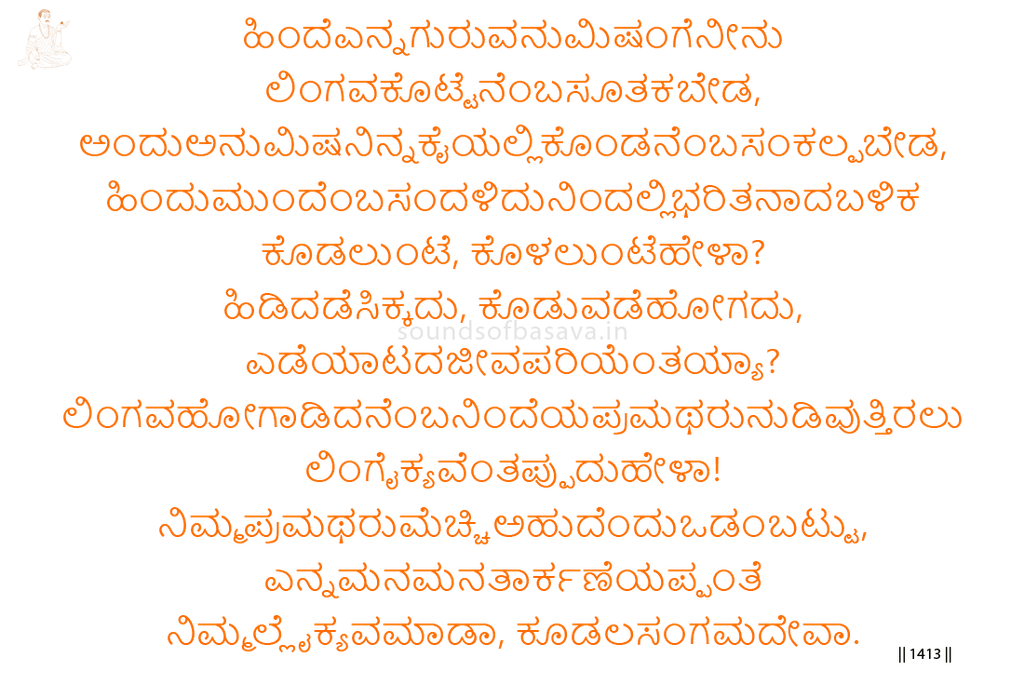
Basavanna asks that no defiling claim be made that Kudalasangama Deva once gave the Linga to his Guru Animiṣa. Nor should the mind construct a particular moment when Animiṣa received the Linga from the Lord’s hand.
When “before” and “after” have disappeared, every interval has ended, and Animiṣa has become filled with Kudalasangama Deva, who remains separately to give and who remains separately to receive?
The Linga is not property that can be secured by holding or lost by giving. Basavanna therefore asks what kind of life remains when no interval exists between Linga, Guru, and the one who receives.
Yet the accusation that Animiṣa abandoned the Linga continues to be spoken. Basavanna asks how Linga-Aikya can be understood while such a claim remains. He does not certify the realization by himself; he asks that Kudalasangama Deva’s Pramathas recognise and affirm it, that the debate within his mind cease, and that the Lord make him Aikya in Himself.
Imagery & Symbolic Relevance
The Vachana moves through the language of giving and receiving, the disappearance of temporal sequence, the paradox of possession, the accusation of abandoning Linga, the discernment of the Pramathas, and Basavanna’s final prayer for Aikya.
“You Gave the Linga to My Guru Animiṣa”
The first statement rejects the claim that Kudalasangama Deva gave the Linga to Animiṣa as one person gives an object to another.
Such language assumes three separate positions:
the giver;
the Linga that is transferred;
the receiver.
Basavanna calls this a sūtaka, a defiling conception. The impurity lies in turning the beginningless Linga-relation into an exchange between separate possessors.
Guru Animiṣa remains the one through whom the Linga is received and known, but the deepest truth of that relation cannot be contained by the language of ownership and transfer.
“On That Day He Received It”
The second statement rejects the sankalpa that, on a particular day, Animiṣa took the Linga from Kudalasangama Deva’s hand.
The phrase “on that day” places the relation within a sequence:
first the Linga was with the Lord;
afterward it came into Animiṣa’s possession.
Basavanna questions this construction because it treats Linga as absent before the event and newly acquired afterward.
The sacred act of bestowal remains meaningful within Guru-disciple practice. But in the realised vision of Aikya, the Linga cannot be reduced to something that begins to exist in the recipient only at a particular moment.
When Before and After Disappear
The decisive movement comes when “before” and “after” cease.
Temporal sequence depends upon difference: one condition precedes and another follows. When the interval between them disappears, the relation can no longer be described as a transaction moving from one separate centre to another.
Animiṣa is then described as filled with Kudalasangama Deva.
Fullness leaves no unoccupied distance between Lord, Linga, and Guru. What appeared in sequence is recognised within one uninterrupted sacred presence.
Who Gives and Who Receives?
Basavanna preserves the question:
Who is there to give, and who is there to receive?
He does not deny Guru, Linga, or the act of bestowal. He asks whether their deepest relation can still be understood through separate ownership once fullness has removed the interval between them.
The giver cannot stand outside the Linga.
The receiver cannot stand outside the Linga.
The Linga cannot become an object passing between them.
Giving and receiving remain visible as sacred acts, while their inward ground is non-separation.
What Is Held Cannot Be Possessed
Basavanna says that what is held does not become securely possessed.
The hand may hold the Ishtalinga, but holding does not make the Linga personal property. The Linga does not become “mine” merely because it rests in the palm or is borne upon the body.
Physical nearness and spiritual possession are not the same.
The line removes the claim that the Guru or Bhakta owns the Linga as an object under individual control.
What Is Given Does Not Depart
The reciprocal statement follows: when the Linga is given, it does not go away.
Ordinary giving separates the giver from what has been given. The object leaves one hand and enters another.
The Linga does not undergo such departure. The giver is not diminished, and the receiver does not obtain something that was previously absent from the Divine ground.
What is given remains inseparable from its source because Linga-presence cannot be divided through exchange.
The Life Without an Interval
Basavanna asks about the nature of the life in which no intervening distance remains.
This is not lifeless absorption. Guru Animiṣa continues as a living presence, yet his life is no longer understood as standing between a distant Lord and a separately possessed Linga.
The question points toward living non-separation: Linga is not intermittently present, newly acquired, or capable of departure.
Life itself proceeds within the uninterrupted relation.
“He Abandoned the Linga”
The accusation that Animiṣa abandoned or cast away the Linga reveals the same misunderstanding from the opposite direction.
Only something possessed as an object can be discarded as an object. If Linga is treated as external property, one may say that it was received, retained, lost, or abandoned.
Basavanna asks how Linga-Aikya can be understood while this accusation remains.
Aikya cannot be measured solely by outward possession or absence. Its truth concerns whether separation remains between Anga and Linga.
The Pramathas’ Recognition
Basavanna does not declare privately that his interpretation must be accepted.
He asks that Kudalasangama Deva’s Pramathas be pleased, recognise the truth, and say, “Yes, it is so.”
The realised community becomes the field of discernment. Linga-Aikya is not self-certified through personal reasoning or spiritual assertion.
The Pramathas recognise whether the apparent absence of external possession represents abandonment or whether it reveals a condition in which the distinction between possessor and possessed has ended.
The Debate Within the Mind
Basavanna acknowledges that argument continues within his own mind.
The questions concerning giving, receiving, holding, losing, and abandoning have not been resolved merely through clever explanation. He asks Kudalasangama Deva to end the mind’s divided reasoning.
This humility is essential. Basavanna does not turn a subtle teaching into personal certainty before receiving the affirmation of the Sharanas and the Lord’s grace.
“Make Me Aikya in You”
The final prayer places the agency entirely with Kudalasangama Deva.
Basavanna does not say, “I have become Aikya.” He asks the Lord to make him Aikya in Himself.
The Vachana therefore ends beyond both intellectual conclusion and personal claim. The Lord must resolve the division that the mind cannot settle and establish Basavanna in the reality toward which the questions point.
Lingayoga
Lingayoga begins through actual sacred relationship: Guru bestows Ishtalinga, the Bhakta receives it, holds it in the Karasthala, worships it, and bears it through life.
These acts must be honoured without turning the Linga into personal property. The practitioner should receive without claiming, worship without possessing, and offer without preserving the identity of giver.
The Vachana also requires respect for living Sharana-discernment. A subtle state cannot be established by private reasoning or by rejecting outward practice. Basavanna himself asks for the Pramathas’ affirmation.
The immediate discipline is therefore clear: remain faithful to Guru-given Linga, surrender ownership, avoid judging another’s realised relation through outward appearance alone, and allow the distinction between “I received” and “You gave” to be purified through lived worship and grace.
Editorial Commentary
Animiṣa is Basavanna’s Guru and remains a distinct named sacred agent in the Vachana.
Sūtaka here indicates the defiling conception created by speaking of Linga as transferable property between separate owners.
Sankalpa is the mental construction that fixes the timeless Linga-relation into a dated event of acquisition.
Bharita means filled or made full. Animiṣa is described as filled with Kudalasangama Deva after the distinction of before and after has ended.
Pramathas are Kudalasangama Deva’s realised Sharanas, whose recognition provides the living confirmation Basavanna seeks.
The accusation that Animiṣa “abandoned the Linga” must be read together with the questions concerning possession. The Vachana asks whether Linga can truly be acquired, owned, surrendered, or lost as an external object.
Related Vachana
Supporting Vachana
Sharana Sthala Vachana 1200 — The Illusion of “I Have Given”
In Sharana Vachana 1200, Basavanna exposes the claimant who survives within offering.
To say, “I have given my body,” creates distance from Guru-vachana. To say, “I have given my mind,” creates distance from Linga-mukha. To say, “I have given my wealth,” creates distance from Jangama-mukha. The claim, “I have done this for You,” restores the ego within surrender.
This prepares Vachana 1409 precisely. Sharana Vachana 1200 removes ownership from the giver: the one who says “I gave” has already reclaimed the offering.
Vachana 1409 carries that purification into Aikya. When the claimant who gives has disappeared, even the distinction between giver and receiver can no longer remain the final truth. Guru, Linga, bestowal, and receiving abide within one uninterrupted relation.
Advancing Vachana
Aikya Sthala Vachana 1185 — Knowing and Knowing Again
Vachana 1409 asks Kudalasangama Deva to end the debate within the mind and establish Basavanna in Linga-Aikya.
Vachana 1185 carries this beyond the last attempt to possess realization through thought or body. Remembrance becomes ever new; to know, there is no separate head, and to grasp, there is no separate body.
The movement advances from the ending of giver and receiver to the ending of the knower and possessor. Linga-Aikya cannot be owned by the mind as a conclusion or held by the body as an acquisition.
What remains is the Sharana’s ever-renewed knowing before Kudalasangama Deva—a recognition in which no separate claimant stands behind giving, receiving, knowing, or grasping.
