

Summary
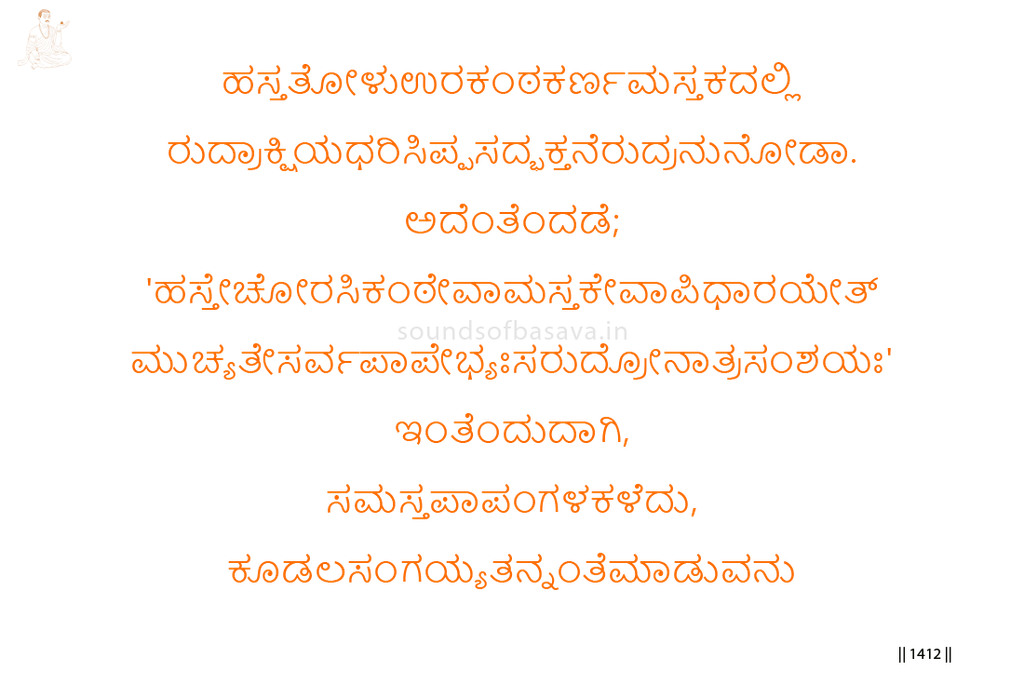
The true Bhakta bears Rudrakshi upon the hands, arms, chest, neck, ears, and head. The sacred sign thus encompasses the whole embodied person.
Basavanna asks us to behold such a Sadbhakta as Rudra. Every faculty has become consecrated, and the devotee’s embodied life now reveals the presence to which Rudrakshi belongs.
Kudalasangayya removes all sin and makes the devotee like Himself. The transformation is therefore the Lord’s work: complete consecration becomes Divine likeness through grace.
Imagery & Symbolic Relevance
The Vachana proceeds through the bodily places upon which Rudrakshi is borne, the recognition of the Sadbhakta as Rudra, the removal of sin, and Kudalasangayya’s act of making the devotee like Himself.
Rudrakshi upon the Hands
The hands are the faculties of action, giving, receiving, work, and service.
When Rudrakshi is borne upon them, action becomes visibly committed to the sacred relation. The hands no longer function as instruments of personal desire alone; they become capable of Kayaka and Dasoha.
The Rudrakshi marks action as belonging to Kudalasangayya.
Rudrakshi upon the Arms
The arms carry strength and undertake service.
Their consecration means that strength is placed within right conduct. Power becomes available for protection, support, work, and service rather than self-assertion.
The devotee’s strength now bears the sign of Rudra.
Rudrakshi upon the Chest
The chest is the inward field of feeling, courage, devotion, and resolve.
Rudrakshi upon the chest shows that Bhava has been brought into the Linga-relation. Devotion is held close to the life-centre and becomes firm rather than occasional.
The sacred sign reaches the devotee’s inward disposition.
Rudrakshi upon the Neck
The neck carries the voice and joins thought with spoken expression.
Its consecration brings speech under sacred discipline. What is understood inwardly must be expressed truthfully, and the Name of Shiva must govern the voice.
Speech becomes part of the devotee’s offering.
Rudrakshi upon the Ears
The ears receive teaching, praise, blame, truth, and falsehood.
Bearing Rudrakshi upon them signifies consecrated listening. The devotee becomes receptive to Guru, Linga, Jangama, and the speech of the Sharanas.
What is heard is no longer spiritually neutral; hearing becomes part of awareness and discernment.
Rudrakshi upon the Head
The head signifies understanding, judgment, remembrance, and governing awareness.
Rudrakshi upon the head places thought and knowledge under Kudalasangayya’s authority. The devotee’s understanding no longer establishes an independent centre apart from Linga.
With the head consecrated, the whole embodied being is gathered into one orientation.
The Whole Body Bearing Rudrakshi
The sequence extends across the complete person:
action through the hands;
strength through the arms;
Bhava through the chest;
speech through the neck;
receptivity through the ears;
understanding through the head.
Rudrakshi is therefore distributed across the whole Anga. No faculty is left outside the sacred commitment.
The bodily sign and the devotee’s lived condition correspond to one another.
“The Sadbhakta Is Rudra”
Basavanna then declares: behold, the Sadbhakta himself is Rudra.
The statement recognises the fulfilment of consecration. The devotee no longer bears Rudrakshi as a sign unrelated to life; the qualities of Rudra have become visible through the devoted Anga.
The Sadbhakta does not independently announce, “I am Rudra.” Basavanna beholds and identifies the transformed devotee.
The Divine likeness is received and revealed, not personally manufactured or possessed.
The Removal of All Sin
Kudalasangayya removes all sins.
Sin here includes the actions and inward formations that keep the faculties divided from their sacred purpose. When the hand, strength, feeling, speech, hearing, and understanding are turned toward Linga, the former direction of life loses its hold.
The removal is attributed to Kudalasangayya. The devotee’s consecration becomes complete through Divine grace.
Kudalasangayya Makes Him Like Himself
The final line gives the Lord complete agency:
Kudalasangayya makes him like Himself.
The devotee does not climb toward Divine likeness by self-power. Kudalasangayya purifies and forms him.
The earlier declaration that the Sadbhakta is Rudra and the final statement that Kudalasangayya makes him like Himself must remain together. Basavanna sees the Divine likeness already manifest in the consecrated devotee, while clearly identifying the Lord as the one who brought about that transformation.
Lingayoga
Lingayoga must include every faculty of embodied life.
The practitioner cannot reserve worship for the hand that holds Ishtalinga while allowing speech, listening, strength, feeling, and understanding to move in unrelated directions. The whole Anga must share one sacred orientation.
Rudrakshi becomes a continuous call to alignment:
action must serve;
strength must protect and support;
Bhava must remain devoted;
speech must be truthful;
hearing must be discerning;
understanding must remain centred in Linga.
The Divine likeness described here is the fruit of complete consecration and grace. Practice prepares it by ensuring that the sacred sign worn upon the body becomes truthful through conduct.
Editorial Commentary
Sadbhakta means the true or fully established Bhakta whose devotion has entered the whole of life.
Rudrakshi is the sacred emblem of Rudra borne upon the body. In this Vachana, its placement across the bodily faculties expresses complete consecration.
“The Sadbhakta is Rudra” identifies the Divine character revealed through the transformed devotee.
Samasta pāpa means the whole burden of sin or binding wrongdoing that Kudalasangayya removes.
Tannante māḍuvanu means “He makes him like Himself.” The likeness is bestowed by Kudalasangayya.
Related Vachana
Supporting Vachana
Sharana Sthala Vachana 1201 — The Plea at the Feet of the Sharana
Sharana Vachana 1201 places body, mind, and wealth in the service of Kudalasangama Deva’s Sharana. It also requires mind, speech, and body to know no other centre than the Lord.
This prepares Vachana 1403 through complete alignment. In Sharana Sthala, the faculties are consciously guarded against self-seeking and divided orientation. In Vachana 1403, this discipline has ripened visibly: the hands, arms, chest, neck, ears, and head all bear Rudrakshi, and the whole Anga reveals one sacred identity.
The earlier Vachana consecrates motive, speech, and conduct. Vachana 1403 beholds the resulting Sadbhakta as Rudra.
Advancing Vachana
Aikya Sthala Vachana 67 — The Indwelling Mountain
Vachana 1403 declares that Kudalasangayya removes all sin and makes the fully consecrated Sadbhakta like Himself.
Vachana 67 reveals the inward ground of this transformation. Basavanna addresses the Linga as complete in every quality and asks who can search for fault in him when that all-complete Linga abides within.
The Rudra-likeness of Vachana 1403 therefore deepens into indwelling presence. The devotee is not transformed because the natural vessel has independently produced Divine greatness; the all-complete Linga has become the governing presence within it.
What is visibly borne as Rudrakshi across the whole body in Vachana 1403 is inwardly established in Vachana 67 as the presence of the complete Linga.
