

Summary
Basavanna presents four sacred ornaments whose authority is greater than the bodily faculties upon which they are worn.
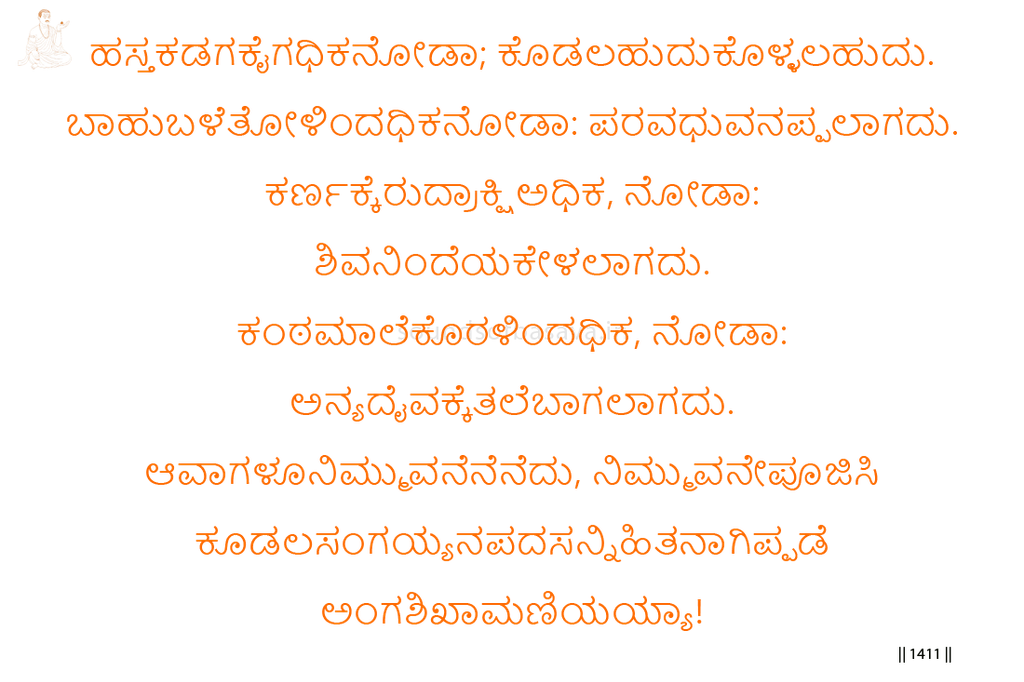
The bracelet governs the hand: it can give but cannot receive for personal gain. The armlet governs the arm: it cannot embrace another’s wife. The earrings govern the ears: they cannot listen to slander against Shiva. The neck-garland governs the neck: it cannot bow before another deity.
These adornments reveal a body whose action, strength, hearing, relationship, and allegiance have become consecrated.
Remembering and worshipping Kudalasangama Deva at all times, Basavanna remains forever near the Lord, the Linga-Shikhamani.
Imagery & Symbolic Relevance
The Vachana unfolds through four sacred ornaments. Each ornament is said to be greater than the bodily faculty it adorns because it governs how that faculty may act.
The Bracelet Greater Than the Hand
Basavanna first asks us to behold the bracelet upon the hand.
The bracelet is greater than the hand because the consecrated hand can give but cannot receive for personal acquisition.
Giving opens the hand toward Dasoha. Receiving for self-interest closes it around possession. The bracelet therefore marks the transformation of action from transaction into offering.
The hand remains active in the world, but its movement is no longer governed by bargaining, accumulation, or the expectation of return.
Its true adornment is generosity.
The Armlet Greater Than the Arm
The armlet is greater than the arm because the arm cannot embrace another’s wife.
The ornament governs bodily strength and intimacy. Power is not permitted to become desire, violation, or betrayal.
The line gives the Vachana a clear ethical dimension. Consecration to Linga must enter embodied relationship and sexual conduct. The arm cannot wear a sacred emblem while acting contrary to the fidelity that emblem requires.
The armlet therefore signifies disciplined strength, purity in relationship, and bodily integrity.
The Earrings Greater Than the Ears
The earrings are greater than the ears because the ears cannot listen to slander against Shiva.
Hearing is not passive. What is repeatedly received through the ears enters the mind, shapes feeling, and influences speech.
The consecrated ear does not welcome speech that insults Shiva or delights in hostility toward the sacred. It refuses to make itself the dwelling place of such words.
The earrings reveal discernment in listening. The ears remain open to truth, devotion, and the speech of the Sharanas, while refusing what turns awareness away from Shiva.
The Neck-Garland Greater Than the Neck
The garland is greater than the neck because the neck cannot bow before another deity.
Bowing expresses surrender, allegiance, and acceptance of authority. The consecrated neck has only one sacred centre.
Basavanna’s devotion is therefore undivided. His worship does not move among different refuges according to fear, gain, or circumstance.
The garland declares that the neck which bows to Kudalasangama Deva cannot bow elsewhere.
The Ornament Governing the Faculty
Each ornament is more than decoration:
the bracelet governs giving and receiving;
the armlet governs bodily strength and intimacy;
the earrings govern hearing;
the garland governs surrender and worship.
The sacred sign and the bodily faculty have become inseparable. The ornament continually recalls the discipline, while the conduct gives truth to the ornament.
Adornment has therefore become Achara.
Remembering Kudalasangama Deva at All Times
After the four bodily declarations, Basavanna names their inward source: continuous remembrance of Kudalasangama Deva.
The hand gives, the arm remains faithful, the ears refuse Shiva-slander, and the neck bows to no other because awareness remains centred in the Lord.
Remembrance is not one activity added to these disciplines. It is the inward continuity holding them together.
The whole body has become the embodied expression of one remembrance.
Worshipping You Alone
Basavanna worships Kudalasangama Deva alone.
The word “alone” completes the declaration made by the neck-garland. His action, relationship, hearing, and surrender all arise from one-pointed worship.
The Vachana does not divide ethical conduct from devotion. Fidelity in the body and fidelity in worship are expressions of the same undivided allegiance.
Forever Near
Through continuous remembrance and worship, Basavanna remains sadā sannihita—forever near.
This nearness is abiding intimacy with Kudalasangama Deva. It does not depend upon a particular place or appointed period of worship.
The body may continue through ordinary activities, but remembrance does not leave the Lord. Nearness has become continuous because every faculty remains governed by the sacred relation.
Linga-Shikhamani
Basavanna addresses Kudalasangama Deva as Linga-Shikhamani, the crest-jewel of Linga.
The name gathers the whole Vachana into the Lord. The ornaments worn upon the body receive their sacred meaning from the supreme jewel who is remembered and worshipped.
The bracelet, armlet, earrings, and garland adorn the devotee; Kudalasangama Deva is the incomparable adornment and sovereign centre of the devotee’s life.
Lingayoga
Lingayoga must enter the body’s actual faculties.
The hand must become capable of giving without turning every act into acquisition. Bodily strength and intimacy must remain faithful. Hearing must refuse slander and seek truthful speech. The head and neck must preserve undivided Divine allegiance.
These disciplines gather the scattered faculties into one Linga-centred life. Sacred ornaments then become living commitments rather than external marks alone.
Continuous remembrance is the inward thread joining them. As worship and conduct cease to separate, nearness to Kudalasangama Deva becomes constant rather than occasional.
Editorial Commentary
Hastakaḍaga means the bracelet worn upon the hand. Its discipline is giving without personal acquisition.
Bāhubale means the armlet. It governs the arm’s strength and its integrity in embodied relationship.
Karṇakuṇḍala means the earrings. They signify hearing consecrated to Shiva.
Kaṇṭhamāle means the garland or necklace worn upon the neck. It marks undivided surrender and worship.
The repeated statement that each ornament is greater than its bodily faculty means that the sacred commitment governs the faculty’s conduct.
Sadā sannihita means abiding forever near or in continuous Divine intimacy.
Linga-Shikhamani means the crest-jewel or crown-jewel of Linga and is an address to Kudalasangama Deva.
Related Vachana
Supporting Vachana
Sharana Sthala Vachana 1201 — The Plea at the Feet of the Sharana
Sharana Vachana 1201 asks that body, mind, and wealth be directed toward the Lord’s Sharana, and that mind, speech, and body know no centre other than Kudalasangama Deva.
It also guards against the first inward movement of self-claim—“I want”—through which what has been offered is quietly reclaimed for personal possession.
This prepares Vachana 1402 directly. What Sharana Vachana 1201 establishes as vigilance over body, mind, wealth, speech, and action becomes visibly embodied in the four sacred ornaments. The hand does not acquire, the arm does not violate fidelity, the ears do not receive Shiva-slander, and the neck does not bow before another deity.
The earlier discipline of knowing no other centre ripens into a body wholly adorned by undivided remembrance.
Advancing Vachana
Aikya Sthala Vachana 80 — No Other Refuge
Vachana 1402 shows every bodily faculty governed by sacred remembrance and one-pointed worship of Kudalasangama Deva.
Vachana 80 carries this consecration fully inward. Basavanna knows no other within his mind. “Om Namah Shivaya” has become both mantra and japa, and remembrance no longer stands apart as an act periodically performed by the devotee.
The four ornaments of Vachana 1402 preserve undivided allegiance throughout embodied life. In Vachana 80, that allegiance becomes the mind’s sole refuge, where the Name, its remembrance, and the Linga are no longer experienced as separate.
The state of remaining forever near therefore deepens into complete inward absorption in which even the ownership of remembrance is surrendered to Kudalasangama Deva.
