

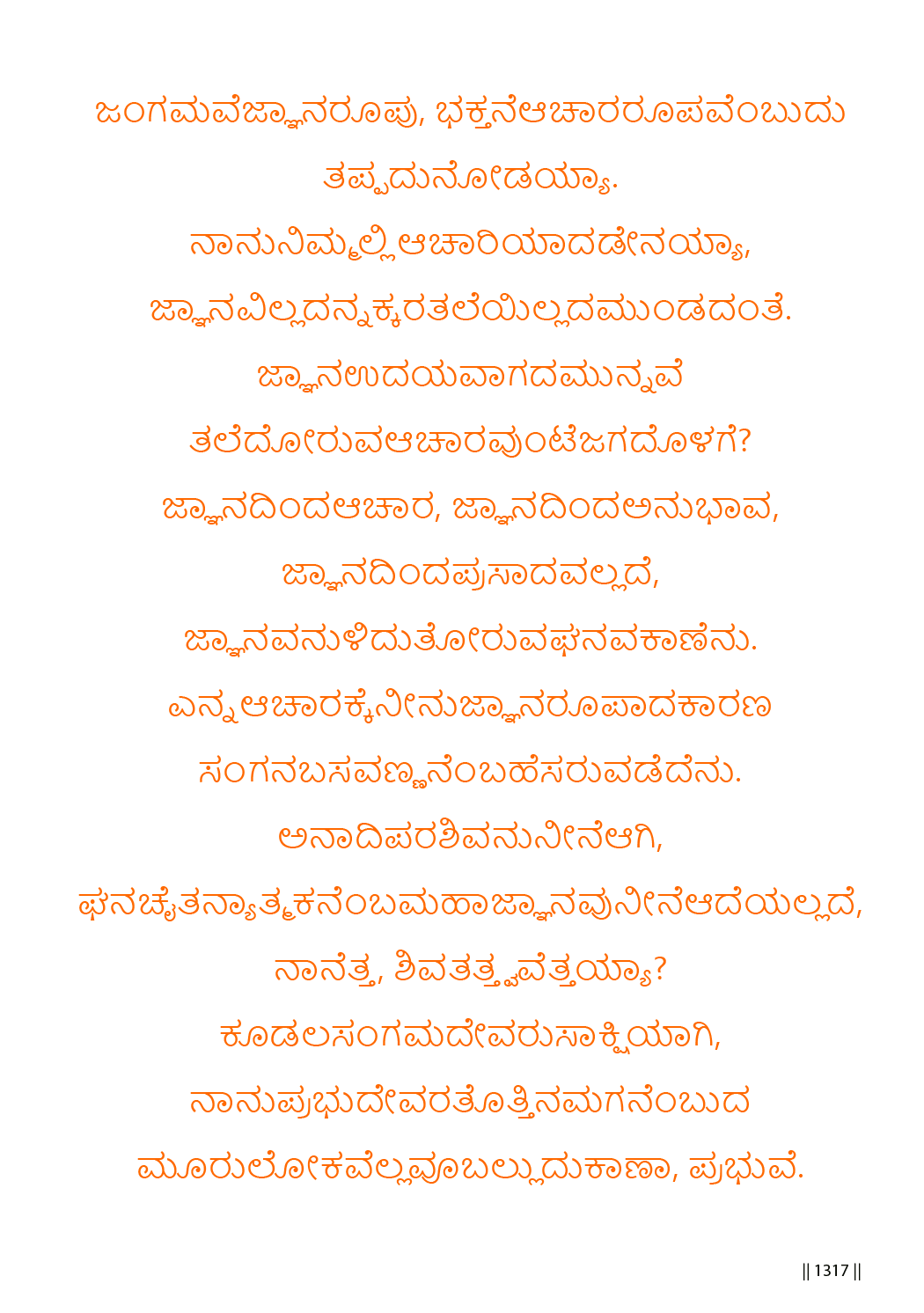
Summary
Basavanna declares that Jangama is the form of Knowledge and the devotee is the form of conduct. Conduct without Knowledge is like a body without a head.
True Achara, Anubhava, and Prasada arise from Knowledge. Because Prabhudeva became the Knowledge supporting Basavanna’s conduct, he came to bear the name Sangana Basavanna.
Basavanna recognizes Prabhudeva as the Beginningless Parashiva and the Great Knowledge of concentrated Consciousness. With Kudalasangama Deva as witness, he declares himself the spiritually nurtured son of Prabhudeva.
Imagery & Symbolic Relevance
The opening statement establishes a living relation:
Jangama is the form of Knowledge;
the devotee is the form of conduct.
Knowledge and conduct are distinct in function but inseparable in spiritual life. Knowledge gives direction and life; conduct makes that Knowledge visible.
Basavanna then asks what it would mean to become an Achari without Knowledge. His answer is the image of a body without a head. The body may remain outwardly formed, but it lacks the governing centre required for meaningful action.
The following question strengthens the image: can true conduct appear before Knowledge dawns? The implied answer is no. Conduct that precedes awakened understanding may be habit, imitation, rule, or display, but it is not the Achara described here.
The repeated phrase “from Knowledge” governs the central movement:
from Knowledge comes Achara;
from Knowledge comes Anubhava;
from Knowledge comes Prasada.
Achara is lived conduct. Anubhava is direct spiritual experience. Prasada is sacred fulfilment received through grace. Basavanna refuses to treat these as separate achievements. They arise from one source.
He therefore says that apart from Knowledge he sees no greatness worth revealing. External conduct, claimed experience, or possession of Prasada cannot establish spiritual fullness when their living source is absent.
The address then becomes personal. Prabhudeva became the form of Knowledge for Basavanna’s conduct. Basavanna’s Achara is therefore not self-created; it receives direction and life through the realized Jangama.
The name Sangana Basavanna expresses this relation. His identity is not presented as an independent title. It is formed through Knowledge received in the living field of Prabhudeva and witnessed by Kudalasangama Deva.
Basavanna then recognizes Prabhudeva as Anādi Parashiva and Mahājñāna of Ghanachaitanyātma. Anādi means beginningless. Ghana conveys concentrated, undispersed fullness; Chaitanya is living Consciousness. Prabhudeva is thus recognized as the living embodiment of beginningless Knowledge.
The questions, “Without You, where am I? Where is Shiva-tattva?” remove independent identity and self-produced understanding. Without the Jangama who embodies Knowledge, Basavanna does not claim either spiritual stature or knowledge of Shiva-tattva.
The conclusion preserves the roles clearly. Kudalasangama Deva is witness. Basavanna is the spiritually nurtured son. Prabhudeva is the one who nurtured him through Knowledge.
The final “Prabhuve” addresses Prabhudeva in this context. The preceding declaration specifically names Basavanna as Prabhudeva’s nurtured son.
Lingayoga
This vachana places Knowledge before authentic conduct.
Lingayoga practice cannot be validated by outward discipline alone. Worship, Achara, service, Karasthala practice, or reception of Prasada must arise from awakened understanding rather than habit or self-claim.
The relation between Jangama and devotee is central. Jangama is not merely an external teacher or recipient of service. Here Jangama is the living form of Knowledge through whom the devotee’s conduct receives direction.
The practitioner must therefore examine whether conduct arises from:
awakened Knowledge;
imitation and convention;
fear of criticism;
pride in religious identity;
desire for spiritual recognition.
Knowledge in this vachana is not accumulated information. It is living Consciousness expressed through Prabhudeva. When it becomes active in the devotee, it appears as Achara, matures as Anubhava, and is received as Prasada.
The practical movement is to allow knowledge and conduct to remain inseparable. Knowledge must become lived action, and action must never lose its root in Knowledge.
Editorial Commentary
The Kannada does not say merely that Jangama possesses knowledge. It says that Jangama is the form of Knowledge.
Likewise, the devotee does not merely perform conduct. The devotee becomes the form through which Knowledge appears as Achara.
The body-without-a-head image concerns direction and living coherence. It does not condemn the body; it shows the incompleteness of conduct separated from its governing Knowledge.
Ghanachaitanyātma indicates living Consciousness in concentrated, undispersed fullness. It should not be reduced to intellectual knowledge.
The roles remain distinct:
Prabhudeva — Jangama, Knowledge-form, and spiritual nurturer;
Basavanna — devotee, conduct-form, and nurtured son;
Kudalasangama Deva — Divine witness.
The statement that Prabhudeva is Anādi Parashiva expresses Basavanna’s recognition of the realized Jangama. It does not merge the grammatical roles of Prabhudeva and Kudalasangama Deva.
Related Vachana
Supporting Vachana
Sharana Sthala Vachana 656 — The Hollow Conduct
Sharana Vachana 656 asks what value Achara and Shivachara possess when delusion remains unrecognized. Shiva-thought and claimed Shiva-knowledge do not make conduct true if inward confusion has not been removed.
This prepares Vachana 1189 directly. Vachana 656 exposes conduct that has lost its living root. Vachana 1189 identifies that root as Knowledge embodied in Jangama.
The movement is precise:
Vachana 656 tests whether conduct is inwardly true.
Vachana 1189 states that true conduct cannot precede Knowledge.
What appears hollow in Sharana becomes knowledge-born Achara in Aikya.
Achara, Anubhava, and Prasada are gathered into one living source.
Advancing Vachana
Aikya Sthala Vachana 1204 — The Natural One Beyond Self
Aikya Vachana 1204 describes the sahaja sujñāni, the natural knower who acts and gives without selfhood. Action continues, but no separate doer claims it. Giving continues, but possessiveness has ended.
Vachana 1189 establishes that conduct arises from Knowledge. Vachana 1204 advances this into natural action in which Knowledge and conduct no longer appear as separate stages.
The progression is exact:
Vachana 1189 joins Knowledge with Achara, Anubhava, and Prasada.
Vachana 1204 shows that union functioning naturally.
The knower acts without claiming authorship.
Knowledge has become spontaneous conduct, and conduct no longer creates a separate self.
Speech finally reaches its limit in the gathered state before Kudalasangama Deva.
What begins as knowledge-directed Achara in Vachana 1189 matures in Vachana 1204 as effortless action and giving without selfhood.
