

Summary
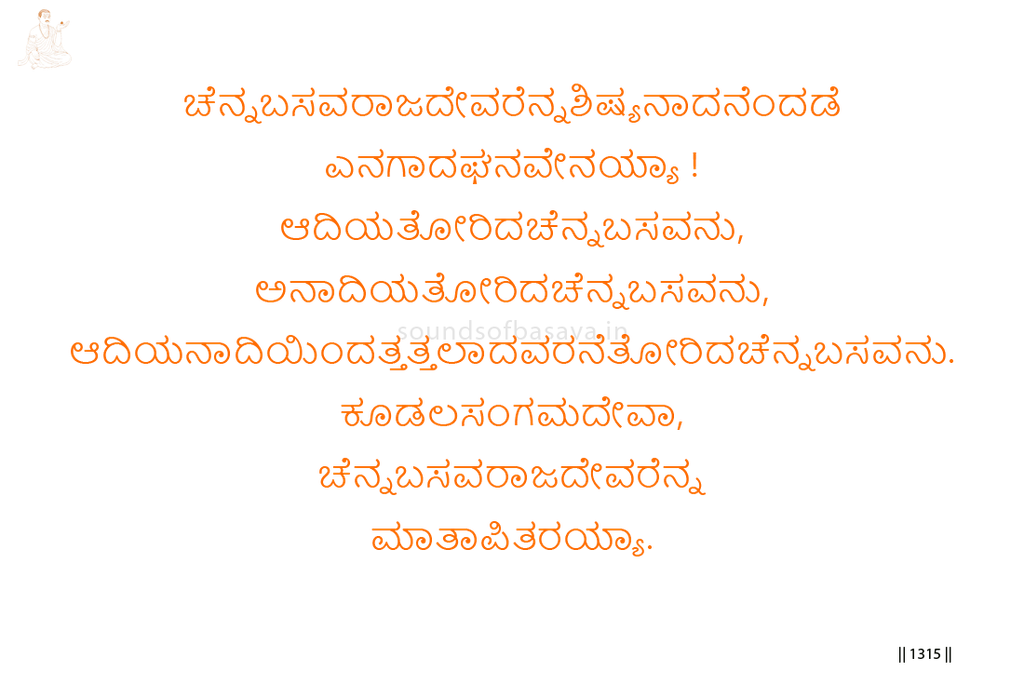
Basavanna asks what greatness has come to him through becoming the disciple of Chennabasavaraja Deva. That greatness does not lie in rank or personal attainment, but in what Chennabasavanna revealed.
He revealed Ādi, the Beginning; Anādi, the Beginningless; and finally the One beyond both beginning and beginninglessness.
Basavanna therefore declares before Kudalasangama Deva that Chennabasavaraja Deva is his mother and father—the Guru through whom he received spiritual birth, direction, and recognition.
Imagery & Symbolic Relevance
The opening question establishes the disciple–Guru relationship. Basavanna does not claim independent greatness. Whatever fullness has come to him has come through Chennabasavanna’s revelation.
The word ghana indicates greatness, fullness, or spiritual dignity. It does not suggest social superiority. Basavanna’s greatness lies in having been shown what could not be reached through self-claim.
The repeated phrase “Chennabasava revealed” governs the vachana. Chennabasavanna remains the acting subject, while Basavanna receives the revelation.
The movement unfolds in three stages:
Ādi — the Beginning, the point from which arising or manifestation is understood;
Anādi — the Beginningless, that which has no temporal origin;
that which is beyond both Ādi and Anādi.
The final movement is decisive. Reality is not confined either to having a beginning or to being beginningless. “Beyond both” does not indicate another point in time; it removes the adequacy of the entire contrast.
The Kannada therefore moves from origin, to beginninglessness, and then beyond both categories. Basavanna does not attribute this recognition to reasoning, ritual, or personal yogic achievement. Chennabasavanna showed it.
The address to Kudalasangama Deva preserves the distinction between Guru and Lord. Chennabasavanna does not create the Reality revealed, nor does he replace Kudalasangama Deva. He is honoured as the Guru through whom that Reality became known.
The concluding words “mother and father” express complete spiritual parenthood. A mother gives birth and nurtures; a father protects, directs, and sustains. Chennabasavanna becomes both to the disciple because his revelation gives Basavanna new spiritual birth and orientation.
This parenthood is not biological. It expresses gratitude for the Guru who revealed Ādi, Anādi, and the One beyond both.
Lingayoga
This vachana preserves the essential role of Guru-revelation in Lingayoga.
Practice, worship, Karasthala discipline, sacred learning, or breath-regulation may prepare the seeker, but they do not independently produce the recognition described here. Basavanna attributes the revelation directly to Chennabasavanna.
Knowing the terms Ādi and Anādi conceptually is not the same as receiving what the Guru reveals. The Guru shows the Reality that cannot be confined within either category.
The disciple must therefore remain receptive and without ownership. What is revealed must not later be claimed as personal discovery, intellectual mastery, or self-produced Aikya.
The Guru does not create an absent Linga. He reveals what the disciple could not recognize through separate effort.
The practical movement is:
acknowledge the true source of recognition;
do not convert Guru-revealed understanding into personal achievement;
do not reduce Ādi, Anādi, or “beyond both” to conceptual possessions;
preserve gratitude toward the Guru who gives spiritual birth and direction.
Aikya does not erase gratitude. Basavanna’s recognition deepens his reverence for Chennabasavanna.
Editorial Commentary
Ādi means beginning or primal commencement.
Anādi means beginningless—without an originating point in time.
The Kannada then moves beyond both. This must not be reduced to saying that Reality is merely ancient or endless. The line shows that neither beginning nor beginninglessness can finally contain the One revealed.
The repeated verb “revealed” must be preserved. Chennabasavanna does not create the Reality; he reveals it.
The roles are distinct:
Chennabasavanna — Guru and revealer;
Basavanna — disciple and recipient;
Kudalasangama Deva — the Lord before whom the declaration is made.
Calling Chennabasavanna “mother and father” expresses complete spiritual dependence and gratitude. It does not make him the parent of Kudalasangama Deva or replace the Lord.
The approved title mentions the Beginningless Source, but the Kannada movement is broader: Ādi, Anādi, the One beyond both, and the concluding recognition of Chennabasavanna as spiritual mother and father.
Related Vachana
Supporting Vachana
Sharana Sthala Vachana 600 — The True Guru of All
Sharana Vachana 600 rejects spiritual authority based merely on learning, ritual status, or birth. It declares the Sharana of Kudalasangama Deva to be the true Guru.
This prepares Vachana 1187 directly. Basavanna does not honour Chennabasavanna because of lineage or office, but because he revealed Ādi, Anādi, and the One beyond both.
What Sharana Vachana 600 establishes as the nature of the true Guru becomes personal testimony in Vachana 1187. The realized Sharana becomes the Guru who gives spiritual birth; therefore Chennabasavaraja Deva is called mother and father.
Advancing Vachana
Aikya Sthala Vachana 1045 — Beyond the Notions of Possible and Impossible
Aikya Vachana 1045 states that Linga cannot be treated as something attainable either in Ādi or Anādi. The ideas of “possible” and “impossible” still preserve a seeker standing apart from Linga.
The vachana advances into uninterrupted fullness, where difference no longer remains and Pranalinga is recognized as Kudalasangama Deva Himself.
The progression is precise:
Vachana 1187 reveals Ādi, Anādi, and the One beyond both through Chennabasavanna.
Vachana 1045 removes the remaining seeker–goal division.
What was revealed by the Guru becomes lived as uninterrupted Linga-presence.
Difference, the seed of further Bhava, no longer stands.
Thus Vachana 1045 completes the movement from Guru-revealed understanding to direct Aikya recognition.
