

Summary
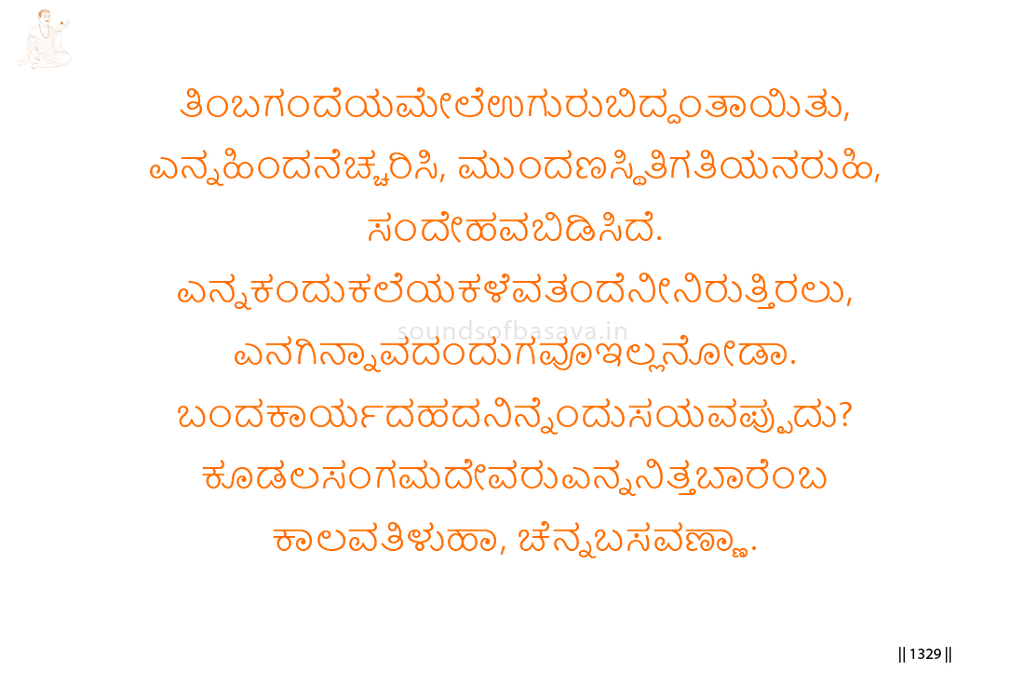
Chennabasavanna awakened Basavanna to what lay behind him, revealed the condition ahead, and removed his doubt.
Basavanna calls him the father who removes his inner deficiency. With such a father present, no further burden troubles him.
He asks when the work for which he has come will reach its proper completion and requests Chennabasavanna to reveal the time when Kudalasangama Deva will call him, saying, “Come.”
Imagery & Symbolic Relevance
The opening comparison is to pressure falling upon a swollen sore. What had remained painfully enclosed is forced open. The image introduces the relief that follows Chennabasavanna’s intervention.
Chennabasavanna first makes Basavanna aware of what lies behind. This is not mere recollection of past events; the past is brought into clear understanding so that it no longer governs him through unrecognized doubt.
He then reveals the future state and course. Basavanna is not left looking backward alone. Chennabasavanna shows the direction in which his life and spiritual work are moving.
Through this twofold revelation—clarifying what lies behind and showing what lies ahead—doubt is released. Chennabasavanna acts throughout as the revealer; Basavanna receives the understanding.
The address “father” expresses guidance, protection, correction, and care. Chennabasavanna removes the deficiency that had prevented Basavanna from standing without uncertainty.
Because the father remains present, Basavanna says that no further danduga—burden, affliction, or troubling difficulty—remains for him. The assurance comes from relationship, not from a claim of independent strength.
The next question concerns the work that has come. Basavanna recognizes that his life carries an entrusted purpose. He asks when that work will attain its proper ripeness and completion.
The final movement places completion entirely under Kudalasangama Deva. Basavanna does not decide for himself when the work is finished. He asks Chennabasavanna to make known the time when the Lord will say, “Come.”
The vachana therefore moves from painful uncertainty, through revelation and fatherly assurance, to readiness for the Lord’s call.
Lingayoga
In Lingayoga, uncertainty cannot be removed merely through personal speculation. The seeker requires the realized Guru-Sharana who can clarify the movement already lived and reveal the direction ahead.
Chennabasavanna’s role is not to replace Kudalasangama Deva. He prepares Basavanna to recognize the Lord’s will and the proper completion of the work entrusted to him.
The practical movement is:
• allow the past to be clarified rather than unconsciously carried;
• receive guidance concerning the state ahead;
• do not claim that spiritual work is complete by personal judgment;
• remain ready for Kudalasangama Deva’s call without attempting to determine its time.
The final line does not encourage escape from embodied life. Basavanna remains committed to the work that has come until it reaches its proper fulfilment.
Editorial Commentary
The opening bodily comparison expresses the painful release of what had accumulated. It should not be enlarged into an independent medical symbolism.
Sthiti-gati refers to the condition and course ahead. Chennabasavanna reveals both the state and its movement.
The expression concerning Basavanna’s inner deficiency indicates something that diminishes or clouds him. Chennabasavanna removes it through guidance and revelation.
Danduga carries the sense of burden, affliction, or troubling difficulty.
The “work that has come” is the entrusted work of Basavanna’s life. The Kannada asks about its proper ripening or completion, not about abandoning it unfinished.
Kudalasangama Deva is the one who will call. Chennabasavanna is the father and guide asked to reveal that time. Their roles must remain distinct.
Related Vachana
Supporting Vachana
Sharana Sthala Vachana 1337 — Show Me the Difference Between Prana and Prana-Linga
In Sharana Vachana 1337, Basavanna admits that he has not understood the living relation between his Prana and Prana-Linga. Outward worship has not removed the uncertainty, so he asks Chennabasavanna to show the distinction directly.
This prepares Vachana 1206. The Sharana vachana presents the unresolved question and the appeal for revelation. In Vachana 1206, Chennabasavanna has awakened Basavanna, shown the course ahead, and removed doubt.
What begins as a request to be shown becomes, in Aikya, gratitude toward the father who has revealed and clarified.
Advancing Vachana
Aikya Sthala Vachana 1154 — The Revelation of Linga-Aikya
Aikya Vachana 1154 shows Chennabasavanna establishing the Fivefold Achara, making the experiential path of Shatsthala firm, revealing Prana-Linga and Linga-Prana, removing delusion, and showing Linga-Aikya.
Vachana 1206 presents Chennabasavanna as the father who clarifies past and future, removes doubt, and prepares Basavanna for the completion of his entrusted work.
Vachana 1154 reveals the fuller content of that guidance:
• uncertainty is removed through clear revelation;
• the path is firmly established;
• the living Linga–Prana relation becomes known;
• the movement reaches Linga-Aikya.
Thus the fatherly guidance of Vachana 1206 advances into the completed revelation of Linga-Aikya before Kudalasangama Deva.
