

Summary
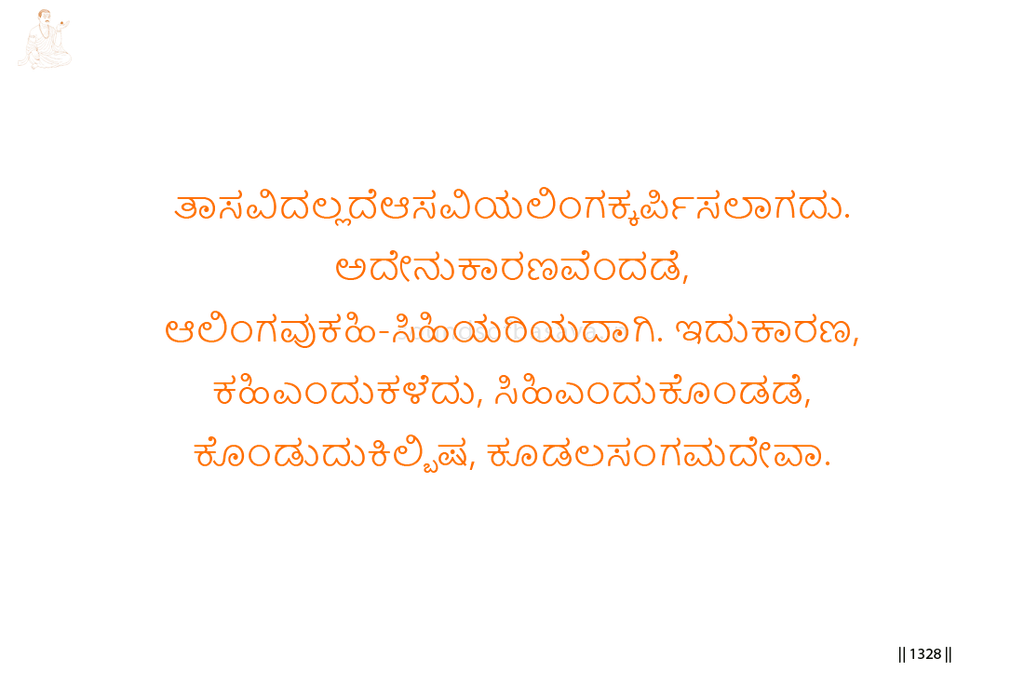
Basavanna states that a taste cannot be offered to the Linga unless one has personally tasted it. Sacred offering cannot arise from borrowed knowledge or an experience not inwardly known.
The Linga does not distinguish between bitter and sweet. Therefore, rejecting something as bitter and accepting another as sweet preserves preference and division.
The fault lies in this selective taking before Kudalasangama Deva.
Imagery & Symbolic Relevance
Taste is the governing image. Taste cannot be transferred through description alone; it must be directly experienced. Basavanna therefore places personal tasting before offering.
The first negative is exact: without tasting, that taste cannot be offered to the Linga. One cannot present hearsay, imitation, or another person’s experience as one’s own sacred offering.
The rhetorical question—“What is the reason?”—leads to the nature of the Linga: the Linga does not know bitter and sweet.
This does not mean that the Linga lacks awareness. It means that the Linga is not governed by the preference that accepts one taste and rejects the other.
Bitter and sweet are distinguishable in ordinary experience. The problem begins when the devotee casts away the bitter merely because it is bitter and takes the sweet merely because it is sweet.
The final word, kilbiṣa, identifies this selective taking as fault or transgression. The Kannada does not say that sweetness itself is faulty. The fault lies in receiving according to preference while offering to the Linga who makes no such distinction.
The vachana therefore moves through four clear steps:
• one must personally taste;
• only then can the taste be offered;
• the Linga does not distinguish bitter and sweet;
• preference-based rejection and acceptance become fault.
Lingayoga
In Lingayoga, the practitioner must bring the actually lived condition before the Linga rather than offer borrowed understanding.
Practice becomes selective when pleasant experiences are accepted as spiritually valuable while painful or difficult experiences are excluded. Such selection allows personal preference to govern the offering.
The practical movement is direct:
do not claim an experience that has not been personally known;
do not present borrowed knowledge as Anubhava;
do not offer only what appears pleasant;
do not reject an experience merely because it is bitter;
place the whole lived condition before the Linga without preference-based division.
This does not erase ordinary discernment. The vachana addresses the distinction made through personal attraction and aversion—discarding one taste and possessing the other.
Editorial Commentary
Savi means taste or flavour. In this vachana, it also carries the force of something directly experienced rather than merely described.
The statement that Linga does not know bitter and sweet means that Linga is not governed by selective preference. It must not be translated as ignorance or sensory incapacity.
Kaḷedu means casting away or rejecting.
Koṇḍaḍe means taking, accepting, or holding.
Kilbiṣa means fault, offence, or transgression. It must not be rendered as “poison.”
The fault belongs to the selective act of rejecting bitter and taking sweet, not to either taste by itself.
Related Vachana
Supporting Vachana
Sharana Sthala Vachana 1391 — Beyond Sweetness and Blows
Sharana Vachana 1391 asks why happiness should create attachment, why sorrow should cause agitation, why sweetness should be clung to, and why one should flee when blows come.
Its concluding question places the Sharana within the role given by Kudalasangama Deva. The role must be lived without attachment to what pleases and without escape from what hurts.
This prepares Vachana 1205 directly. Sharana Vachana 1391 disciplines the movements of clinging and fleeing. Aikya Vachana 1205 reveals their deeper fault: the Linga does not distinguish bitter and sweet, and selective acceptance cannot become a complete offering.
What is practised in Sharana as steadiness amid opposites becomes, in Aikya, offering without preference.
Advancing Vachana
Aikya Sthala Vachana 1153 — Beyond Distinctions, Into Grace
Aikya Vachana 1153 removes distinctions based on caste, self-asserted status, and social standing. Those who come must be received equally, without dividing them as “this one” and “that one.”
It also declares that Kudalasangama Deva bears both the formless and formed modes. Rejecting one while holding only the other is a deficiency.
Vachana 1205 removes selection between bitter and sweet in what is offered to Linga. Vachana 1153 advances the same recognition into sacred relationship:
experiences are not divided by personal preference;
those who come are not divided as greater and lesser;
the formed and formless are not divided through exclusive attachment.
The freedom from selective taste in Vachana 1205 thus deepens into equal reception and undivided recognition before Kudalasangama Deva.
