

Summary
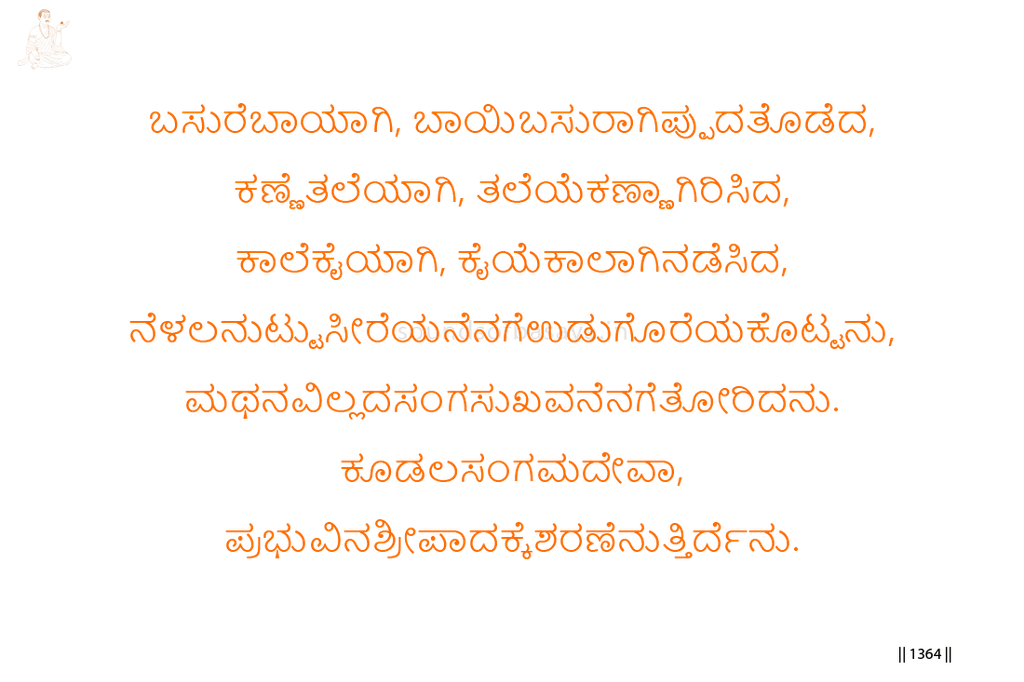
Prabhudeva overturns Basavanna’s fixed order of perception. He removes the distinction between womb and mouth, makes the eye function as the head and the head as the eye, turns the feet into hands and the hands into feet, and leads Basavanna onward.
He gives Basavanna, as a gift, a sari of shadow—a covering that has presence without solid substance, protects without enclosing, and accompanies without possessing. He then reveals the bliss of union free from mathana—churning, agitation, or inward conflict.
Addressing Kudalasangama Deva, Basavanna declares that he has taken refuge at Prabhudeva’s sacred feet. Prabhudeva is the transforming and revealing agent; Basavanna’s response is surrender.
Imagery & Symbolic Relevance
The Womb and the Mouth
The vachana begins by overturning the normal distinction between two functions:
the womb, where life is inwardly conceived and formed;
the mouth, through which what is within becomes expression.
Prabhudeva removes their fixed separation. The inward source becomes expression, and expression becomes capable of bearing and forming inward truth.
This is not an anatomical change. It reveals that realization and expression can no longer remain divided. What is conceived inwardly must become truthful speech, while speech must arise from the depth in which sacred understanding is formed.
Prabhudeva, not Basavanna, performs this reversal.
The Eye and the Head
The eye ordinarily sees, while the head interprets and directs. Prabhudeva makes the eye the head and the head the eye.
Direct seeing now guides understanding. At the same time, thought must become capable of seeing rather than merely arranging inherited ideas.
The reversal does not reject knowledge. It changes its order. Understanding must follow realized seeing instead of forcing Anubhava to conform to previously established concepts.
The Feet and the Hands
The feet carry the person forward, while the hands perform action. Prabhudeva makes the feet into hands and the hands into feet and leads Basavanna.
Movement becomes sacred action, and action itself becomes the path. What Basavanna does can no longer be separated from where Prabhudeva is leading him.
The concluding action is essential: Prabhudeva leads him. Basavanna does not claim to have discovered or constructed the path independently.
The Sari of Shadow
Prabhudeva gives Basavanna, as a gift, a sari of shadow.
This is one indivisible image. The shadow and the sari are not two separate gifts or actions. The sari itself is constituted by shadow.
Shadow is shade—the absence of direct light rather than darkness. It has a discernible presence, yet it is not an independently solid thing. It accompanies form but cannot be possessed as material substance.
The sari of shadow is therefore a presence that is also absence, and a covering that is not an object.
To wear this shadow-sari is:
to be protected without being armoured;
to be covered without being concealed;
to be accompanied without being possessed;
to be sheltered without being confined.
The gift is not a reward added after transformation. The shadow itself is the gift. Prabhudeva gives Basavanna a form of grace that does not become another visible possession or outward spiritual distinction.
One clothed in shadow does not stand forth through the glare of a proclaimed devotional identity. The devotee is not displayed through self-assertion, rank, costume, or public brightness. What is perceived is the absence of such glare—the quiet shade produced when the separate self no longer demands to be seen.
The image therefore continues the earlier reversals. Just as the normal functions of womb and mouth, eye and head, feet and hands are overturned, the ordinary meaning of clothing is transformed. A garment usually makes a person visibly identifiable; this garment removes the glare of visible self-identification.
The shadow-sari is grace that remains near without becoming an object of ownership.
Sanga-Sukha Without Mathana
Prabhudeva reveals mathanavillada sanga-sukha—the bliss of union without churning.
Mathana carries the meaning of churning, agitation, turmoil, or the friction of opposing inward movements.
The bliss is not reached by forcing the mind through continued struggle. The reversals performed by Prabhudeva have removed the established order that produced the conflict.
The shadow-sari prepares this condition. Where the devotee no longer seeks visible identity or spiritual glare, the agitation of self-display and self-certification subsides. Union can then be revealed without the mind churning over its own attainment.
Basavanna does not say that he produced this bliss. Prabhudeva showed it to him.
Refuge at Prabhudeva’s Sacred Feet
The concluding grammar must remain exact.
Basavanna addresses Kudalasangama Deva, but he declares that he has taken refuge at Prabhudeva’s sacred feet.
Kudalasangama Deva is the Divine ground before whom the testimony is offered. Prabhudeva is the realized Sharana and Guru who reverses, leads, gives the shadow-sari, and reveals union without churning.
The vachana preserves both relations without confusing their roles.
Lingayoga
In Lingayoga, realization does not merely add spiritual knowledge to the seeker’s existing order. The manner in which one forms understanding, speaks, sees, thinks, moves, and acts must itself be transformed.
The womb–mouth reversal joins inward realization with truthful expression.
The eye–head reversal places direct seeing before inherited conceptual authority.
The feet–hands reversal makes the path inseparable from sacred action.
The sari of shadow removes the demand to appear visibly spiritual. Grace protects the practitioner without turning protection into armour, identity, superiority, or public distinction.
This is especially important because spiritual identity can become another form of glare. The practitioner may wish to be seen as a Bhakta, Sharana, knower, servant, or realized person. The shadow-garment does not display such claims. It shelters the inward relation while removing the need for visible self-importance.
Mathanavillada sanga-sukha arises when the practitioner no longer churns over spiritual identity, attainment, comparison, or recognition.
Yet Basavanna does not achieve this reversal by personal experimentation. He is led by Prabhudeva and receives the shadow-sari as grace. The final response remains refuge at the Guru’s sacred feet.
Editorial Commentary
The opening reversals are functional and relational, not anatomical.
The unnamed masculine agent throughout the vachana is identified by the conclusion as Prabhudeva:
he removes the former distinctions;
he reverses the faculties;
he leads Basavanna;
he gives the sari of shadow;
he reveals Sanga-Sukha.
The phrase concerning the shadow and sari must be read as one integrated image. It does not describe two actions—first clothing Basavanna in shadow and then giving him another sari.
The shadow-sari is the gift. Shadow is not darkness but shade—the absence of direct glare. It is perceptible without being materially possessable.
The image indicates grace that covers without concealing, protects without hardening, and accompanies without becoming an object of ownership.
Mathanavillada means without churning, agitation, or inner turmoil. It should not be unnecessarily enlarged into a catalogue of unrelated negatives.
Prabhuvina Śrīpāda means the sacred feet of Prabhu—here, Allama Prabhudeva.
Kudalasangama Deva remains the directly addressed Divine Lord. Prabhudeva is the realized Sharana through whom the transformation and revelation occur.
Related Vachana
Supporting Vachana
Sharana Sthala Vachana 1042 — The One Who Revealed the Beginningless
In Sharana Vachana 1042, Prabhudeva reveals the Beginning and the Beginningless, loosens the hold of the worldly, establishes the Beyond, and reveals the Ghana Reality.
He straightens Basavanna’s mind, shows the subtle path, makes him ready, weakens bodily self-identification, reveals the Great State, uncovers the hidden root of former becoming, and removes doubt concerning the way ahead.
Basavanna repeatedly bows at Prabhudeva’s sacred feet within Kudalasangama Deva.
This prepares Vachana 1279 directly. Prabhudeva does not merely communicate doctrine; he reorganizes Basavanna’s entire capacity for perception and movement.
In Vachana 1279, this transformation is expressed through the reversals of womb and mouth, eye and head, feet and hands. It then reaches the gift of the shadow-sari, where even visible spiritual identity is removed from glare and placed under subtle grace.
Both vachanas end in reverence at Prabhudeva’s sacred feet before Kudalasangama Deva.
Advancing Vachana
Aikya Sthala Vachana 1283 — The Fragrance Before the Flower
Aikya Vachana 1283 speaks of a crop arising without being sown and fragrance appearing before the flower. The ordinary sequence of seed and harvest, flower and fragrance, and cause and effect is surpassed.
It declares a self-existent Reality prior to beginning and non-beginning. Through Guru’s compassion, without forceful striking or manipulation, Chennabasavanna becomes established in Linga and reveals the true path within Kudalasangama Deva.
Vachana 1279 shows Prabhudeva overturning the seeker’s fixed order and giving the intangible shadow itself as a garment of grace.
Vachana 1283 advances from transformed order to the Reality that precedes all ordinary sequence. The shadow-sari already prepares this movement: what has no solid substance becomes a true covering, just as fragrance may precede the visible flower.
The progression is from reversal through Guru-grace to recognition of the self-existent Reality that is not produced by ordinary cause and effect.
