

Summary
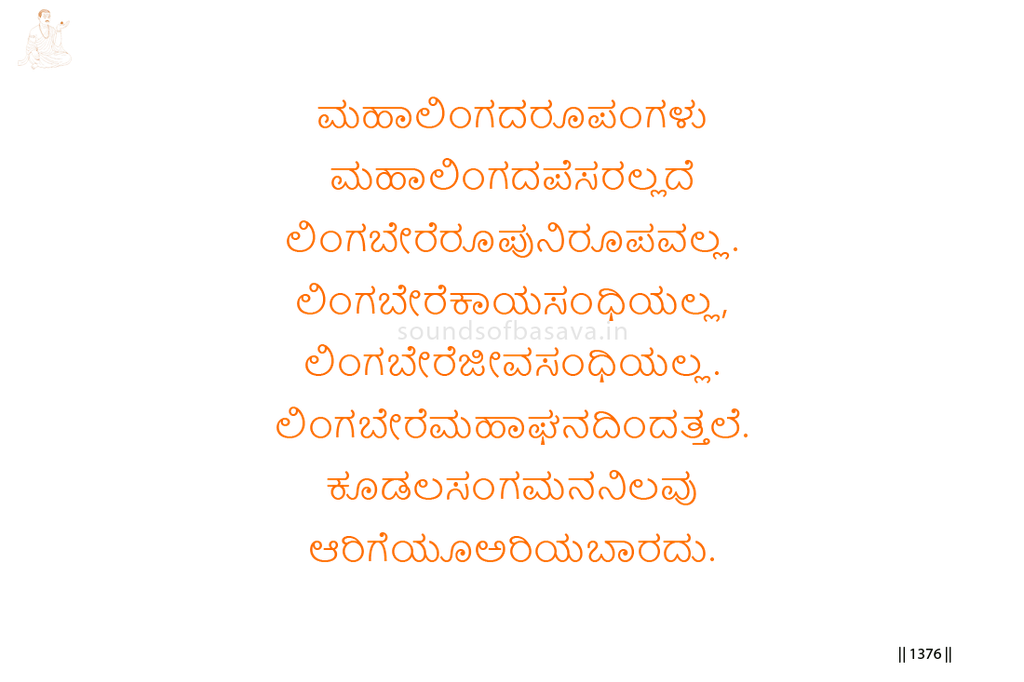
The forms of Mahalinga are not realities apart from Mahalinga. Linga is not one thing while its manifestation is another; it is not separate from the conjunction of body, from the conjunction of living being, or from Mahaghana.
Yet Basavanna does not convert this inseparability into a final definition. The true state of Kudalasangama cannot be fully known by anyone. The vachana joins non-separation with humility before the unfathomable Divine state.
Imagery & Symbolic Relevance
The Forms of Mahalinga
The opening statement removes the assumption that Mahalinga exists in one place while its forms arise elsewhere.
The forms are Mahalinga’s own expressions. They do not possess an independent source outside it.
This does not mean that one particular form contains the whole of Mahalinga. Rather, no manifestation stands outside the Reality from which it appears.
Linga and Its Manifestation
The repeated word “separate” governs the vachana.
Linga is not one reality and its form another. The distinction between the sacred source and its manifestation cannot be turned into an actual division.
The vachana therefore avoids two errors:
limiting Linga to a single visible form;
seeking Linga by rejecting every form.
Kāya-sandhi and Jīva-sandhi
Linga is not separate from kāya-sandhi, the conjunction or integrated condition of embodiment.
It is also not separate from jīva-sandhi, the conjunction of living being.
Body and life are not presented as independent realities later joined to Linga. They arise and function within the same sacred ground.
The Kannada does not say that ordinary bodily identity itself is the final state. It removes the belief that embodiment and living existence stand outside Mahalinga.
Mahaghana and the Unknowable State
Linga is not situated elsewhere, apart from Mahaghana, the great undivided fullness.
After removing separation at every level, Basavanna ends by saying that the state of Kudalasangama cannot be fully known by anyone.
The conclusion protects the teaching from becoming a claim of mastery. Mahalinga is inseparable from manifestation, body, and life, yet its true state cannot be reduced to any of them or contained within conceptual knowledge.
Lingayoga
The Lingayogi must not seek Linga by rejecting embodied life, nor reduce Linga to bodily appearance.
Body, life, worship, and conduct must become integrated within the Linga-relation. At the same time, the practitioner must not claim complete knowledge of Kudalasangama’s state.
Editorial Commentary
Mahalinga is the all-encompassing Linga-Reality whose manifestations are not apart from it.
Sandhi means junction, conjunction, or integrated relation. Thus kāya-sandhi and jīva-sandhi indicate embodied and living continuity rather than two external objects attached to Linga.
Mahaghana means the great dense or undivided fullness of Reality.
Nilavu means state, abiding, or true condition. The closing line says that Kudalasangama’s state cannot be fully grasped by anyone.
Related Vachana
Supporting Vachana
Sharana Sthala Vachana 1390 — Beyond the Conflict of Form and Formless
In Sharana Vachana 1390, Basavanna confesses that he became weary by searching for the Formless apart from Form. He asks Kudalasangama Deva for the steady true devotion in which this mistaken opposition ends.
It prepares Vachana 1313 by correcting divided seeking. The present vachana reveals the fulfilled understanding: Mahalinga and its manifestations were never separate.
Advancing Vachana
Aikya Sthala Vachana 1317 — Living, Enjoying, and Delighting Through the Ghanalinga
Aikya Vachana 1317 shows this inseparability operating within life. Living is grounded in Ghanalinga, partaking becomes Mahaprasada, and delight arises through Sahaja.
Vachana 1313 establishes that body and living being are not outside Mahalinga; Vachana 1317 advances this into the Sharana’s transformed way of living, receiving, and rejoicing.
