

Summary
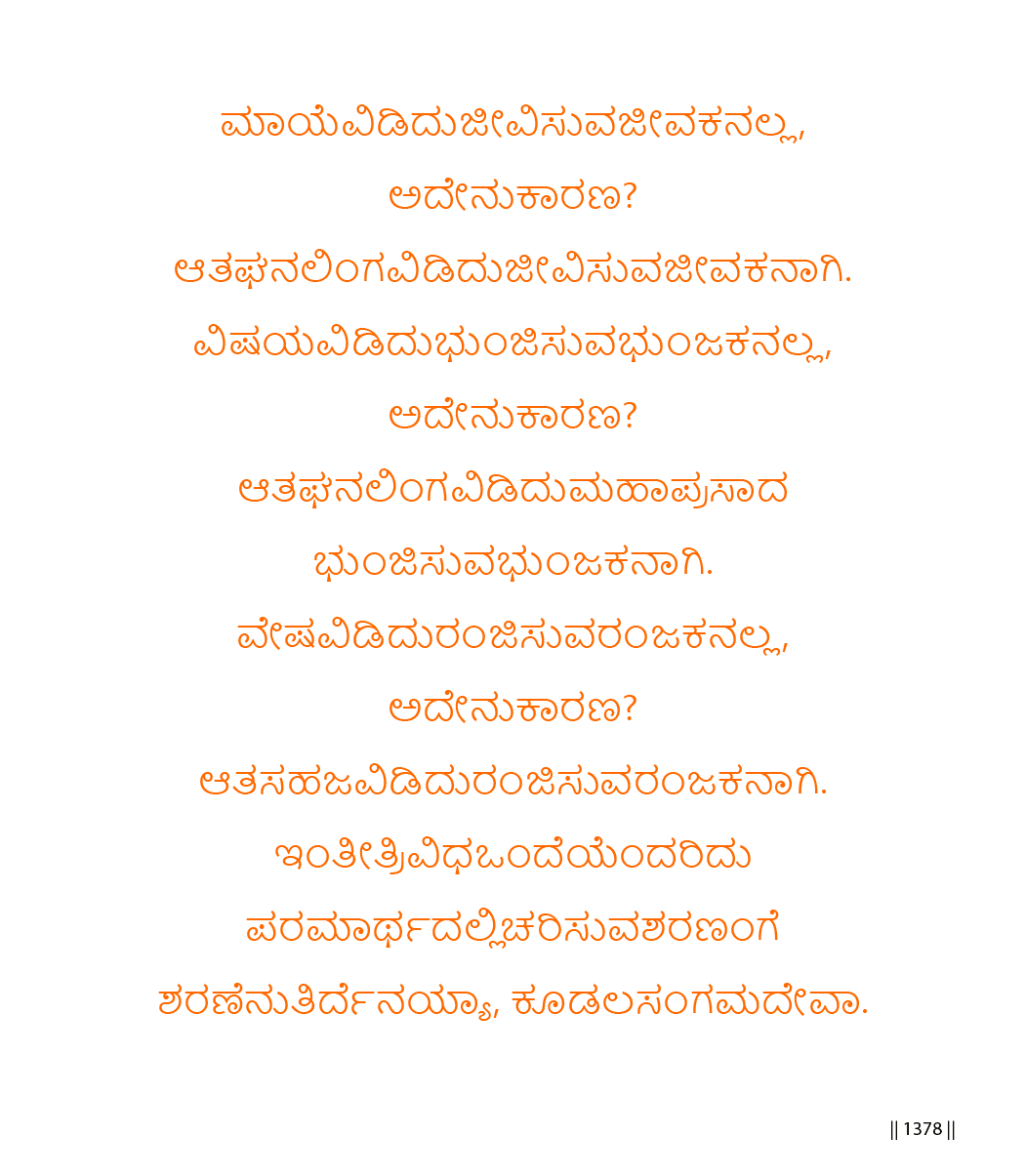
The Sharana does not live by holding to Māyā; he lives holding to Ghanalinga.
He does not partake under the rule of viṣaya, the objects of desire; through Ghanalinga, he partakes of Mahāprasāda.
He does not seek delight through veṣa, outward guise or display; his delight arises through Sahaja.
Knowing these three—living, partaking, and delighting—as one, the Sharana moves in Paramārtha. Basavanna declares surrender to such a Sharana before Kudalasangama Deva.
Imagery & Symbolic Relevance
The vachana contains no material image. Its movement is formed through three parallel contrasts, each followed by the question, “What is the reason?”
Living Through Ghanalinga
The first contrast distinguishes life held by Māyā from life held by Ghanalinga.
Basavanna does not reject embodied living. He identifies the ground from which the Sharana lives. Māyā no longer directs or sustains that life; Ghanalinga has become its abiding foundation.
The repeated question, “What is the reason?” prevents the statement from remaining merely negative. The Sharana is not defined by withdrawal from life, but by the sacred ground through which he lives.
Partaking of Mahāprasāda
The second contrast concerns receiving and enjoyment.
The Sharana is not a partaker governed by viṣaya. Viṣaya is what is approached as an object of personal gratification. When receiving is governed by desire, the object is valued for what it gives to the separate self.
The Sharana instead partakes of Mahāprasāda through Ghanalinga. The act of receiving remains, but its relationship changes. What is received is no longer grasped merely as an object of enjoyment; it is received as sacred gift.
Delighting Through Sahaja
The third contrast concerns delight.
The Sharana does not delight through veṣa—outward guise, assumed role, appearance, or display. Such delight depends upon how one appears or is recognized.
His delight arises through Sahaja, the natural and unforced condition. Joy is therefore not produced by performance or spiritual identity. It arises from the state in which he abides.
The Three Known as One
The conclusion gathers the three movements:
life grounded in Ghanalinga;
partaking as Mahāprasāda;
delight arising through Sahaja.
The Sharana knows these not as separate practices, but as one movement in Paramārtha. Living, receiving, and rejoicing arise from the same undivided ground.
Basavanna then moves from description to surrender. Kudalasangama Deva is the Lord addressed; the Sharana is the realized one to whom Basavanna bows. The two relationships remain distinct.
Lingayoga
This vachana asks the practitioner to examine what governs ordinary living, receiving, and delight.
Living must be grounded in Linga rather than Māyā. Receiving must lose the claim of personal gratification and become Prasāda. Delight must cease to depend upon outward identity and arise naturally from established relation with Linga.
The unity described in the conclusion is a fulfilled condition, not a verbal claim. The three become one only when they arise continuously from the same Ghanalinga-centred ground.
Editorial Commentary
Ghanalinga indicates the full and undivided Linga-reality in which the Sharana’s life is established.
Mahāprasāda is sacred receiving freed from the rule of personal desire; it is not limited to physical food.
Veṣa means outward guise, role, or display.
Sahaja is the natural, unforced state.
Paramārtha is the supreme truth within which the three transformed movements are known as one.
Related Vachana
Supporting Vachana
Sharana Sthala Vachana 1347 — Where the World Ends and the Sharana Begins
Sharana Vachana 1347 shows Chennabasavanna no longer governed by worldly desire: Linga is his dwelling, Jangama his sovereign, and Prasāda his life-breath.
It prepares Vachana 1317 by establishing sacred relation as the whole structure of the Sharana’s life. Vachana 1317 deepens this into the unity of living through Ghanalinga, partaking of Mahāprasāda, and delighting through Sahaja.
Advancing Vachana
Aikya Sthala Vachana 1321 — I Saw That I Was Not, and You Alone Were
Vachana 1317 establishes living, partaking, and delighting as one movement in Paramārtha.
Vachana 1321 carries this unity into direct seeing: the independent “I” no longer stands as a separate ground, and Kudalasangama Deva alone is seen.
This does not deny embodied life. It removes the remaining claim that the unified life described in Vachana 1317 belongs to an independently existing self.
