

Summary
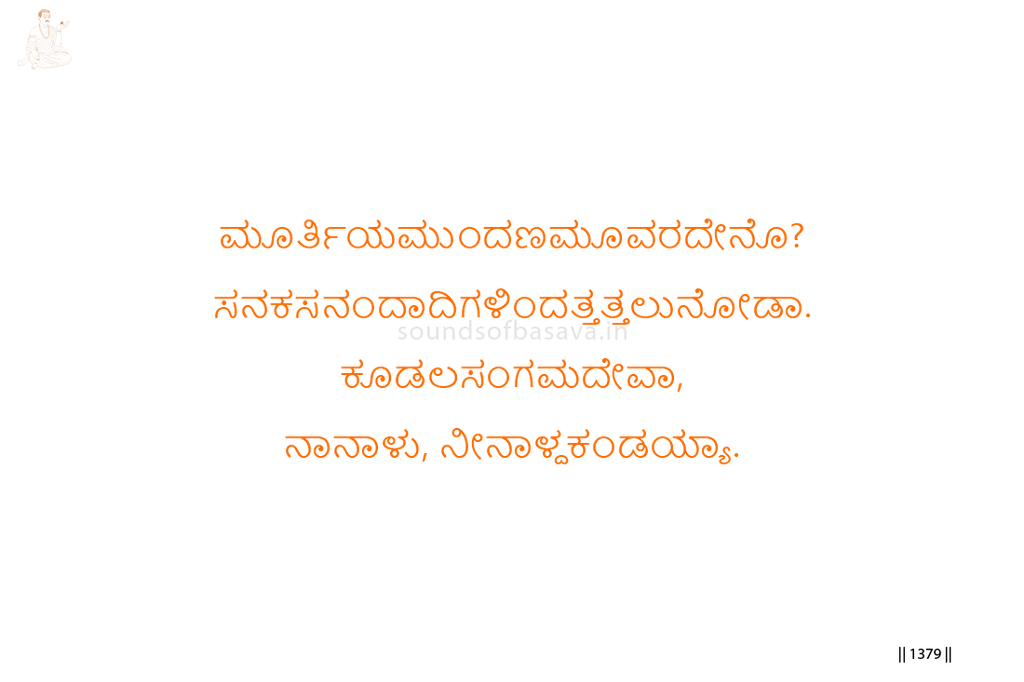
Basavanna asks what significance “the three” can retain before that supreme Form. He then directs the vision beyond even Sanaka, Sanandana, and the other ancient sages.
The movement is not toward another form, authority, or attainment. It culminates in direct seeing before Kudalasangama Deva:
The independently standing “I” was not there; Kudalasangama Deva alone was.
This is not a claim about what the seeker has become. It is the recognition that separate selfhood no longer remains as the ground of seeing.
Imagery & Symbolic Relevance
The vachana has no extended material image. It moves through an unanswered question, a direction to look beyond, and a final declaration of seeing.
The Form and “the Three”
The opening question places “the three” before the Form and asks what they amount to there.
The Kannada does not identify the three explicitly. Their precise identity should therefore not be fixed through doctrinal assumption. The force of the question lies in their loss of independent significance before the Form beheld by Basavanna.
The question is not answered by explaining or ranking the three. The vachana immediately moves beyond them.
Beyond Sanaka and Sanandana
Sanaka, Sanandana, and the other ancient sages represent exalted wisdom and spiritual attainment.
Basavanna does not condemn them. The instruction to look beyond them establishes that even the greatest sages cannot become the final boundary of seeing. Their knowledge, example, and attainment remain secondary before the direct presence of Kudalasangama Deva.
The movement is therefore beyond dependence upon revered intermediaries, not a rejection of their greatness.
“I Was Not; You Alone Were”
The conclusion is a statement of direct seeing.
Basavanna does not say, “I became You,” nor does he present himself as equal to Kudalasangama Deva. He says that the separately standing “I” was not seen and that Kudalasangama Deva alone was.
The distinction is important. The sentence removes independent self-claim; it does not create a new claim of personal divinity.
The body and world are not said to disappear. What ceases to stand is the separate “I” that would possess the seeing, name the attainment, or declare itself the final reality.
Lingayoga
Lingayoga may employ sacred form, instruction, and the guidance of realized beings, but it cannot end in dependence upon them as separate finalities.
The practice-direction is to let seeing become free from the claimant who says, “I have known” or “I have attained.” The state declared in the final line, however, is realized recognition and must not be imitated as a verbal assertion.
Editorial Commentary
The Kannada leaves “the three” unnamed. Identifying them exclusively as the Trimurti, three states, or any other fixed triad would exceed the vachana.
The instruction to look beyond Sanaka and Sanandana does not diminish the sages. It establishes that direct recognition of Kudalasangama Deva cannot be confined within even the highest inherited authority.
“I was not” concerns the absence of independently claiming selfhood within the seeing. It does not indicate bodily disappearance, unconsciousness, or destruction of the person.
Related Vachana
Supporting Vachana
Sharana Sthala Vachana 3 — The Divine Vehicles
Sharana Vachana 3 presents a self without an independently chosen role. According to Kudalasangama Deva’s mode of presence, the speaker becomes knowledge, consciousness, the bull that bears the Lord, and finally the servant of the Jangama.
It prepares Vachana 1321 by surrendering self-defined identity. In the Sharana stage, the “I” remains only as responsive service; in Vachana 1321, even that independently standing “I” is absent from the final seeing, and Kudalasangama Deva alone is beheld.
Advancing Vachana
Aikya Sthala Vachana 1325 — When All Three Become One
Vachana 1321 gives the concentrated recognition that the separate “I” was not and Kudalasangama Deva alone was.
Vachana 1325 unfolds this recognition across the remaining divisions. Seer, seeing, and seen become one; Pindanda and Brahmanda are known as one; and Guru, Linga, and Jangama are no longer held as separate finalities. Bondage falls away in Linga-Aikya.
The direct seeing of Vachana 1321 thus advances into the comprehensive ending of division in Vachana 1325.
