

Summary
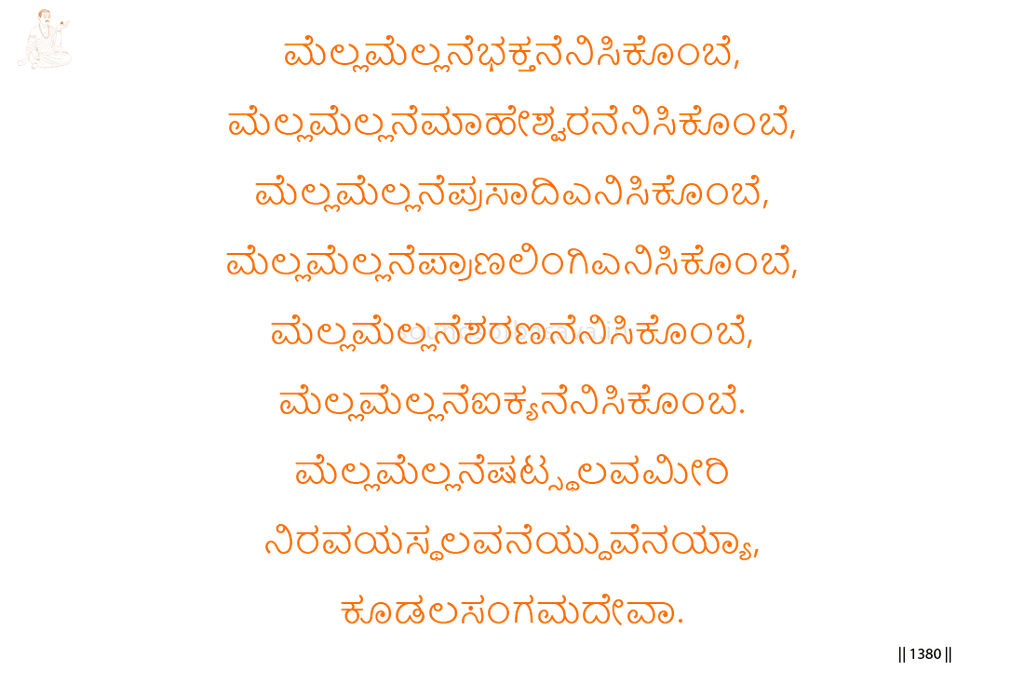
Gently and without self-assertion, Basavanna passes through the conditions of Bhakta, Maheshwara, Prasadi, Pranalingi, Sharana, and Aikya.
None is presented as a title seized through personal achievement. Each condition ripens naturally into the next.
Having passed through all six Sthalas, he does not remain bound even by their spiritual designations. He crosses the Shatsthala and enters Niravaya Sthala—the fearless, divisionless state before Kudalasangama Deva.
Imagery & Symbolic Relevance
The vachana contains no material image. Its movement is formed through repetition, ordered spiritual maturation, and the final crossing beyond every stage-name.
“Gently, Gently”
The repeated mellamellane—“gently, gently” governs every line.
Basavanna does not describe conquest, force, or sudden self-proclaimed attainment. The movement unfolds quietly, with each condition becoming established before the next appears.
The repetition also prevents the six Sthalas from becoming ranks to be hurried through. Spiritual ripening cannot be forced merely by adopting the language of a later stage.
The Six Sthalas
The sequence is precise:
Bhakta;
Maheshwara;
Prasadi;
Pranalingi;
Sharana;
Aikya.
Basavanna says that he becomes known through each condition. The wording does not glorify a self that collects six identities. Each name indicates a lived spiritual relation that gradually ripens.
Bhakta establishes devotion. Maheshwara carries devotion into sacred conduct. Prasadi receives through Prasāda. Pranalingi establishes life in Linga. Sharana rests in surrender. Aikya brings the movement into non-separation.
The Kannada preserves the order. No Sthala is omitted, reversed, or treated as unnecessary.
Crossing Even the Shatsthala
After becoming known through Aikya, Basavanna says that he crosses even the Six Sthalas.
This does not reject the Shatsthala or declare its earlier conditions false. The crossing becomes possible only after the complete movement has been lived.
What is crossed is the need to remain defined by the stages:
“I am a Bhakta”;
“I am a Maheshwara”;
“I am a Sharana”;
“I am in Aikya.”
The path remains valid, but its designations no longer become separate identities to be retained or defended.
Entering Niravaya Sthala
The final movement is entry into Niravaya Sthala.
Niravaya indicates a condition without fear, fracture, vulnerability, or division. It is not presented as a seventh stage added after Aikya. It is the condition in which even the distinctions needed to describe spiritual progression have become unnecessary.
The repeated “gently, gently” continues into this final crossing. Basavanna does not violently discard the stages. Their distinctions fall away naturally after their purpose has been fulfilled.
Lingayoga
Lingayoga must ripen through lived transformation rather than through the adoption of spiritual titles.
The practitioner should not hurry to call himself Bhakta, Sharana, or Aikya. Each condition must become true in devotion, conduct, receiving, life, and surrender.
The final crossing cannot be manufactured as a rejection of discipline. It belongs to the fulfilled state in which the stages have been lived completely and no longer need to be held as separate identities.
Editorial Commentary
Mellamellane means “gently, gently” or “gradually and naturally.” It indicates ripening without force or self-display.
Shatsthala is the complete sixfold movement through Bhakta, Maheshwara, Prasadi, Pranalingi, Sharana, and Aikya.
Niravaya Sthala is not another Sthala beyond Aikya in a numerical sequence. It indicates fearless, divisionless abidance in which even stage-consciousness has fallen away.
Related Vachana
Supporting Vachana
Sharana Sthala Vachana 1372 — The Fearless Walk
Sharana Vachana 1372 presents samsara as a forest containing tigers and bears, yet Kudalasangama Deva’s Sharana does not tremble. Fearlessness arises not from personal courage, but from complete refuge in the Lord.
It prepares Vachana 1322 by establishing fearlessness while the Sharana still walks within the conditions of life. Vachana 1322 deepens this into Niravaya, where fearlessness is free even from dependence upon the identity of being a Sharana or belonging to any other stage.
Advancing Vachana
Aikya Sthala Vachana 875 — The Sharana Who Is Not Two
Vachana 1322 crosses the six spiritual designations and enters the state without division.
Vachana 875 clarifies how that condition remains embodied: the Sharana is not confined by becoming, doubt, form, or formlessness, yet neither body nor life is denied or deceived.
Thus the crossing beyond stage-identity in Vachana 1322 deepens into a life no longer divided between opposing conditions. Niravaya becomes visible as the undivided integrity of Kudalasangama Deva’s Sharana.
