

Summary
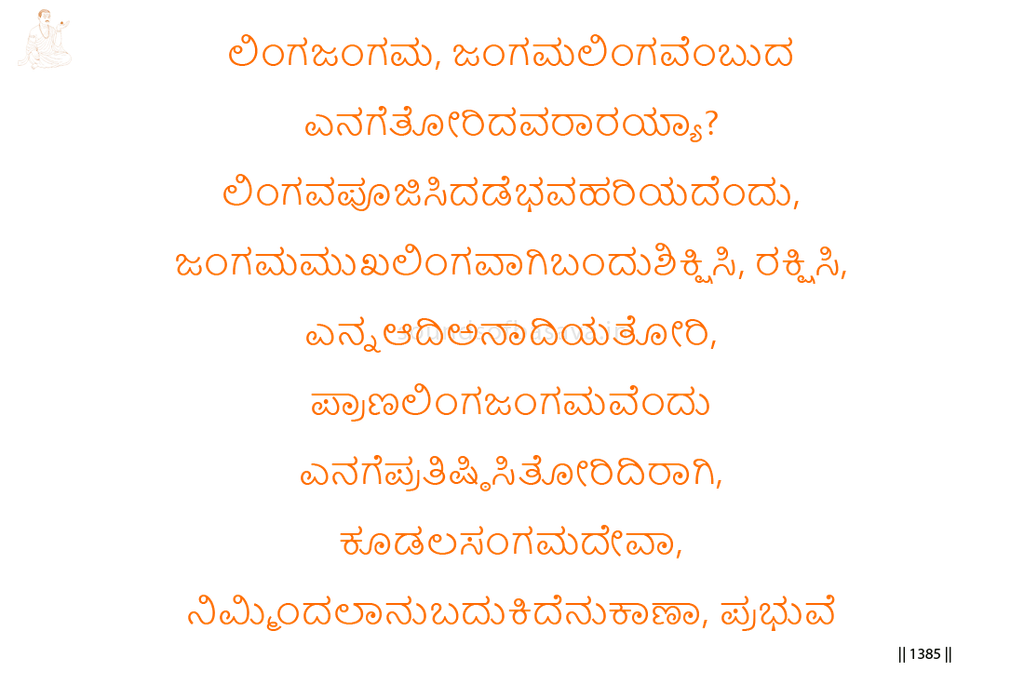
Basavanna asks who revealed to him that Linga is Jangama and Jangama is Linga.
Worship of the Linga by itself had not ended bhava, the continuing formation of separate existence. The Jangama therefore came as Mukhalinga—the Linga with a living face—instructing and protecting him.
Through this living revelation, Basavanna was shown his Ādi and Anādi, his origin and its beginningless ground. It was then firmly established within him that Pranalinga itself is Jangama.
He finally declares to Kudalasangama Deva: “Through You I have truly lived, O Lord.”
Imagery & Symbolic Relevance
The vachana contains no extended material comparison. Its movement proceeds through a question, the limitation of worship, the arrival of Jangama, instruction and protection, revelation, establishment, and the declaration of true life.
“Who Showed Me?”
The opening remains a question:
Who showed Basavanna that Linga is Jangama and Jangama is Linga?
The question carries gratitude and praise. The recognition was not created by Basavanna’s reasoning or claimed as his independent achievement. It was shown to him through the grace of Kudalasangama Deva and the living intervention of Jangama.
Linga Is Jangama; Jangama Is Linga
The reciprocal statement must be preserved in both directions.
Linga is not separated from the living Jangama, and Jangama is not treated as something outside the sacred presence of Linga. The fixed and worshipped presence and the moving, speaking, living presence are not two unrelated realities.
Their functions are not erased. Linga remains Linga, and Jangama remains Jangama; what ends is the division that treats one as Divine and the other as merely human.
Worship That Did Not End Bhava
Basavanna does not reject Linga worship. He acknowledges its limitation when it remains separated from living recognition.
Although the Linga had been worshipped, bhava had not disappeared. Ritual approach alone had not ended the separate condition of the worshipper.
The line therefore tests the completion of worship. If Linga is revered while Jangama is not recognized, the relation remains divided, and bhava continues.
Jangama as Mukhalinga
The decisive change occurs when Jangama comes as Mukhalinga—the Linga with a living face.
Mukhalinga is not passive. The Jangama comes, instructs, and protects. Through speech, presence, correction, and care, what remained incomplete in worship becomes living understanding.
The movement is from a Linga approached by the worshipper to a living sacred presence that approaches and transforms the worshipper.
Showing Ādi and Anādi
The Jangama shows Basavanna his Ādi and Anādi.
Ādi concerns origin or beginning. Anādi points to that which is beginningless. The revelation shows that the seeker’s true ground cannot be confined to the limited history of the separate self.
This does not make the individual an independently beginningless deity. It reveals the seeker’s origin and relation within the beginningless reality of Linga.
Establishing Pranalinga as Jangama
The truth is not merely explained; it is pratiṣṭhita—firmly established within Basavanna.
Pranalinga is recognized as Jangama. The Linga joined to living Prana is not separated from the moving sacred presence encountered in Jangama.
This establishment changes the teaching from an idea into lived certainty. Basavanna no longer merely hears that Linga and Jangama are one; the truth becomes inwardly grounded.
“Through You I Have Lived”
The conclusion addresses Kudalasangama Deva directly.
Basavanna does not refer merely to biological survival. Through instruction, protection, revelation, and establishment, his life has become spiritually true.
The closing Prabhuve means “O Lord” and refers to Kudalasangama Deva. It does not refer to Allama Prabhudeva.
Lingayoga
Lingayoga must not remain confined to private worship of the Linga. The recognition received before Linga must become openness to Jangama as living sacred presence.
The practitioner must be willing to receive instruction and correction, not merely perform worship according to personal preference. The fruit of practice is shown when Linga-relation becomes active in conduct, service, and response to Jangama.
The identity of Pranalinga and Jangama described here is an established realization. It cannot be produced merely by repeating that they are one.
Editorial Commentary
Bhava here indicates continuing separate formation or becoming. It is not devotional feeling.
Mukhalinga means the Linga with a living face—the sacred presence encountered through Jangama. It does not diminish or reject the worshipped Linga.
Pranalinga is Linga established in living Prana. The term does not require an unsupported system of subtle channels or breath retention.
Ādi–Anādi expresses origin and beginninglessness. It must be understood through the seeker’s relation to Linga, not as personal self-deification.
Prabhuve means “O Lord” and addresses Kudalasangama Deva.
Related Vachana
Supporting Vachana
Sharana Sthala Vachana 435 — The Divine Who Asks for Servanthood
Sharana Vachana 435 shows Kudalasangama Deva coming as Jangama-Mukhalinga to ask, test, and see whether servanthood has become real.
It prepares Vachana 1334 by establishing that the Divine must be recognized when He comes through living Jangama. Vachana 1334 deepens that recognition: Mukhalinga not only tests the seeker but instructs, protects, reveals Ādi and Anādi, and establishes Pranalinga as Jangama.
Advancing Vachana
Aikya Sthala Vachana 381 — The Alchemy of Surrender
Vachana 1334 establishes within Basavanna that Pranalinga is Jangama and that true life has arisen through Kudalasangama Deva.
Vachana 381 carries this realization into surrender. Through the images of camphor entering fire, the serpent within nectar, and the powerful elephant yielding before the lion, Basavanna declares that he has yielded to Jangama.
What is revealed and established in Vachana 1334 therefore advances in Vachana 381 from recognition into complete surrender to the living Jangama.
