

Summary
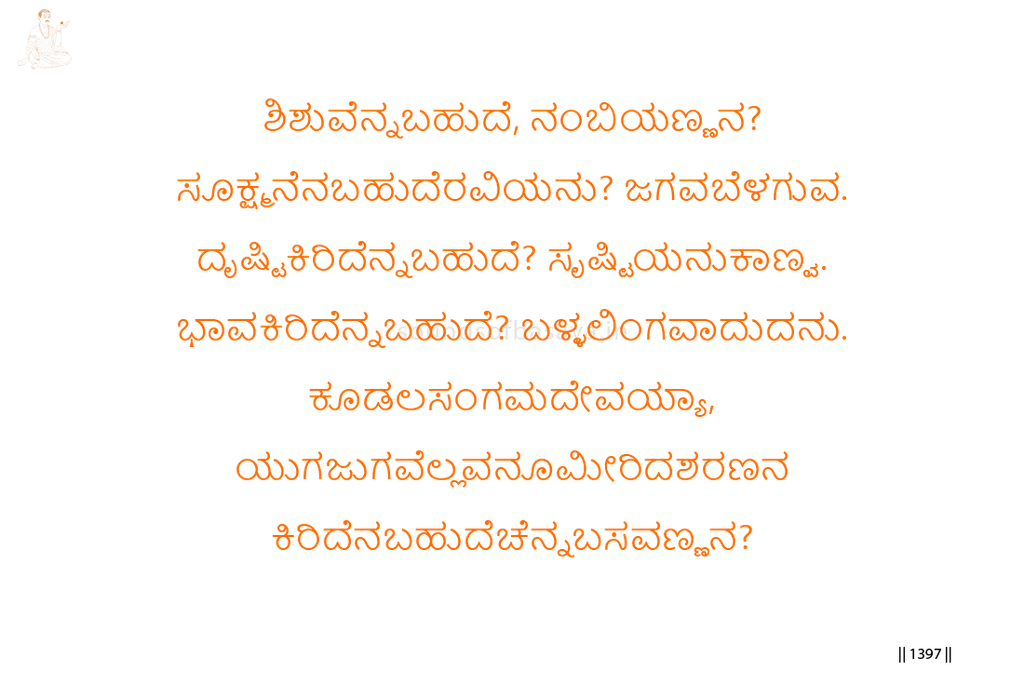
Can one established in absolute faith be regarded as a child or as spiritually small? Can the sun be called small when it illuminates the world? Can vision be called small when it beholds creation? Can Bhava be called small when it has become the abundant Linga?
Basavanna uses these questions to reveal that greatness cannot be measured by outward size, visibility, age, or appearance. What seems limited may carry immeasurable power.
He brings this movement to Chennabasavanna. The Sharana who has surpassed age after age cannot be called small. His embodied form is visible, but the realization he bears transcends ordinary measure.
Imagery & Symbolic Relevance
The Vachana unfolds through five rhetorical questions. Each contrasts apparent smallness with an immeasurable inward power.
The One Established in Absolute Faith
The opening asks whether the one established in absolute faith can be called a child.
Nambiyanna here is not a personal name. It means the one whose faith, trust, and belief have become complete and unwavering.
Such faith is not uncertainty covered by devotional words. It is a settled inward trust that no longer divides its reliance between different centres.
A person established in this faith may appear ordinary, inexperienced, or insignificant to outward judgment. Yet the strength of absolute trust cannot be measured by appearance.
The word “child” therefore expresses the smallness attributed by others, while the question reveals the inward maturity created by complete faith.
The Sun That Illuminates the World
The sun appears as a small disc in the sky, yet its light fills the world.
Its visible size gives no measure of its illuminating power. What appears limited carries a radiance extending far beyond its form.
The sun establishes the central movement of the Vachana: greatness is known through the extent of what it reveals and transforms.
Vision That Beholds Creation
The faculty of vision appears small, yet through it the vast creation is seen.
The movement proceeds from the sun that illuminates the world to the vision that beholds it. Illumination and recognition belong together.
The greatness of vision is not found in physical size but in its capacity to receive and reveal an immense field.
Bhava Becoming the Abundant Linga
The next question turns inward: can Bhava be called small when it has become the abundant Linga?
Bhava is the inward spiritual disposition through which the seeker relates to Linga. When it becomes wholly established in Linga, it is no longer confined to private emotion or limited devotional experience.
Its measure becomes the Linga itself.
The Kannada carries the sense of a Linga that is vast, full, or abundant. Bhava that has entered such fullness cannot be judged as something slight merely because it remains inward and unseen.
Chennabasavanna Beyond the Ages
The final question gathers all the preceding comparisons.
Can Chennabasavanna be called small—the Sharana who has surpassed age after age?
His bodily form may be human and outwardly measurable, just as the sun appears as a small disc and the eye occupies little space. Yet the realization he bears reaches beyond ordinary time and estimation.
The phrase “surpassed age after age” presents Chennabasavanna as established in a truth that is not confined to one generation, period, or temporal boundary.
His greatness lies in the Linga-realization he embodies and reveals.
The Complete Movement
The sequence moves through:
absolute faith;
world-illuminating radiance;
vision capable of beholding creation;
Bhava becoming the abundant Linga;
Chennabasavanna’s timeless Sharana-realization.
Each image enlarges the preceding one. Faith becomes illumination, illumination becomes vision, vision becomes realized Bhava, and realized Bhava is finally shown in the living Sharana.
Kudalasangama Deva is the Lord addressed. Chennabasavanna is the Sharana whose immeasurable greatness Basavanna recognises.
Lingayoga
Lingayoga requires unwavering faith before it can mature into direct vision.
When trust remains divided, the inward relation with Linga remains unstable. Absolute faith gathers thought, devotion, conduct, and reliance into one centre.
Such faith must then become illumination and vision. The practitioner is not established merely by believing; faith must open the capacity to see the presence of Linga and to allow Bhava to become Linga-filled.
The living Sharana reveals the fulfilment of this movement. Chennabasavanna’s greatness is known through his capacity to illuminate the path, clarify the Linga–Prana relation, and lead others toward realized understanding.
Editorial Commentary
Nambi/Nambiyanna means the one established in absolute faith, trust, or belief. It is not a personal name in this Vachana.
Shishu means child. Here it suggests one regarded as young, immature, or small by outward estimation.
Sūkṣma carries the sense of minute, subtle, or apparently small.
Dṛṣṭi means sight or vision—the faculty through which creation is beheld.
Bhava is the inward spiritual disposition that becomes fulfilled in Linga.
Baḷḷa Linga carries the sense of the great, abundant, or immeasurable Linga.
The statement that Chennabasavanna has surpassed age after age expresses the timeless extent of his realization.
Related Vachana
Supporting Vachana
Sharana Sthala Vachana 1337 — Show Me the Difference Between Prana and Prana-Linga
In Sharana Vachana 1337, Basavanna acknowledges that outward worship has not revealed the intimate relation between Prana and Prana-Linga.
He therefore turns to Chennabasavanna and asks him to show the distinction directly.
This prepares Vachana 1364 by demonstrating the realized capacity behind Chennabasavanna’s greatness. He is the Sharana through whom what remains hidden to ordinary worship and understanding can be revealed.
The request for his guidance in Vachana 1337 becomes reverent recognition in Vachana 1364: one who bears such illuminating vision cannot be called small.
Advancing Vachana
Aikya Sthala Vachana 1154 — The Revelation of Linga-Aikya
Vachana 1364 presents Chennabasavanna as the Sharana whose realization surpasses ordinary and temporal measure.
Vachana 1154 reveals the full work of that realization. Chennabasavanna establishes the Fivefold Achara, makes Shatsthala-Anubhava clear, reveals Prana-Linga and Linga-Prana, removes delusion, and shows Linga-Aikya.
The greatness praised through images in Vachana 1364 becomes direct revelatory action in Vachana 1154.
As the sun illuminates the world and vision beholds creation, Chennabasavanna illuminates the complete relation of Prana, Linga, and Aikya.
