Poetic Rendering
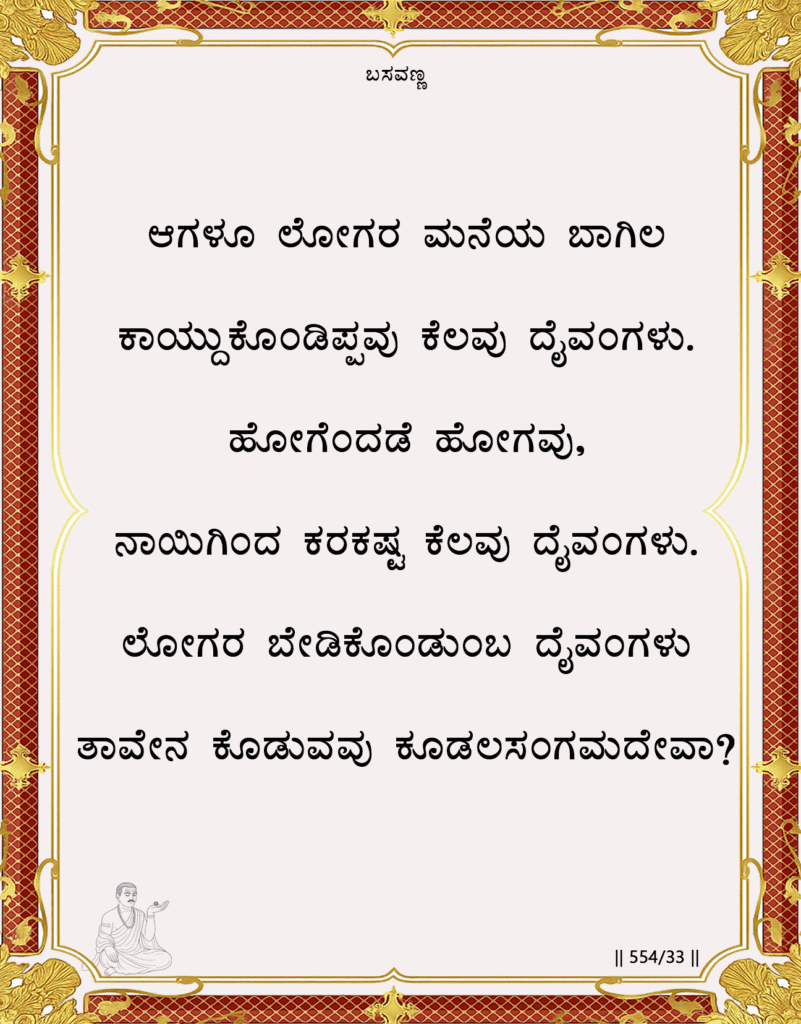
Some gods guard the doors of men’s houses,
barking like dogs when called.
Some gods speak only when prompted,
powerless without offerings.
But what can such gods give, O Lord?
Only You, Koodalasangamadeva, are the true giver.
Basavanna describes two kinds of powerless “gods”: those who guard houses like watchdogs, barking only when called, and those who speak only when prompted by offerings. He then asks what such dependent beings can possibly give, concluding that only Kudalasangamadeva is the true, independent source of all gifts.
Spiritual Context
Core Spiritual Principle: The Divine is not a transactional entity to be bribed or commanded. True divinity is characterized by absolute sovereignty and unconditional grace. Worship that is based on fear or a desire for exchange is a form of spiritual ignorance that creates powerless, man-made idols.
Cosmic Reality Perspective: The Linga is the non-dual, all-pervading consciousness that is the source and substance of everything. It does not “guard” one part of itself against another, nor does it need offerings, as it is the owner of all. The “other gods” are fragmented mental projections that deny this fundamental unity.
Historical Reality (Anubhava Mantapa context): This vachana is a direct assault on the polytheistic, ritualistic Hinduism of Basavanna’s time, particularly the worship of Gramadevatas (village deities) and deities propitiated for specific boons. It aims to purify devotion by directing it away from fearful, transactional relationships and toward a singular, loving, and awe-inspiring relationship with the formless Absolute.
Interpretation
1. “Some gods guard the doors… barking like dogs…” : This critiques deities worshipped for protection. The metaphor of the “dog” is intentionally provocative, reducing the deity to a servile, reactive entity. This type of worship is born from fear and the desire for security.
2. “Some gods speak only when prompted… powerless without offerings.” : This critiques deities worshipped for boons. These gods are portrayed as mute and impotent until activated by a ritual transaction (offerings). This type of worship is born from desire and the illusion of control.
3. “But what can such gods give…?” : This is the logical conclusion. A being that is itself dependent on human invocation and sustenance has nothing of its own to give. Its “power” is an illusion granted by the worshipper’s belief.
4. “Only You… are the true giver.” : This is the triumphant affirmation. Kudalasangamadeva is Aptakama (one whose desires are fulfilled), needing nothing. Therefore, Its nature is purely to give ( Datta ). The air gives breath, the sun gives light; similarly, the Divine gives existence, consciousness, and grace spontaneously and unconditionally.
Practical Implications: The seeker must examine their own motives for prayer and worship. Is it a transaction (“I give this, you give that”)? Is it born of fear? True devotion (Bhakti) is an offering of love and surrender without any expectation of return, directed toward the one source that is, by its very nature, a continuous act of giving.
The Cosmic Reality
Anga (Human Dimension): The human being trapped in dualistic thinking, creating limited “gods” that reflect their own limited fears and desires (for protection, for wealth). The Anga is the source of the projection.
Linga (Divine Principle): Kudalasangamadeva as the non-dual, sovereign reality. The Linga is not a separate entity to be bargained with but is the very ground of being that generously sustains all.
Jangama (Dynamic Interaction):The Jangama is the insight that shatters the illusion of transactional deities. It is the dynamic turning of the heart away from petty commerce with projections of the ego, toward a receptive surrender to the one true Giver.
Shata Sthala
Primary Sthala: Bhakta. This vachana guides the Bhakta toward the purification of their devotion, moving it from a state of fearful or greedy transaction to one of selfless love and recognition of true grace.
Supporting Sthala: Prasadi. The recognition of God as the “true giver” is the essence of the Prasadi stage, where the seeker sees every breath and every moment as a gift (Prasada) from the Divine.
Integration
Arivu (Awareness): Cultivate awareness of your internal bargaining with the Divine. Notice when you pray for specific outcomes or make “deals.” Shift your prayer to gratitude for what is already given and surrender to the divine will.
Achara (Personal Discipline): Let your discipline be an offering, not a payment. Perform worship and good deeds as an expression of love and gratitude, not as a currency to purchase divine favor.
Kayaka (Sacred Action): See your work as participating in the divine act of giving. Become a channel for the generosity you recognize in the universe, offering your skills selflessly to the world.
Dasoha (Communal Offering): Understand that Dasoha is not a transaction with God but an imitation of God’s own nature. We give because God is the Giver; we share because all is already a gift from the one Source.
Modern Application
The “transactional god” is alive and well in modern “prosperity gospel” and in the common perception of religion as a system for achieving health, wealth, and success. We also create new “gods” in the form of ideologies, brands, and influencers, expecting them to provide identity and security in exchange for our loyalty and consumption.
This vachana liberates us from spiritual consumerism. It frees us from the anxiety of having to constantly “pay” or “perform” to earn divine favor. It invites us into a relationship of trust and grace with a universe that is fundamentally benevolent and giving. It transforms life from a series of anxious transactions into a grateful reception of an endless gift.
Essence
A god who barks upon command,
A mute who waits for outstretched hand
What can they give, who are not free?
The Source of All gives endlessly.
Metaphysically, this vachana distinguishes between Saguna Brahman (the absolute with attributes) as misunderstood by the ignorant, and Nirguna Brahman (the absolute without attributes). The “watchdog god” is a gross, limited form of Saguna worship, where the devotee’s own fear and desire create a bound, finite image. Kudalasangamadeva represents the true Nirguna reality attributeless, unconditioned, and supremely sovereign. The vachana does not reject Saguna worship outright but purifies it, guiding the devotee to see that the true object of any worship is the one, attributeless source of all grace, which can be petitioned but never commanded.
Any power that demands your subservience or can be bought is not a true source of strength. Real power is that which gives freely and sustains all. Place your trust and devotion not in the petty tyrants of your own fears and desires, but in the boundless, generous principle at the heart of existence itself.

Views: 15