Poetic Rendering
To worship the Linga
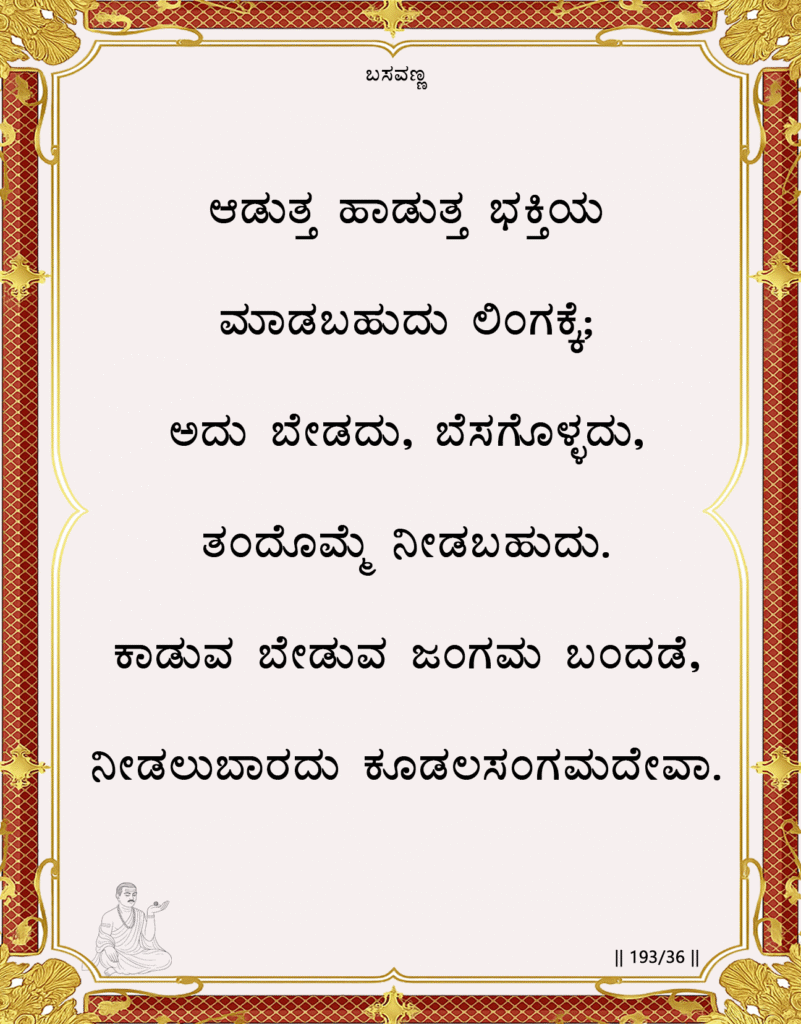
to sing, to play,
to keep its presence in the heart
is easy.
But when the Jangama comes,
hungry, weary,
and stands before you
that is the true moment of worship.
Fail then,
and all devotion falls empty,
O Kudalasangamadeva.
Basavanna contrasts effortless ritual devotion with the true test of spirituality: responding with compassion when a Jangama arrives in need. Real worship is not in songs or play, but in the living act of service.
Spiritual Context
Core Spiritual Principle: The ultimate validation of spiritual practice is compassionate action. Rituals and inner feelings are preparatory; they find their true meaning and purpose only when translated into selfless service (Dasoha) to a living being in need, especially one who embodies the spiritual path (the Jangama).
Cosmic Reality Perspective: The Linga is the all-pervading, formless consciousness. The Jangama is the dynamic, moving manifestation of this consciousness in human form. To honor the formless God but ignore Its living form is a fundamental contradiction and a failure of spiritual vision.
Historical Reality (Anubhava Mantapa context): This vachana is the practical cornerstone of the Lingayat ethos. It ensures that the community’s spirituality remains grounded in radical compassion and social responsibility. It prevents the path from becoming a self-indulgent mystical pursuit and makes serving the wandering saint and the community the highest sacrament.
Interpretation
1. “To worship the Linga… is easy.” : Basavanna makes a provocative and profound statement. The “easy” worship includes not just external rituals but even the intimate act of “keeping its presence in the heart.” This is because these actions, however deep, are controlled, safe, and occur within the devotee’s own spiritual comfort zone.
2. “But when the Jangama comes…” : This is the pivot. The test is not chosen; it arrives unexpectedly, demanding a response. The “Jangama” represents the unpredictable, often inconvenient, and very real needs of the world and the spiritual community.
3. “…hungry, weary…” : The description is crucial. The Jangama is not a majestic, awe-inspiring figure in this moment, but one in a state of human vulnerability. The test is to see the Divine not in power and glory, but in need and humility.
4. “that is the true moment of worship.” : Worship is redefined in this instant. It is no longer a song or a prayer, but the concrete act of offering food and rest. The altar moves from the temple to the threshold of one’s home.
5. “Fail then, and all devotion falls empty…” : This is the stern, unequivocal conclusion. A life of sincere ritual and heartfelt feeling is rendered meaningless if it does not culminate in active, selfless compassion when the opportunity arises. The essence is in the integration of belief and action.
Practical Implications: The seeker must be prepared to be interrupted. Spiritual practice is not a retreat from the world but a preparation to engage with it compassionately. The measure of one’s spiritual progress is their spontaneous, generous response to human need.
The Cosmic Reality
Anga (Human Dimension): The devotee in their home, comfortable in their rituals. The Anga is presented with a choice: to remain in comfortable worship or to step into the messy, demanding reality of service.
Linga (Divine Principle): Kudalasangama Deva as the ultimate reality that is being served. The Linga is the silent witness to this test of integrity.
Jangama (Dynamic Interaction): The Jangama is the active, living test of the devotee’s realization. It is the dynamic principle that bridges the gap between the Anga’s inner devotion and the outer world, making spirituality tangible and consequential.
Shata Sthala
Primary Sthala: Bhakta. This vachana presents the critical examination for the Bhakta. It is the moment where sentimental devotion must prove itself through the fire of selfless action.
Supporting Sthala: Sharana. The being who passes this test effortlessly, for whom service is the natural expression of their union with the Divine, is the true Sharana.
Practical Integration
Arivu (Awareness): Cultivate the awareness that every person in need, especially those on the spiritual path, is a Jangama a living opportunity to worship God through service.
Achara (Personal Discipline): Let your discipline include a vow of hospitality and readiness to serve. Keep your heart and home open to those who seek help.
Kayaka (Sacred Action): See your work and resources as not just for your own family, but as a fund for Dasoha, ready to be deployed when the “Jangama” arrives at your door.
Dasoha (Communal Offering): This vachana is the doctrine of Dasoha. The highest form of giving is to recognize the divine in the guest and to serve them as you would God.
Modern Application
We often compartmentalize our spirituality. Our meditation, prayer, or yoga is one thing; our response to the homeless person, the demanding relative, or the colleague in crisis is another. We may feel spiritually elevated in solitude but remain selfish and indifferent in our daily interactions.
This vachana liberates by tearing down this compartmentalization. It declares that your response to the next phone call from someone in trouble, your reaction to the stranger asking for help, is your real spiritual practice. It brings God out of the temple and into the street, making every moment a potential altar and every interaction a test of authentic devotion.
Essence
To sing to God is simple grace,
To see God in a hungry face,
And then to act, to serve, to give
That is the worship that makes God live.
Metaphysically, this vachana resolves the dichotomy between Saguna (with form) and Nirguna (without form) worship. The Linga is Nirguna, the formless absolute. The Jangama is the supreme Saguna manifestation. The vachana teaches that the culmination of Nirguna devotion (meditating on the formless) is the recognition of the Nirguna in the Saguna (seeing the formless God in the formed human). To fail to make this connection is to remain in a state of spiritual duality. The “easy” worship is the worship of a conceptual God; the “true” worship is the non-dual realization that service to the Jangama is service to the Linga.
The ultimate test of your beliefs is not what you say or do in your sacred spaces, but how you treat people, especially those who are vulnerable and in need. Your character is revealed not in your celebrations, but in your compassion. True integrity is when your actions align with your professed values at a personal cost.

Views: 8